
Summary
- You pay for the aircraft's time, from engine start to engine shutdown, not for the straight line distance between two cities.
- On high demand days the nearest free aircraft is often somewhere else, and the empty flight to collect you is folded into your quote.
- Two jets of the same model can quote differently because of home base, cabin age, crew duty and when the aircraft is next needed elsewhere.
- A serious quote names the tail, its current position, the block time charged and the operator's certificate.
Two quotes, forty minutes apart, same desk, same phone. London to Geneva, one passenger, a Challenger 350. The first is for a Tuesday morning in late September, the aircraft already sitting at Farnborough with nothing after it. The second is for the Friday of the same week, departure requested at four in the afternoon, and the only Challenger with an open slot is finishing a job in northern Germany. Same model, same cabin, same route drawn on the same chart. Two very different numbers. Nothing about the aeroplane has changed. Everything about the day has.
Private jets cost more on a Friday because the price follows aircraft availability, not mileage. On peak departure days, notably Friday afternoons and Sunday evenings, the aircraft still free to quote are fewer, often based further away, and must be flown in empty first, so the same tail on the same route can carry a materially higher number. Understanding why private jets cost more on Friday means understanding five things: block time, positioning legs, demand days, tail specific availability and operator certification.
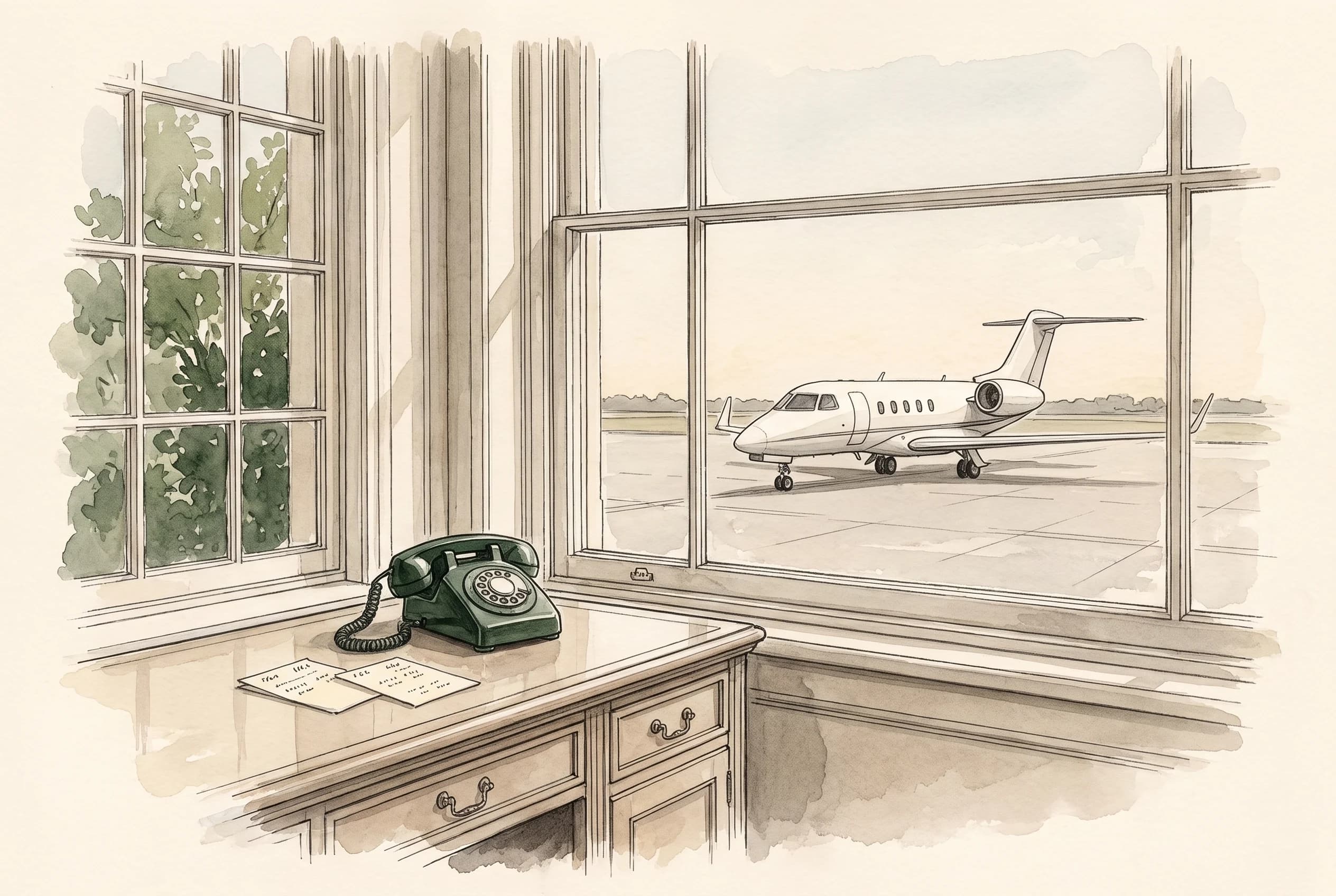
This is the map that rarely gets drawn before someone asks you for a deposit. It is not complicated, but it is counterintuitive, because almost every instinct a traveller brings to a charter quote comes from buying airline seats, where the price attaches to a route and a fare class. In charter, the price attaches to an aircraft, on a particular day, in a particular place, with a particular crew and a particular commitment tomorrow morning. Learn to read those five things and you stop being surprised.
Why do private jets cost more on Friday?
Because demand for private aircraft is not spread evenly across the week, and the supply of aircraft able to serve a given hour is finite and fixed. Friday afternoon out of the financial capitals and Sunday evening back into them are the two densest windows in the business. Everyone wants the same three hours. The aircraft that can still be sold into those three hours are the ones nobody else has booked yet, which is usually a polite way of saying they are somewhere else.
Look at it from the operator's chair. A well run light jet does not sit still; it strings together a week of work in which each flight leaves it usefully placed for the next. A Friday request that pulls the aircraft out of that sequence costs the operator its own Saturday plan. It may need a second crew to stay inside legal duty limits. It may end the day at an airport where the aircraft earns nothing until Monday. None of that is greed. It is arithmetic, and it lands in the figure you are shown.
There is a second, quieter effect. On dense days the aircraft classes fill from the bottom up. Very light and light jets go first, because they are numerous and because most requests are short hops with two or three passengers. By mid afternoon on a Friday in season the honest answer to a last minute Geneva request is often not a higher price for the jet you wanted, but a different jet altogether, one class up, because that is what is left standing on the ramp.
What is block time, and why do you pay for it?
Block time is the clock that runs from engine start to engine shutdown, and it is the unit almost every charter operator bills in. It includes taxiing out, any hold before departure, the actual routing through controlled airspace rather than the straight line on a map, and the taxi in at the other end. You are buying the aircraft's working time. The distance is just one input into how much time that is.
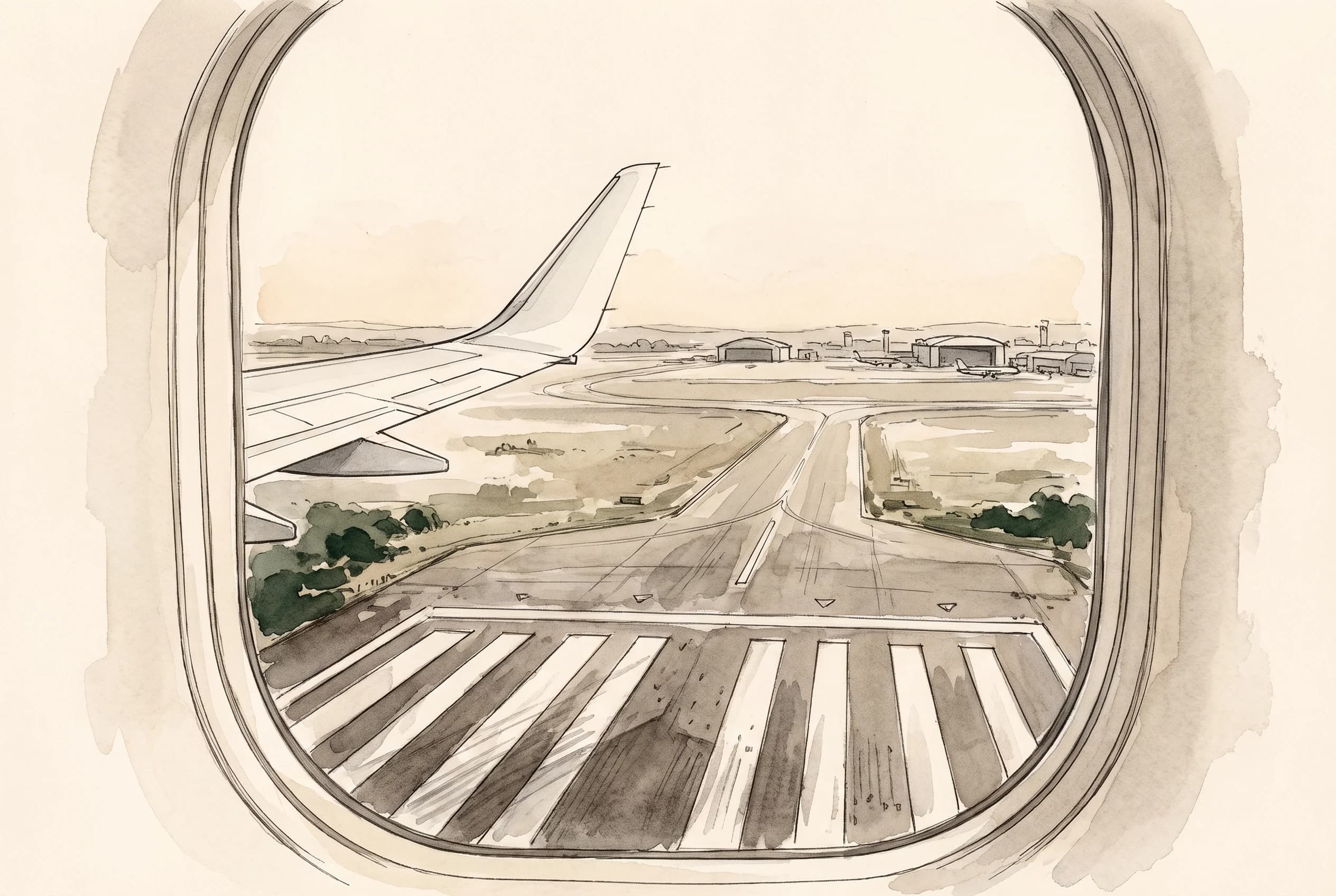
This is why short sectors look expensive per mile and long ones look cheap. Atljet market data for September 2026 puts a Citation XLS from London Farnborough to Paris Le Bourget at 47 minutes of block time, with a market estimate of €7,000 to €8,500 one way for the aircraft. The same class across the Atlantic, Teterboro to Van Nuys, shows 335 minutes and an estimate of €38,100 to €48,600. Seven times the time, roughly five and a half times the money. The fixed costs of a departure, crew, handling, landing fees, the cost of simply waking an aircraft up, do not shrink when the sector does.
| Route | Class and type | Block time | Estimate, one way, per aircraft |
|---|---|---|---|
| London Farnborough to Paris Le Bourget, 197 nm (365 km) | Light Jet, Citation CJ3 | 50 min | €6,000 to €7,300 |
| London Farnborough to Paris Le Bourget, 197 nm (365 km) | Midsize Jet, Citation XLS | 47 min | €7,000 to €8,500 |
| London Farnborough to Paris Le Bourget, 197 nm (365 km) | Ultra Long Range, Gulfstream G550 | 45 min | €13,000 to €17,100 |
| London Farnborough to Geneva, 431 nm (798 km) | Midsize Jet, Citation XLS | 80 min | €10,500 to €13,100 |
| London Farnborough to Geneva, 431 nm (798 km) | Heavy Jet, Falcon 900 | 76 min | €15,600 to €20,700 |
| Nice to London Luton, 615 nm (1,139 km) | Super Midsize Jet, Challenger 350 | 102 min | €16,100 to €20,300 |
| Teterboro to Van Nuys, 2,257 nm (4,180 km) | Midsize Jet, Citation XLS | 335 min | €38,100 to €48,600 |
| Teterboro to Van Nuys, 2,257 nm (4,180 km) | Ultra Long Range, Gulfstream G550 | 302 min | €76,600 to €103,800 |
Notice something in that table. On the short Farnborough to Le Bourget sector, the Gulfstream G550 is two minutes faster than the Citation XLS and roughly double the price. Speed buys you almost nothing over 197 nm (365 km). It buys you a great deal over 3,165 nm (5,862 km), where the same G550 crosses to Teterboro in 416 minutes against 442 for the Challenger 350. The right aircraft is the one whose strengths match the sector, which is also, usually, the one that reads best on the invoice.
What is a positioning flight, and why might you pay for one you never see?
A positioning flight is the empty leg an aircraft flies to reach your departure airport, or to leave it afterwards for its next job. You never board it, you may never be told about it, and on a busy day it can be the single largest hidden component of your quote. If the aircraft is already based where you are standing, this costs nothing. If it is 400 nm (741 km) away with a crew starting its day, it costs real block time, and somebody has to carry it.
That somebody is decided by luck and timing. When an operator has another client flying the reverse direction, your positioning leg quietly disappears into their booking and your number improves. When it does not, the leg sits inside your price. This is the whole logic of the empty leg market: those flights exist because aircraft must move whether or not anyone is aboard, and an operator would rather recover part of the cost than all of nothing. We have written about that machinery in The empty leg is a system.
The practical consequence is flexibility, used precisely. Moving a Friday four o'clock departure to Friday eleven in the morning, or to Thursday evening, often changes which aircraft is available, and therefore which positioning story applies. Half a day of movement in the schedule tends to be worth more than any amount of negotiation, because it changes the underlying facts rather than arguing about them.
Why does the same aircraft model quote two different prices?
Because you are not buying a model, you are buying one specific aircraft with a registration, a home base, a cabin of a certain age and a diary. Two Challenger 350s in the same class table can differ by a decade of interior, by whether the cabin has been refurbished, by whether the operator flies it with one crew or two, by the handling agent it uses, and by how urgently it is needed somewhere else on Saturday. Every one of those differences has a number attached.

- Home base: an aircraft based at your departure airport carries no positioning cost. One based three sectors away carries most of one.
- Age and cabin: a recently refurbished interior, newer seats, a properly working connectivity system, these command a premium and are worth asking about before you accept the cheaper tail.
- Crew pattern: a single crew can only fly so long legally. A long day, or a late return, may require a second crew, which is a line item.
- Next commitment: an aircraft with an owner's flight the following morning must be home that night, and the cost of getting it there is yours.
- Fuel and fees: fuel prices differ by airport, as do landing, handling and parking charges. Departing Farnborough, Le Bourget and Linate are not equivalent commercial acts.
This is also the honest answer to the most common frustration in charter, the quote that will not stay still. A figure you were given on Monday for a Friday flight was attached to a tail. If that tail sold on Tuesday, the number you are given on Wednesday belongs to a different aircraft, with a different base and a different diary. The route did not change. The aeroplane did. Anyone who explains this before you ask is worth keeping. For the full anatomy of what should appear on the page, see Anatomy of a real charter quote.
You are never quoting a route. You are quoting one aircraft's day, and the day is what moves.
Atljet Editorial
What does a Part 135 certificate actually guarantee?
A Part 135 certificate is a legal threshold, not a marketing badge. In the United States, on demand charter is flown under 14 CFR Part 135, and the FAA states that it requires a higher level of pilot training and certification, maintenance procedures and safety rules than private flying under Part 91. That distinction matters to a passenger because it governs who is in the two front seats, how the aircraft is maintained, and what rules the operator must answer to.
The market is larger than most people assume and smaller than the marketing suggests. FAA charter figures list 1,837 Part 135 certificate holders and 11,582 Part 135 authorized aircraft in the United States. Those numbers move as certificates are issued and surrendered, so treat them as a snapshot rather than a constant. The agency publishes that charter data, which makes an operator's certificate one of the few things in this business you can verify yourself in a few minutes.
For a client, the practical use of all this is simple. The operator's certificate is a fact, checkable against the regulator. Everything else in a proposal, the photographs of the cabin, the description of the crew, the promise about catering, is a representation. Ask for the operating certificate holder by name, not for the name of the company that sent the email, because on many bookings those are two different entities. Outside the United States the same principle holds under each national authority and EASA oversight, with different paperwork and the same logic.
How should you read a charter quote before you book?
A clear quote answers four questions without being asked: which specific aircraft, where it is now, how much block time is being charged, and which certificated operator is flying it. If a proposal gives you a class, a price and nothing else, you are being asked to trust a number you cannot interrogate. There is no need for suspicion, only for structure. The four questions take a minute and change the tone of every conversation that follows.
It helps to know roughly where the market sits before you look. Atljet market data for September 2026 estimates Nice to Geneva, 172 nm (319 km), at 44 minutes of block time and €6,700 to €8,000 for a Midsize Jet, and Milan Linate to Geneva, 149 nm (276 km), at 41 minutes and €6,300 to €7,600 in the same class. Those are market estimates for the aircraft, one way, not guaranteed prices, and they will move with demand, routing, fuel and availability. But a figure that sits far outside its band on an ordinary day is telling you something, and the polite version of the question is simply: what is in this number that I am not seeing.
The five variables, and what to do about each, in the order they usually matter:
- Block time: ask for the block time in minutes, not the flight time, so you can compare two proposals on the same basis.
- Positioning: ask where the aircraft is now and what it does after you land. This is where Friday hides.
- Demand day: if your date is a Friday, a Sunday evening, or the opening of a season, book earlier than feels necessary. Weeks, not days.
- The tail: ask for the registration, the cabin year and whether the quoted aircraft is the one that will actually appear. Then ask what happens if it does not.
- The operator: ask which certificate holder is flying, and check it. On long sectors, ask whether the day requires two crews, because the answer affects both the price and your own departure window.
Aircraft class is the last decision, not the first, and it follows from the sector rather than from ambition. Under about 500 nm (926 km), the time difference between a light jet and an ultra long range aircraft is a handful of minutes and the price difference can be double. Over an ocean, the calculation inverts, and cabin, range and the ability to fly the sector without a fuel stop are worth every euro. Our notes on how weight, range and cabin interact are in What a Gulfstream weighs, and the classes themselves are laid out across the fleet pages.
None of this is a trick being played on you. It is a business with fixed assets, legal duty limits, immovable maintenance schedules and a demand curve that spikes on the same two afternoons every week. The Friday premium is simply what scarcity looks like when the thing being sold cannot be manufactured on the day. Our own flight desk works the same map, and when the last stretch matters, the motorboat at the pier, the helicopter over the traffic, the car waiting at the aircraft steps, it can be arranged alongside the flight rather than after it.
Back to those two quotes, forty minutes apart. The Tuesday number was lower not because someone was generous, but because an aircraft was already in the right place with nothing behind it. The Friday number was higher because a Challenger in northern Germany would have to give up its afternoon to be in Hampshire at four. Once you can see that, the quote stops being a verdict and becomes a description. You are not buying miles. You are buying one aircraft's day, and some days are simply busier than others. People fly you. Data prices you.
Questions people ask
- Why is a private jet more expensive on Friday?
- Because fewer aircraft are still free. On Friday afternoons the jets with an open slot are often based elsewhere and have to fly in empty to collect you, and that empty leg is priced into your quote. Demand also concentrates into a narrow window of two or three hours, so the operators who can still deliver an aircraft in that window have little reason to quote at their softest number.
- What is block time in private aviation?
- Block time is the period from engine start to engine shutdown, the unit almost every operator bills in. It includes taxi, any holding, and the actual airways route rather than the straight line. That is why London Farnborough to Paris Le Bourget shows 47 minutes of block time for a Citation XLS in Atljet market data for September 2026, and why you pay for time rather than for distance.
- Why does my private jet quote change every time I ask?
- Because it is a live number, not a published tariff. Between your first enquiry and your second, the specific aircraft quoted may have been sold to another client, moved to a different airport, or entered scheduled maintenance. The route, the aircraft class and the demand on that day stay comparable, but the individual tail behind the figure changes, and with it the positioning cost.
- What is a positioning or repositioning flight?
- It is the empty flight that brings the aircraft to your departure airport, or takes it away afterwards to its next assignment. If the aircraft is already based where you are, there is nothing to pay. If it is two hours away, someone has to pay for those two hours, and on a busy day that someone is usually you.
- What does a Part 135 certificate actually guarantee?
- It confirms that the operator is legally certificated by the FAA to carry paying passengers on demand, under standards the FAA describes as higher than those for private flying under Part 91, covering pilot training and certification, maintenance procedures and safety rules. The FAA publishes the charter certificate data, so the claim can be checked rather than taken on trust. It is a verifiable threshold, not a comfort rating.
Questions on this guide? The flight desk answers within the hour.
Request options