
Summary
- Atljet market data, October 2026, estimate: Van Nuys to Las Vegas runs from €5,500 to €6,500 in a Very Light Jet and €13,300 to €17,400 in an Ultra Long Range aircraft, one way, per aircraft.
- Block time across the whole Van Nuys sector varies by only eleven minutes between the smallest and the largest cabin. The price spread is close to threefold. You are buying the aircraft, not the clock.
- The binding constraint during a Grand Prix is ramp space and crew duty time, not runway capacity. That is why most aircraft drop passengers and leave again.
- Fix the departure before the arrival. The post race exodus is the single most contested movement of the week.
Six in the morning in the Mojave, and the ramp is cold enough for jackets. Three jets sit nose out with their covers already folded, the Strip a grey smudge on the horizon behind them. In the office behind the glass a dispatcher refreshes a screen: two more arrival requests for Thursday, one of them a Falcon that will land, unload four passengers and lift off again inside ninety minutes, because there is nowhere to keep it. This is what a Grand Prix looks like from the airfield side. A scheduling problem with a price attached.
Las Vegas Grand Prix charter prices are not set by a published race week tariff. They are built on a baseline that Atljet market data for October 2026 puts at €10,500 to €13,800 for a Heavy Jet on the short Van Nuys to Las Vegas sector and €53,700 to €73,200 on Teterboro to Las Vegas, both estimates, one way, per aircraft. During a sold out event week that baseline moves because of positioning, parking and crew hours, not because the distance changed.
How much do Las Vegas Grand Prix charter prices rise during race week?
There is no published race week multiplier, and any outlet quoting one precisely is guessing. What exists is a baseline and a set of variables that move it. Atljet market data for October 2026 reads Van Nuys to Las Vegas at €5,500 to €6,500 in a Very Light Jet and €13,300 to €17,400 in an Ultra Long Range aircraft, estimate, one way, per aircraft. On the transcontinental sector from Teterboro, a Heavy Jet reads €53,700 to €73,200. Those are the numbers in an ordinary market. A Grand Prix does not rewrite them, it loads them.
Four things do the loading. Positioning, because the aircraft has to reach Nevada before it can carry anyone and leave again afterwards. Parking, because apron space in a sold out week is finite and an aircraft that cannot stay must fly two extra empty legs. Crew duty, because a long reposition eats the hours available for the revenue flight and can oblige an operator to carry a second crew. And direction, because almost everyone wants to arrive inside the same narrow window and leave inside an even narrower one. The same mechanics that make Friday evening expensive in Europe, examined in why private jets cost more on Friday, apply here in compressed form.
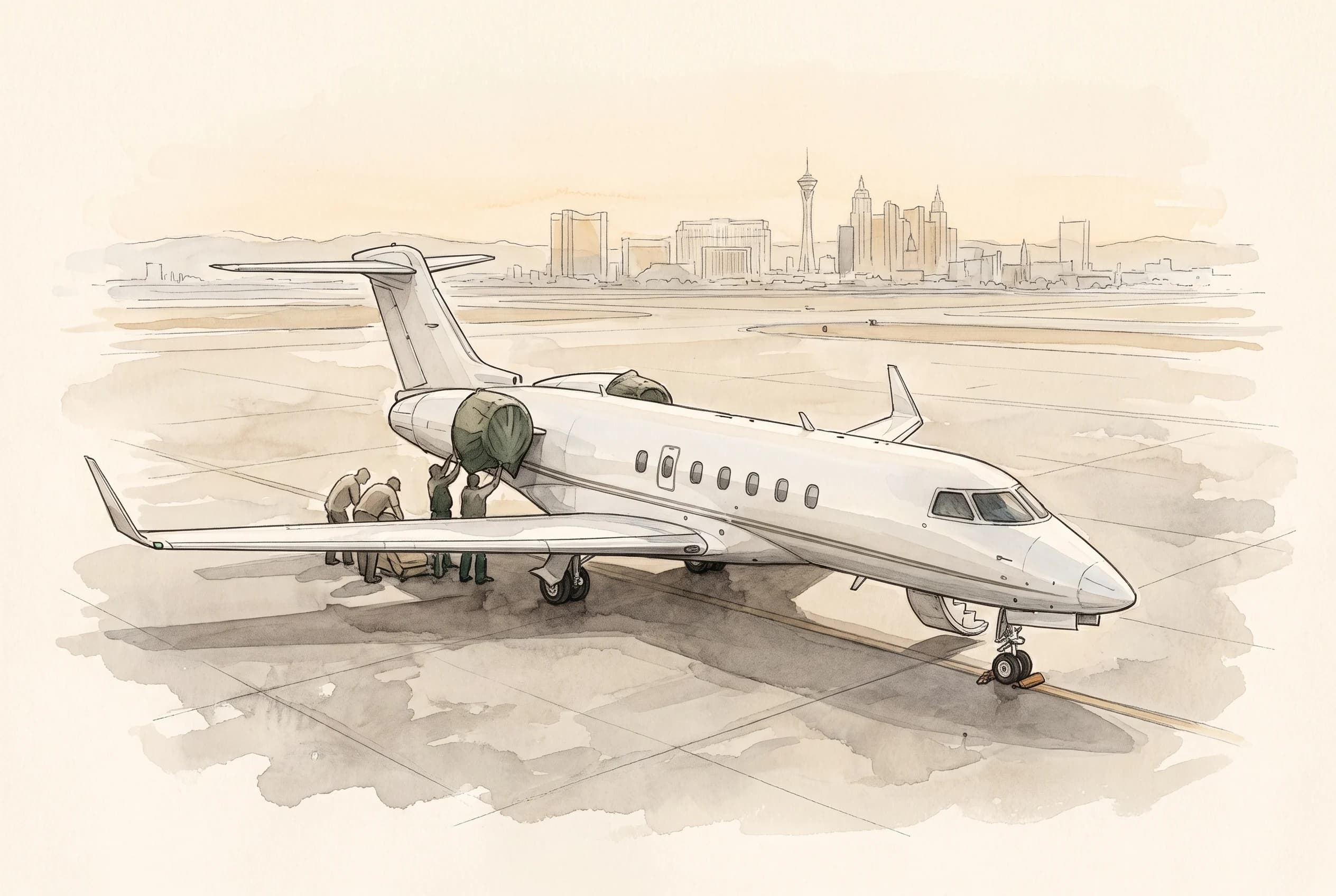
You are not paying for the 211 nm. You are paying for the aircraft that has to be in the desert in order to fly them.
Atljet Editorial
Which airport should you fly into for the Las Vegas Grand Prix?
Three fields serve the city for private arrivals: Harry Reid International (LAS), Henderson Executive (KHND) and North Las Vegas (KVGT). In an ordinary week the choice is a matter of a few minutes by car. In an event week it becomes the entire conversation, because the question is not whether you can land but whether the aircraft can remain on the ground until you want it again. Harry Reid carries the commercial traffic and the pressure that comes with it. Henderson is the business aviation field and, for most private arrivals during a crowded week, the calmer answer.
The practical consequence is simple. If your aircraft can be parked locally, you keep flexibility: an early departure, a change of plan, a day in the desert. If it cannot, the operator will plan a drop and go, sending the aircraft to a quieter field in the region and bringing it back for you. That is two additional empty sectors and it appears in the quote. Ask the question before the price is discussed, not after. Airport information is published by Harry Reid International Airport, and traffic management for the region sits with the Federal Aviation Administration.
How does the price move by aircraft class?
On a short sector the class curve is almost pure cabin, not time. Across the Van Nuys to Las Vegas leg, 211 nm (391 km), the fastest and the slowest aircraft in the table are separated by eleven minutes of block time. The price range across the same six classes runs from €5,500 to €17,400. In other words, the clock barely moves and the number nearly triples. This is the central fact of short sector charter and the reason class selection matters more here than on any long route: you are buying the aircraft for the day, not the minutes it is airborne.

| Class | Aircraft type | Block time | Estimate, one way |
|---|---|---|---|
| Very Light Jet | Citation Mustang | 57 min | €5,500 to €6,500 |
| Light Jet | Citation CJ3 | 52 min | €6,100 to €7,500 |
| Midsize Jet | Citation XLS | 49 min | €7,200 to €8,700 |
| Super Midsize Jet | Challenger 350 | 48 min | €8,600 to €10,500 |
| Heavy Jet | Falcon 900 | 48 min | €10,500 to €13,800 |
| Ultra Long Range | Gulfstream G550 | 46 min | €13,300 to €17,400 |
The behaviour inverts on the long sectors. From Teterboro, 2,051 nm (3,798 km), the Ultra Long Range aircraft is thirty minutes quicker than the Midsize and twice the price, and there the time saved has real value because it is removed from a five hour day. The broader logic of class against sector length is set out across our fleet categories, where the useful comparison is not list price but cost per usable hour of the trip you are actually flying.
What does it cost to fly in from London, Geneva, Dubai and other key cities?
From the United States the race is a half day movement; from Europe it is a full one. Atljet market data for October 2026 reads London Farnborough to Las Vegas at 10 h 20 of block time in an Ultra Long Range aircraft, €155,400 to €211,200, estimate, one way, per aircraft. Geneva adds roughly an hour and reads €168,700 to €229,400. Both are westbound crossings flown against the clock, landing in the afternoon of the same calendar day, which is the single reason they are worth their number: you arrive with the evening intact.
| Route | Class | Distance | Block time | Estimate, one way |
|---|---|---|---|---|
| Teterboro to Las Vegas | Midsize Jet | 2,051 nm (3,798 km) | 5 h 06 | €34,900 to €44,600 |
| Teterboro to Las Vegas | Super Midsize Jet | 2,051 nm (3,798 km) | 4 h 53 | €42,800 to €54,600 |
| Teterboro to Las Vegas | Heavy Jet | 2,051 nm (3,798 km) | 4 h 48 | €53,700 to €73,200 |
| Teterboro to Las Vegas | Ultra Long Range | 2,051 nm (3,798 km) | 4 h 36 | €70,200 to €95,100 |
| Miami Opa-locka to Las Vegas | Midsize Jet | 1,997 nm (3,698 km) | 4 h 59 | €34,200 to €43,600 |
| Miami Opa-locka to Las Vegas | Super Midsize Jet | 1,997 nm (3,698 km) | 4 h 46 | €41,800 to €53,400 |
| Miami Opa-locka to Las Vegas | Heavy Jet | 1,997 nm (3,698 km) | 4 h 40 | €52,300 to €71,200 |
| Miami Opa-locka to Las Vegas | Ultra Long Range | 1,997 nm (3,698 km) | 4 h 30 | €68,700 to €93,000 |
| London Farnborough to Las Vegas | Ultra Long Range | 4,803 nm (8,895 km) | 10 h 20 | €155,400 to €211,200 |
| Geneva to Las Vegas | Ultra Long Range | 5,233 nm (9,692 km) | 11 h 14 | €168,700 to €229,400 |
Dubai is the instructive exception. Dubai International to Las Vegas measures 7,511 nm (13,910 km), and Atljet market data for October 2026 carries no single aircraft estimate for that sector. That absence is the answer. From the Gulf the Las Vegas trip is a routing decision before it is a price decision, resolved through a technical stop or a planned overnight on the way, and the honest figure can only be produced once the routing is fixed. Readers who travel the Gulf race calendar will find the mirror image of this problem in our piece on flying privately to the Abu Dhabi Grand Prix.
How far ahead should you book to avoid the worst of the surge?
Early, and in the right order: fix the departure before the arrival. Arriving into Las Vegas is a spread out affair across two or three days and the market absorbs it. Leaving is not. The hours after the chequered flag are the most contested movement of the week, when most of the fleet in the region wants the same taxiways in the same window, and the client who booked the outbound last is the one who waits. Decide the departure time first, accept it as fixed, and let the rest of the itinerary arrange itself around it.
The second reason to move early is structural. Operators commit aircraft to a region before a peak week begins, positioning them in advance and building their rotations around confirmed bookings. By the time the week arrives the fleet is already allocated, and a late request is not refused so much as matched to whatever remains, which is rarely the aircraft you would have chosen. Booking early does not buy a discount. It buys the right cabin, the right field and a departure time you selected rather than inherited. Our how it works page sets out the sequence.
Is an empty leg a realistic option during race week?
Possible, not plannable. A directional surge of this kind is precisely the condition that creates empty legs: aircraft flown in empty to collect passengers, aircraft flown out empty after a drop and go, aircraft repositioning to a quieter field for the weekend. The supply is genuinely there. What is not there is control. These legs appear at short notice, on the operator's date, from the operator's airport, at the operator's hour, and the good ones are gone within hours of being listed.
The sensible posture is to treat an empty leg as a bonus rather than a strategy. Hold a confirmed booking for the movement that matters, usually the departure, and let the flexible half of the trip watch the market. We explain the mechanics in the empty leg is a system, and live availability sits on empty legs. Race dates and the official event calendar are published by the Las Vegas Grand Prix, which is the only sensible place to anchor your own dates before any aircraft is discussed.
One further point on the last stretch. Between the airfield and the Strip there is a short drive that becomes considerably less short on the Saturday, and the Atljet flight desk can arrange that leg too, whether by chauffeured car or by helicopter, as part of the same booking rather than as an afterthought at the ramp.
By seven the dispatcher's screen has three more lines on it, and the Falcon has already gone, out to a quieter field to wait. Nothing about the week is improvised; it only looks that way from the grandstand. The people who will have an easy race weekend are the ones who decided their departure hour months ago and then stopped thinking about it. That is the whole trick, and it costs nothing. Private aviation, redefined.
Questions people ask
- How much does a private jet to the Las Vegas Grand Prix cost?
- Atljet market data for October 2026 puts Van Nuys to Las Vegas at €6,100 to €7,500 in a Light Jet and €10,500 to €13,800 in a Heavy Jet, estimate, one way, per aircraft. From Teterboro the same Heavy Jet reads €53,700 to €73,200, and from London Farnborough an Ultra Long Range aircraft reads €155,400 to €211,200. Event week quotes are built on these baselines plus positioning and crew cost, which are priced at the moment of booking.
- Which airport should I fly into for the Las Vegas Grand Prix?
- Harry Reid International (LAS) is the main airport and the busiest option during race week. Henderson Executive (KHND) and North Las Vegas (KVGT) are the general and business aviation fields and are usually the calmer choice for a private arrival. The deciding question is not which field you prefer but where your aircraft can be parked, or whether it will have to depart again after drop off.
- Why do charter prices rise during Formula 1 week in Las Vegas?
- Because demand arrives as a single directional wave. Aircraft must be flown into the region empty, parked somewhere expensive or sent away and brought back, and crews run against duty limits. None of that has anything to do with the distance you fly, which is why the same 211 nm (391 km) sector can read very differently in a quiet week and in a race week.
- Is an empty leg a realistic option during race week?
- It is possible but not plannable. The heavy one way traffic into and out of Las Vegas does generate repositioning flights, and some of them are offered as empty legs. They appear at short notice, on the operator's date and time, and are usually gone within hours. Treat an empty leg as an opportunity, never as the plan.
- How far in advance should I book a private jet for the Las Vegas Grand Prix?
- As early as the rest of the trip is decided, and fix the departure first. The aircraft that will serve race week are committed into the region well before it begins, and the post race departure window is the most contested movement of the week. Late requests are not usually refused, they are simply priced on whatever aircraft is left.
Questions on this guide? The flight desk answers within the hour.
Request options