Summary
- Nearly everything that makes a private departure feel effortless is scheduled in the 24 hours before it, not on the morning itself.
- Passports and full passenger details are needed earlier than most first-time clients expect, and they are needed exactly as written in the document.
- Catering, cabin configuration and ground transfers are set the day before; late changes are possible, but they are changes, not defaults.
- You are not navigating an airport. A handling agent takes you from car to aircraft steps, usually in minutes.
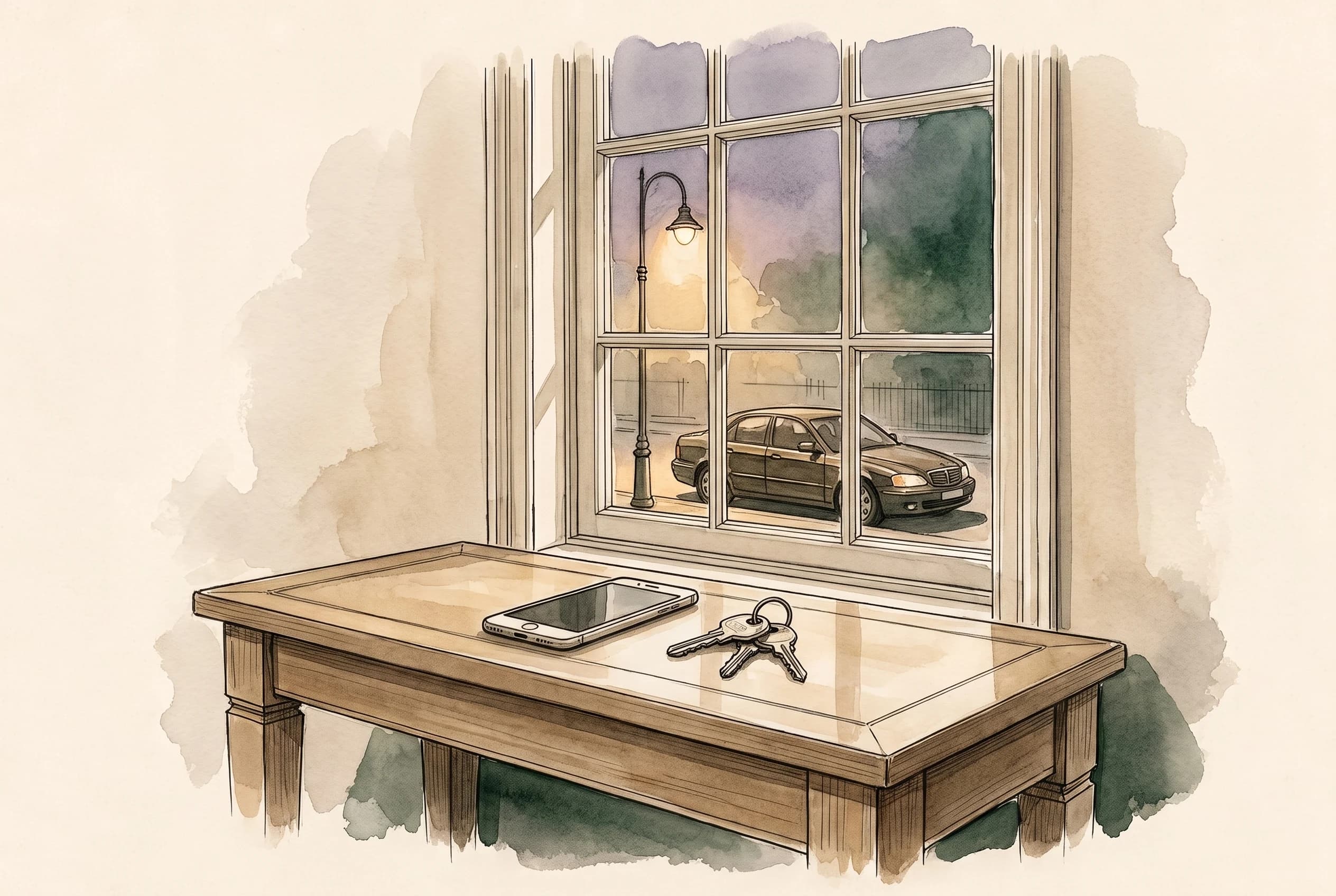
Six in the evening, the day before. A phone screen lights up on a hall table with a message two lines long: tail number, crew names, car at the house at nine forty. Somewhere else entirely, a captain is reading the same tail number on a different screen, checking tomorrow's winds over the Channel. A kitchen has already taken the order. A handling agent has pencilled your name against a stand. Nothing visible is happening. Almost everything has already happened, and it will keep happening quietly all night while you have dinner and go to bed.
The private jet departure day timeline runs from the final confirmation the evening before, when the aircraft, the crew and the reporting time are fixed, through document checks, catering and cabin preparation overnight, to the aircraft positioning and the client's arrival at a private terminal shortly before departure. Most of the work happens before you leave the house: by the time your car reaches the ramp, the flight plan is filed, the cabin is set and the crew is on board. On Atljet market data for October 2026, a Citation XLS from London Farnborough (FAB) to Geneva (GVA) carries about 80 minutes of block time and an estimated €10,500 to €13,100 one way, per aircraft, which is why the hours before matter more than the hour in the air.
That gap, between how little the client does and how much the day requires, is the real subject of this piece. Most explanations of charter flying are written either for pilots or for people trying to sell you a seat. This one is written from your side of the ramp: a private jet departure day timeline, hour by hour, so that a first-time charter client knows what to prepare, what to expect, and who is holding which piece of the day.
The private jet departure day timeline: what happens in the final 24 hours?
In order: the operator confirms the aircraft and crew, your advisor issues a final confirmation, passenger documents are matched to the manifest, catering is ordered, the cabin is prepared, the aircraft positions to your departure airport if it is not already there, the flight plan is filed on the morning, and you arrive at a private terminal shortly before departure. Each step has an owner. None of them is yours except the documents and the hour you leave the house.
The useful thing to understand is proportion. The flight itself is often the shortest part of the exercise. Geneva (GVA) to Nice (NCE) on a Citation CJ3 carries about 46 minutes of block time on Atljet market data for October 2026, an estimated €5,600 to €6,900 one way, per aircraft. Forty-six minutes in the air, most of a day of coordination behind it. That is the trade you are buying: a great deal of invisible work so that your own involvement shrinks to a car journey and a staircase.
The second thing to understand is that the 24 hour window is the consolidation phase, not the planning phase. The planning happened when the quote was agreed, sometimes weeks earlier, sometimes that morning. What happens in the final day is confirmation, preparation and the long list of small permissions and arrangements that cannot be made until the flight is certain. If you want the mechanics of how the number on that quote was built, we set it out in the anatomy of a real charter quote.
How is the aircraft and crew confirmed the day before?
The operator assigns a specific aircraft and a specific crew, then sends that assignment to your advisor, who passes it to you as a written confirmation. Until that point you have bought a class of aircraft and a departure time. After it, you have a tail number, two names in the cockpit, a departure airport and a reporting time. This is the document to read carefully, because it is the one that turns an agreement into a plan.
Three things on that confirmation deserve your attention. The airport, because major cities have several and the business aviation airport is rarely the one on your airline boarding pass. The departure time, which is a wheels-up time, not a meet-at-the-door time. And the tail number, which tells the handling agent where to put your car. If any of the three looks different from what you discussed, the evening before is the cheap moment to say so. Nine in the morning is not.
Behind the confirmation sits a quieter calculation the client never sees: where the aircraft currently is and how it gets to you. If it is parked at your departure field, the crew simply reports. If it is not, it flies in empty, and that positioning flight has to fit around crew rest and the aircraft's other commitments. Positioning is one of the main reasons two quotes for the same route can differ substantially, and one of the main reasons an operator will gently suggest a departure an hour later than you asked for.
The confirmation is the moment the day stops being flexible and starts being a plan. Read it the evening before, not in the car.
Atljet Editorial
What paperwork does a passenger actually need?
For any international flight you need a valid passport, and the operator needs your details exactly as they appear in it: full name including middle names, date of birth, nationality, document number and expiry date. These are compiled into a passenger manifest and submitted by the operator to the relevant authorities. Private flying removes the airline terminal. It does not remove borders, and it does not remove the paperwork that borders require.
The most common delay on a charter departure is not weather. It is a passenger list that changed at the last moment, or a name spelled as it is used socially rather than as it is printed in the document. Anna becomes Anna-Maria, a married surname sits in the manifest while the passport still carries the maiden one, a child's passport is close to expiry when the destination asks for longer validity. None of these are dramatic problems if they surface the day before. All of them are expensive problems if they surface at the aircraft steps.
Requirements for documentation, advance passenger information and security screening vary by country, by airport and by the weight of the aircraft, and they change. Anyone who tells you that private flying is universally document-free is selling something. The practical answer is that your advisor and the operator confirm what applies to your specific routing and tell you in writing, and the standards behind those rules sit with national and international authorities such as the FAA, EASA and ICAO rather than with any individual operator.
- Passport details for every passenger, as printed, including children and infants.
- Any visa or entry permission the destination requires, checked against your nationality and not your residence.
- Pet documentation where animals are travelling, which almost always needs more lead time than people expect.
- Weight and number of bags, which on smaller aircraft is a real constraint rather than a formality.
- Contact details for the person who will actually be reachable on the morning.
How is catering and the cabin prepared before departure?
Catering is ordered the day before, loaded by the crew or the handling agent in the hours before your arrival, and set in the cabin so that it is ready when you board. The effortlessness is a function of lead time. A kitchen needs notice, a handling agent needs a delivery window, and the crew needs the galley stocked before the first passenger reaches the steps.
This is where preference becomes useful information rather than fussiness. Tell the advisor what you actually drink, what temperature you like the cabin, whether you want the table set for a meal or cleared for work, whether anyone on board is sleeping through the flight and should not be offered anything at all. On a flight of 46 minutes there is time for coffee and little else. On Teterboro (TEB) to London Luton (LTN), roughly 433 minutes of block time on a Falcon 900 on Atljet market data for October 2026, the cabin is a dining room, a bedroom and an office in sequence, and the difference between a well-briefed crew and a guessing one is the whole night.
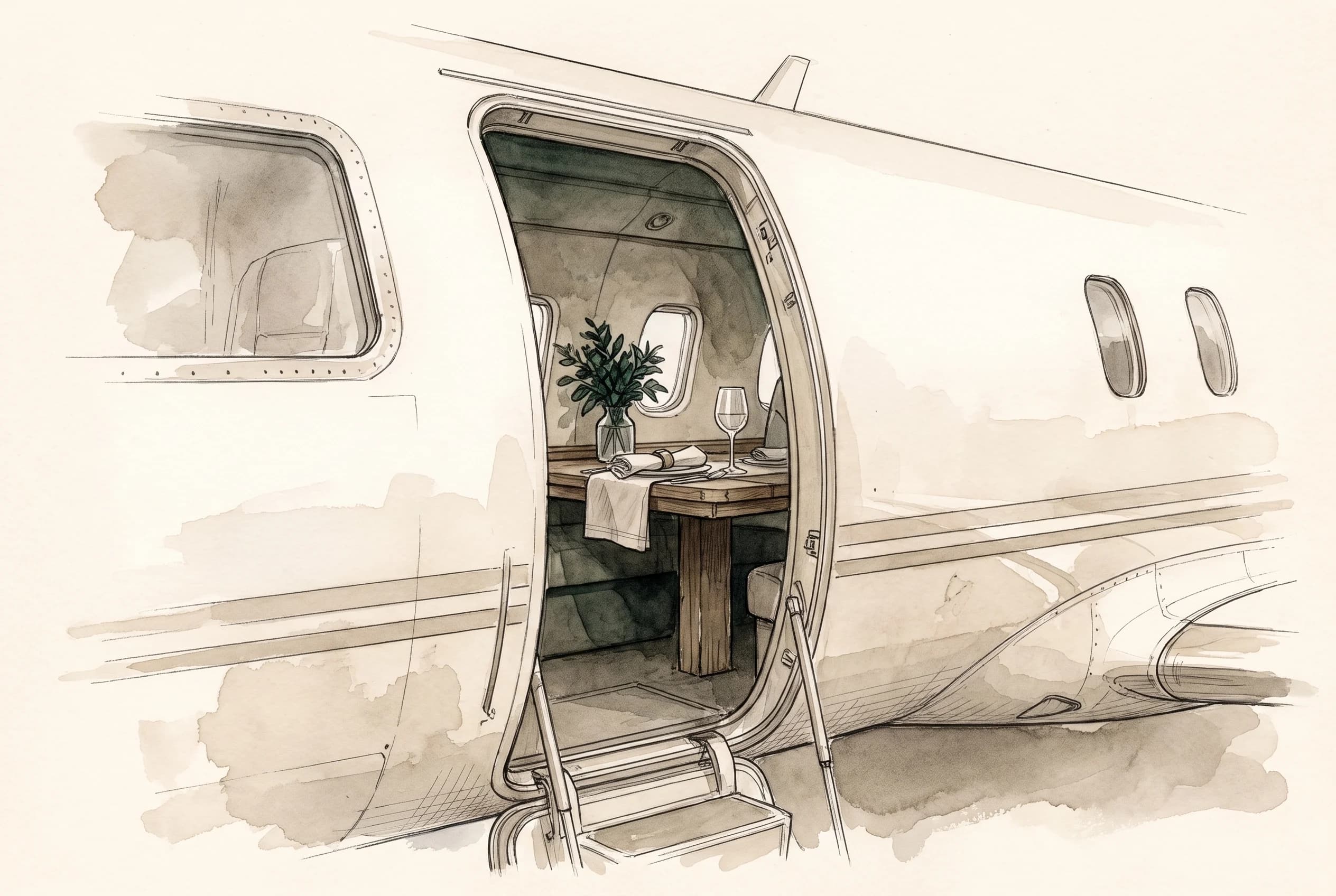
Cabin configuration belongs to the same conversation. Divans made up for sleeping, a conference layout for four, a forward galley stocked for a family with small children: all of it is decided the day before because all of it takes physical work on the aircraft. Aircraft class determines what is possible at all, which is why the choice of cabin matters more than the brochure suggests. We compare what each size actually gives you in light versus midsize versus heavy jet.
| Route | Class | Aircraft | Block time | Distance | Estimate, one way, per aircraft |
|---|---|---|---|---|---|
| Farnborough (FAB) to Geneva (GVA) | Midsize Jet | Citation XLS | 80 min | 431 nm / 798 km | €10,500 to €13,100 |
| Geneva (GVA) to Nice (NCE) | Light Jet | Citation CJ3 | 46 min | 172 nm / 319 km | €5,600 to €6,900 |
| Nice (NCE) to London Luton (LTN) | Super Midsize Jet | Challenger 350 | 102 min | 615 nm / 1,139 km | €16,100 to €20,300 |
| Teterboro (TEB) to London Luton (LTN) | Heavy Jet | Falcon 900 | 433 min | 3,168 nm / 5,867 km | €79,800 to €109,100 |
| Dubai International (DXB) to Geneva (GVA) | Ultra Long Range | Gulfstream G550 | 372 min | 2,816 nm / 5,215 km | €94,000 to €127,500 |
What happens at the airport in the final hour?
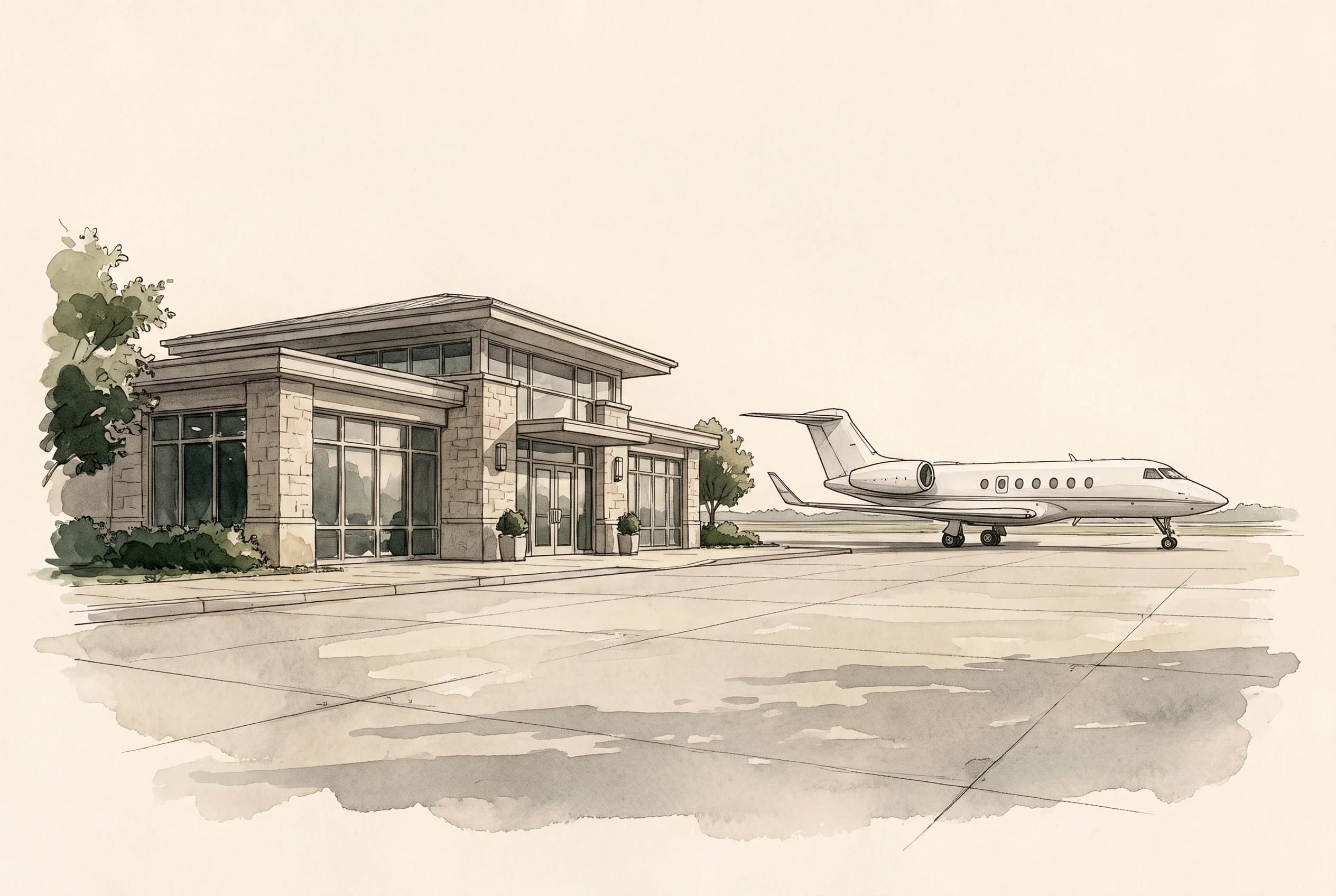
Your car arrives at a private terminal, a handling agent meets you, bags go directly to the aircraft, documents are checked where the route requires it, and you walk to the steps. There is no concourse, no gate number and no queue. In the simplest cases the walk from car door to cabin door is measured in a few minutes. On international departures with border formalities it takes longer, and your advisor will have told you so the evening before.
What you will notice, if you are paying attention, is how much of the airport has been removed. The building is small and quiet. Someone knows your name before you give it. The crew is already on board, has been for a while, and has done the fuel, the weather and the paperwork. The captain comes down to say hello and gives you the one number that matters, the expected flight time, which may differ from the one on your confirmation because winds and routings are decided closer to departure than people imagine.
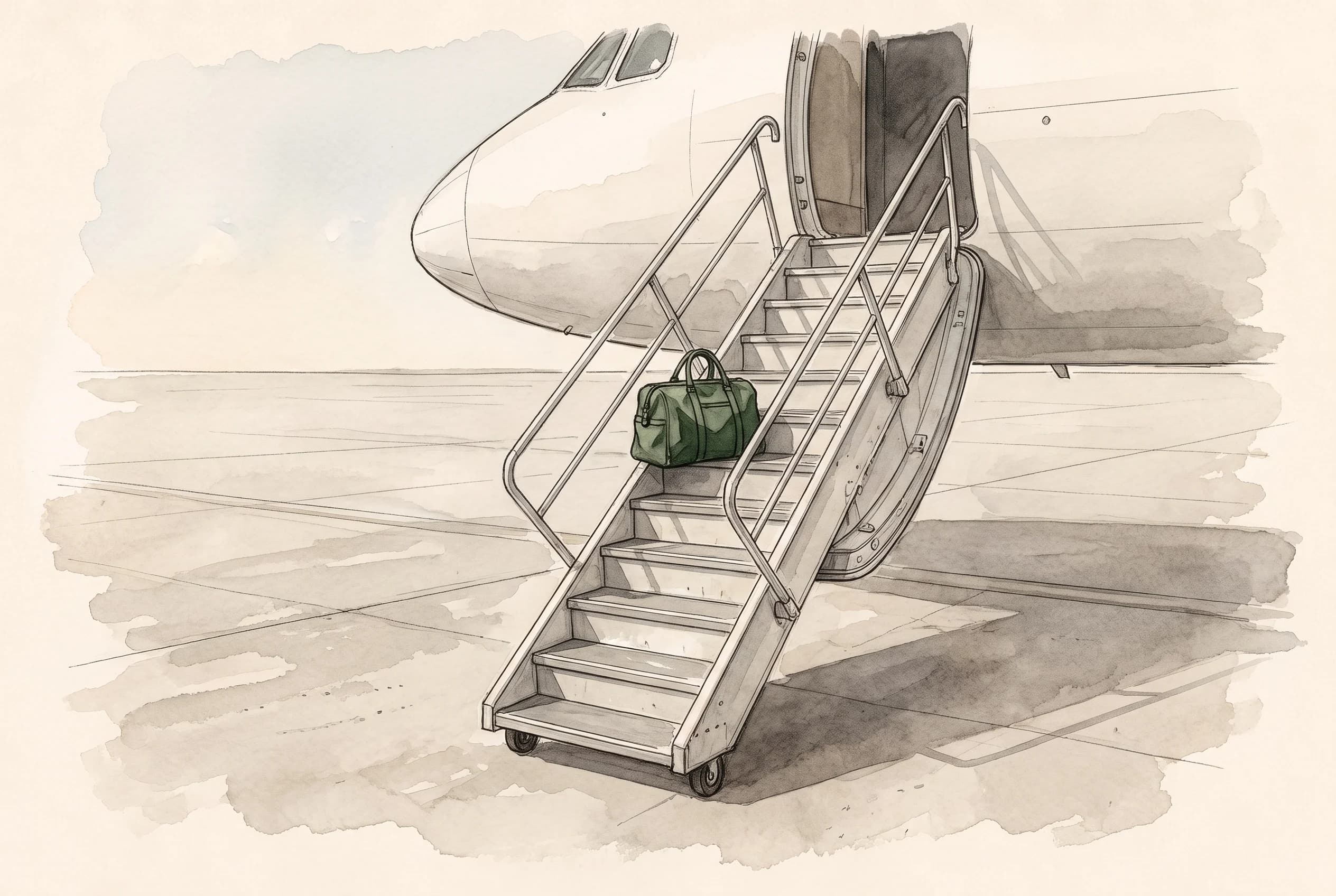
Then the staircase comes up, the door closes with that particular sealed sound, and the day you did not have to manage begins. Everything in the previous day existed so that this part would feel like nothing at all.
Who is working behind the scenes on a private flight?
Four groups, each with a clear job. Your advisor owns the relationship, the quote and the written confirmation. The operator owns the aircraft, the crew and the legal responsibility for the flight. The handling agent owns everything on the ground at each airport. The crew owns the aircraft and the cabin from reporting time to shutdown. When something changes, it travels back up that chain to you, which is why you only ever need one phone number.
Understanding the division matters most when the day goes sideways. A late passenger is an operator and crew problem, measured against duty limits and slot windows. A fog bank is a flight planning problem, resolved between the crew and air traffic control. A missing visa is a document problem that no amount of goodwill at the ramp can fix. Knowing whose problem it is tells you how quickly it can be solved and whether a different departure time, a different airport or a different aircraft is the answer.
People fly you. Data prices you. The pricing side of a charter can be modelled, compared and explained, and we publish it rather than hiding it. The 24 hours before departure cannot be automated in the same way, because it is a sequence of human handoffs, each of which has to be made by someone who has made it a thousand times before. If you want the shape of that process end to end, it is set out in how it works, and the booking side of it in charter on demand.
The Atljet flight desk coordinates the whole of that chain, including the last stretch at either end: a chauffeured car to the steps, a helicopter over a city that is not moving, a motorboat waiting at the water, arranged on request alongside the flight itself.
Which brings the day back to that hall table, and the message two lines long. A tail number and a time. The measure of a well-run departure is that this is all you ever see of it: no calls at midnight, no forms at dawn, no queue at any point. The car comes at nine forty. The rest has already been done by people you will mostly never meet.
Atljet Editorial
Questions people ask
- What happens the day before a private jet flight?
- The operator confirms the aircraft and crew, your advisor sends a final confirmation with tail number, reporting time and departure airport, passenger documents are checked against the manifest, catering is ordered, and ground transfers are booked. If the aircraft is not already at your departure airport, its positioning flight is scheduled too.
- How early should I arrive for a private jet departure?
- There is no single universal figure, and anyone who gives you one is guessing. Short domestic hops often need only a brief arrival window; international departures with customs and immigration formalities need more. Your advisor sets the time for your specific route and airport and puts it in writing the day before.
- Do I need a passport for a private jet flight?
- For any international flight, yes, and the details must match your travel document exactly, including middle names and expiry dates. Requirements vary by country and by aircraft, so your advisor confirms what is needed for your particular routing rather than applying a blanket rule.
- How far in advance is private jet catering ordered?
- Normally the day before, so the kitchen has time and the crew can load it with the rest of the cabin preparation. Same-day requests are often possible on standard items, less so for a specific restaurant or a complex menu.
- How long does it take to book a private jet charter?
- A straightforward point to point can be quoted in under an hour and contracted the same day. Complex itineraries, unusual airports or peak dates take longer, mostly because availability and permissions have to be checked rather than because the paperwork is slow.
Questions on this guide? The flight desk answers within the hour.
Request options