Summary
- Light, midsize and heavy are commercial categories set by range, cabin and payload, not legal classes, so two jets with the same label can differ by a thousand nautical miles.
- Cabin height, not seat count, is the comfort threshold passengers notice after two hours: most light cabins ask you to stoop, most midsize cabins do not.
- Modern midsize aircraft have moved into territory once associated with larger cabins: Embraer publishes 3,340 nm (6,186 km) for the Praetor 500E.
- Quotes are built from block time, positioning, crew duty and fees, so the right question is how many hours the mission commits, not which badge is on the tail.
At 07:40 on a Tuesday, three quotes sit open on the same screen for the same city pair, the same date, the same eight passengers. A light jet, a midsize, a heavy. The hourly rates rise in the order you would expect. The totals do not. The midsize comes in under the light jet, which happens to be parked on the wrong side of a border. The heavy is only marginally dearer than the midsize, and it takes the golf bags. Somewhere in that spread is the whole craft of chartering well.
Light jet vs midsize vs heavy jet is a question about market convention, not certification: the three classes are sorted by range, cabin volume and payload, and the boundaries move as new airframes arrive. The line most passengers actually feel is cabin height. A midsize such as the Cessna Citation Latitude has a cabin 72 in (1.83 m) high, a threshold most light jet cabins do not reach. The line that decides price is block time, the hours the aircraft and crew are committed to you, which is why a larger jet already positioned nearby can cost less over a trip than a smaller one flown in empty to collect you.
Most people choose an aircraft the way they choose a watch, by name and reputation. That instinct is reasonable and almost always expensive. The classes used in this market, light jet, midsize, heavy jet, describe what an aircraft can carry and how far, nothing more, and they were drawn by a fleet that no longer exists. Read them as rough shelves rather than fixed walls, then choose by the hour your mission actually demands. The rest of this piece explains how to do that in the language of a quote.
Light jet vs midsize vs heavy jet: what actually separates them?
Range, cabin volume and payload separate them, not a certification. No aviation authority issues a certificate that reads light jet or heavy jet. The categories are a commercial shorthand used by operators, brokers and insurers so that aircraft of comparable capability can be grouped and compared. That has a practical consequence for anyone reading a quote: two aircraft presented under the same label can differ by a thousand nautical miles of range, by a full cabin class of width, and by the number of bags they will accept once the tanks are full.
The shelves, loosely, run like this. Light jets carry a small party on short sectors. Midsize jets add a stand-up cabin, a real lavatory and transcontinental legs. Super midsize pushes speed and baggage further. Heavy jets bring separate cabin zones, a galley a crew member can work in properly, and the range for long intercontinental sectors. Ultra long range sits above that. The frontier between each pair has been moving for years, in one direction only: upward.
Which is why the label alone tells a buyer very little. What tells them something is the specification sheet: published range under stated reserves, cabin height and width, baggage volume accessible in flight, and the number of passengers assumed in the range figure. Those four lines decide whether a flight is a pleasure or a compromise. We set out how operators turn that specification into a number on a page in the anatomy of a real charter quote.
Why does cabin height matter more than legroom?
Because height is the thing you notice at hour two, and legroom is the thing you notice in a photograph. A small difference in seat pitch disappears the moment you settle in. A cabin ceiling does not. If you cannot walk upright to the galley or the lavatory, every movement on board becomes a small negotiation with your spine, and on a three hour sector with four colleagues and a working lunch, that negotiation happens perhaps twenty times. Passengers rarely articulate this. They simply say the aircraft felt small.
The threshold is measurable. The Cessna Citation Latitude, a midsize, has a cabin 72 in (1.83 m) high and 77 in (1.96 m) wide, tall enough for most adults to stand straight. Most light jet cabins stop short of that line, which is why passengers move through them bent forward. A light jet such as the Citation CJ4 remains a capable and much loved aircraft; it is simply built for different hours. On short sectors the ceiling is irrelevant. Past three hours, it starts to speak.
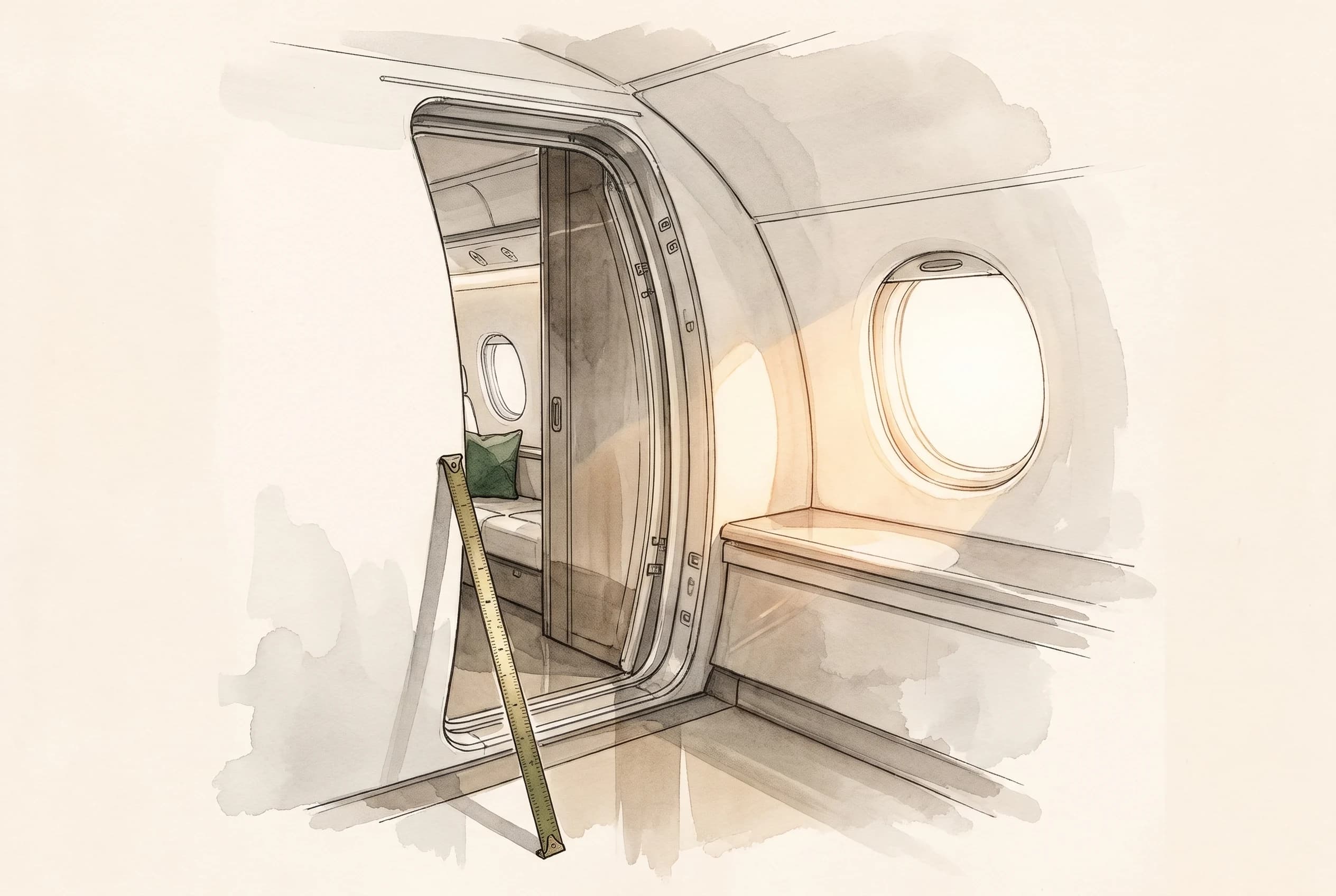
Width matters for the same reason, and in a particular way: it decides whether two people can pass each other, and whether a club four seating arrangement lets four adults work at a table without touching elbows. Large cabin aircraft win here by geometry. Dassault makes the point explicitly with the Falcon 2000LXS, which carries the wide cabin cross section of its larger siblings, the Falcon 7X and 8X. Cabin cross section is the one number no interior refurbishment can change.
How far can each class fly without a fuel stop?
Further than the old categories suggest, and always fewer miles than the headline implies once the cabin is full. Published range figures are engineering statements made under declared conditions. Embraer quotes 3,340 nm (6,186 km) for the Praetor 500E, and states the assumptions plainly: four passengers at 200 lb (91 kg) each, long range cruise, NBAA IFR reserves with a 200 nm alternate. Add four more passengers and their luggage and the achievable distance falls. That is physics, not marketing.
The interesting consequence is that class boundaries have blurred. Embraer presents the Praetor 500E as the fastest and furthest flying midsize jet, fitted with fly by wire and active turbulence reduction, equipment buyers once associated with far larger aircraft. Dassault publishes 4,000 nm (7,410 km) for the Falcon 2000LXS with six passengers and two crew under the same reserve standard, in a cabin cross section shared with the Falcon 7X and 8X. Capability no longer maps neatly onto category names, and anyone still shopping by label is shopping with an outdated map.
| Class | Reference aircraft | Published figure | Stated assumptions |
|---|---|---|---|
| Midsize jet | Cessna Citation Latitude | Cabin 72 in (1.83 m) high, 77 in (1.96 m) wide | Tall enough for most adults to stand upright, a threshold most light jet cabins do not reach |
| Midsize jet | Embraer Praetor 500E | Maximum range 3,340 nm (6,186 km) | 4 passengers at 200 lb (91 kg), long range cruise, NBAA IFR reserves, 200 nm alternate |
| Large cabin | Dassault Falcon 2000LXS | Range 4,000 nm (7,410 km) | 6 passengers and 2 crew, normal cruise, NBAA IFR reserves, wide cabin cross section shared with the Falcon 7X and 8X |
How is a charter quote built around aircraft class?
A quote is built on block time first, and everything else is an adjustment to it. Block time is the period the aircraft is committed to your flight, measured from the moment it first moves under its own power to the moment it comes to rest at the destination. It is longer than the time airborne. Operators price against it because it is what they actually consume: engine cycles, crew duty hours, maintenance intervals. You are buying hours of a machine and a crew, and distance only matters insofar as it creates hours.
On top of block time sit the items that explain why identical routes return different numbers. Positioning, the empty legs flown to collect you and to send the aircraft home, can be the largest single line on a short trip. Crew duty limits and overnight costs enter when a day runs long. Then fuel, landing, handling and parking at each end, de-icing in winter, and catering. Class influences all of these at once, because a larger aircraft burns more, pays higher fees and often parks further from the terminal.
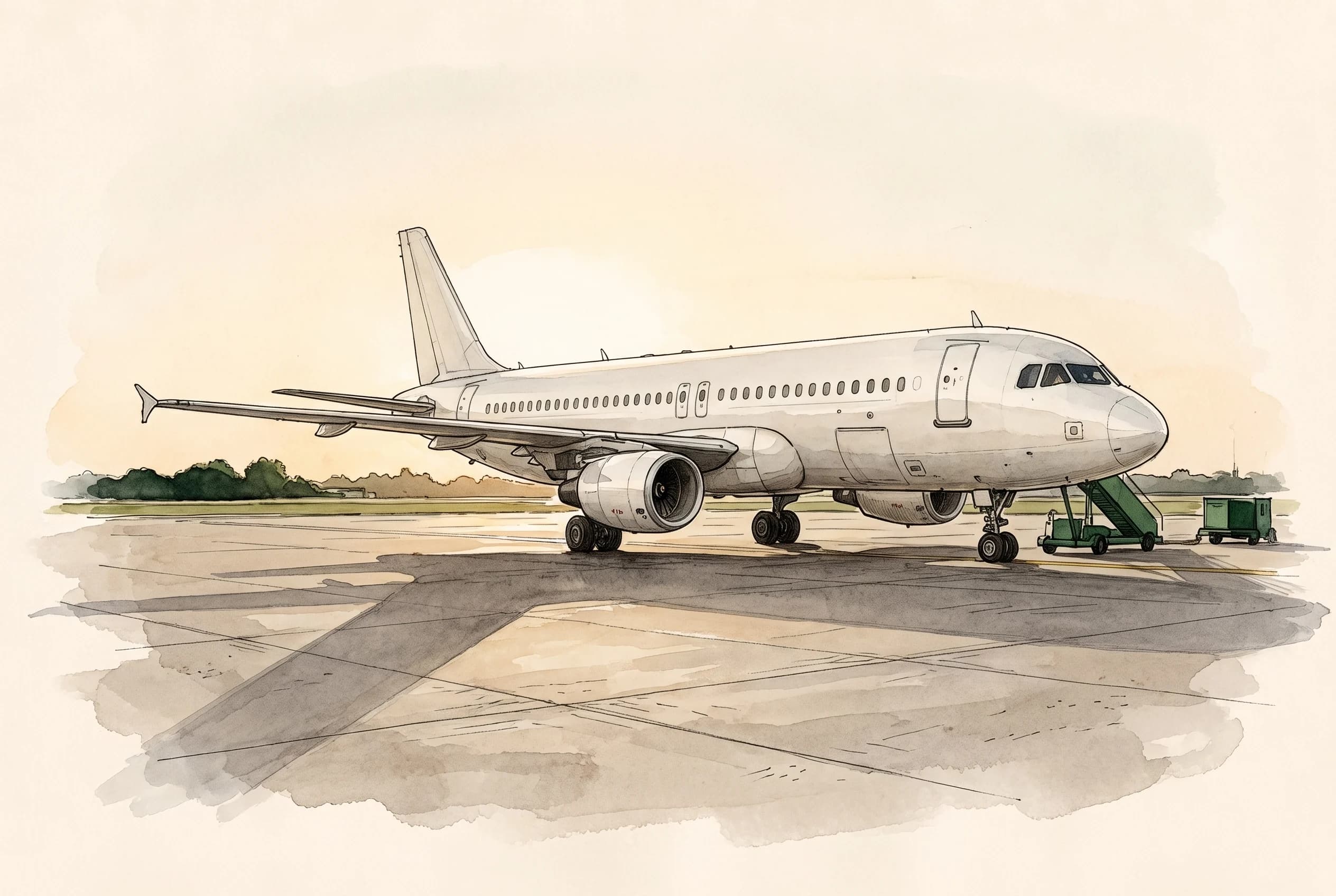
This is why the hourly rate, read alone, misleads. A heavy jet already based near your departure airport will sometimes beat a light jet that must cross a country empty to reach you. The mission shape, where the aircraft starts, where it sleeps, how many days it waits, frequently matters more than the badge. Atljet market data price estimates are always issued per aircraft with the class, the route, the month and the year attached, and always described as estimates, because any figure without those four anchors is a guess.
You are not buying a distance. You are buying the hours of an aircraft and a crew, and the skill lies in buying as few of them as the mission allows.
Atljet Editorial
Which class actually fits your mission?
Three questions settle it: how many people with how much luggage, how far nonstop, and how long on board. Answer those honestly and the class follows, usually in less than a minute. Everything else, the cabin finish, the manufacturer, the year of build, is a refinement applied after the shelf has been chosen. The most common and most costly error is upgrading for prestige on a route that never needed it, or downgrading for economy on a sector where the cabin ceiling will be felt for four hours.
- A small party, a short sector, light bags: a light jet is the efficient answer, and the ceiling will not bother you.
- A working cabin, real luggage, several hours aloft: midsize, where the stand-up cabin changes the character of the day.
- A full group, long sectors, ski or golf equipment, a need to rest properly: large cabin or heavy, chosen for volume as much as range.
- A short runway at one end and a long sector at the other: an airframe built for both, which is a narrower list than the category name suggests.
- Flexible dates on a familiar route: ask what is already positioned nearby before asking what is ideal.
Weight deserves one honest mention, because it decides more trips than passengers expect: fuel, people and bags compete for the same allowance, and a full cabin on a long sector is a different aircraft from a brochure cabin on a demonstration flight. We looked at that arithmetic in detail in what a Gulfstream weighs. The categories themselves, with cabin dimensions and typical missions, are set out across the fleet pages, starting with the midsize jet class where most of the useful compromises live.
A good flight desk works backwards from the day rather than forwards from the catalogue. It asks what time you need to be in the room, not which aircraft you like, and it will say so when a smaller cabin serves you better. The ground side belongs to the same conversation: the Atljet flight desk can arrange the last stretch as well, a chauffeured car, a helicopter over the traffic, a motorboat at the jetty, so that the hours you bought in the air are not surrendered on a motorway. The process is described in how it works.
Back to the three quotes open at 07:40. The right one is rarely the most impressive and almost never the cheapest per hour. It is the one whose hours match the day: an aircraft already close by, a cabin tall enough for the length of the sector, a range figure that still holds with everyone and everything aboard. Choose that way and the class stops being a status question and becomes what it always was, a measurement. People fly you. Data prices you.
Questions people ask
- What is the difference between a light jet and a midsize jet?
- A light jet typically carries a small group on short sectors, with a cabin you move through seated or stooped. A midsize jet adds a stand-up cabin, more baggage volume, a proper lavatory and the range to cross a continent without a fuel stop. The distinction is commercial convention, so compare published range, cabin height and payload rather than the label.
- How is a private jet charter quote calculated?
- It is built from block time at the operator's hourly rate, plus positioning flights to bring the aircraft to you, crew duty and overnight costs, fuel, landing, handling and parking fees, and any de-icing or catering. Distance matters only through the hours it consumes, which is why headwinds, routing and airport choice change the number.
- What does block time mean in private aviation?
- Block time is the period the aircraft is committed to your flight, from first movement at departure to final stop at arrival. It is longer than the time in the air, and it is the quantity most operators price against.
- Can you stand up in a light jet cabin?
- Usually not. The stand-up threshold sits with the midsize class: the Cessna Citation Latitude has a cabin 72 in (1.83 m) high and 77 in (1.96 m) wide, tall enough for most adults to stand upright, a line most light jet cabins do not reach. On a light jet, expect to move through the cabin bent forward.
- Is a heavy jet always more expensive than a midsize jet?
- Per hour, almost always. Per trip, not necessarily. If a heavy jet is already positioned near your departure airport and a midsize would need a long empty repositioning flight, the larger aircraft can produce the lower total. Mission shape decides more often than class.
Questions on this guide? The flight desk answers within the hour.
Request options