Summary
- Samedan (SMV/LSZS) is the only airport for St. Moritz, about fifteen minutes from the village by car.
- Winter days are organised around light, not hours: the mountain in the morning, the frozen lake at midday, the village as the shadows cross the ice.
- Choose a house by temperament: Kulm above the lake, Badrutt's Palace for the season at full volume, Suvretta House for a world apart.
- Atljet market data, October 2026: Zurich to Samedan from €4,500 to €5,400 in a Light Jet, London Farnborough from €10,100 to €12,800, both one way, per aircraft, estimates.
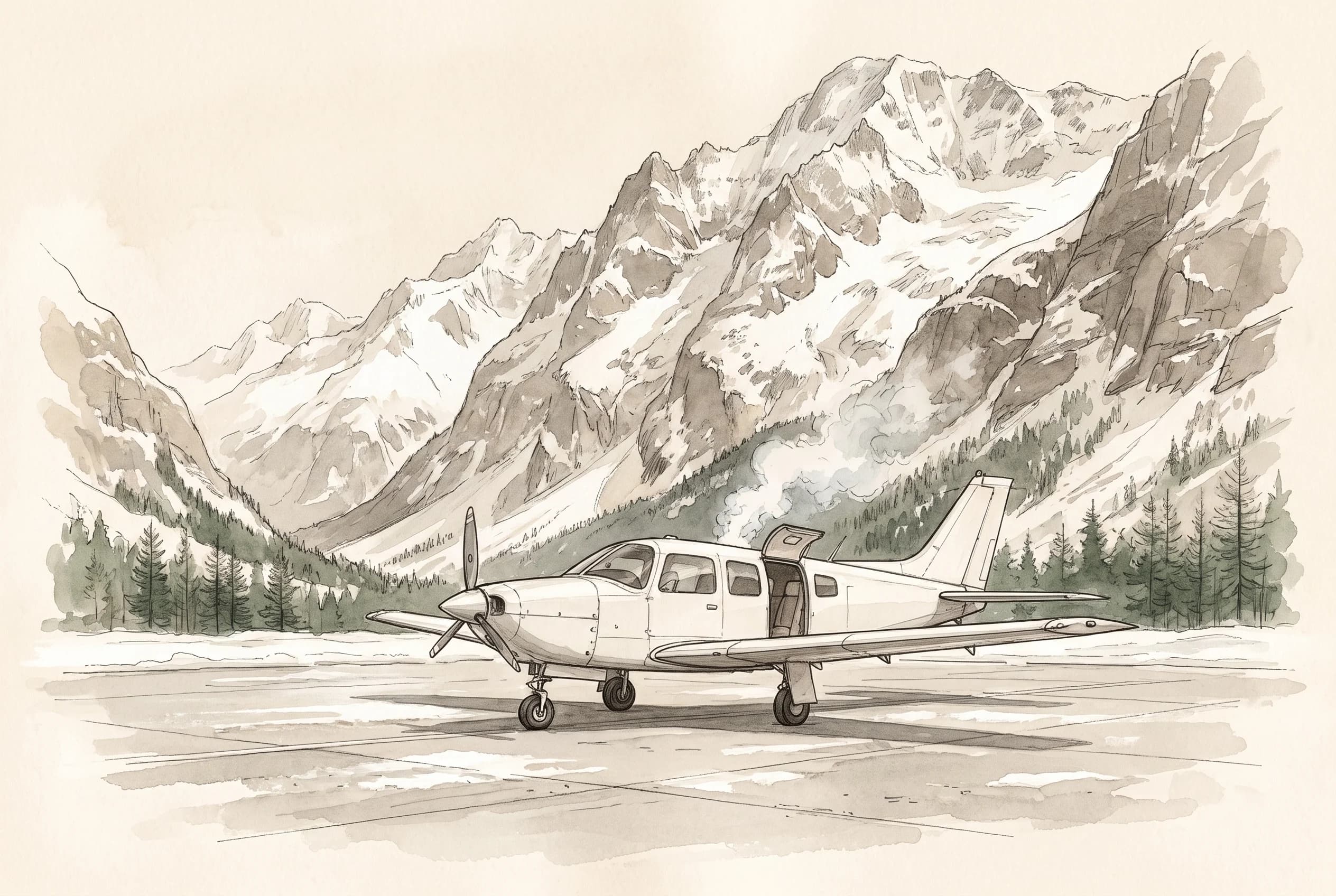
Eleven fifteen in the Engadin. The cabin door opens and the cold arrives first, dry and thin and faintly sweet, larch and frozen gravel. Below the apron at Samedan the valley floor runs white and flat as a table, the river somewhere under it, and the light comes in sideways, already low in January. A driver takes two bags and says nothing useful about the weather. Fifteen minutes later the car turns above the lake and the whole town steps down toward the ice, the Kulm on its terrace, the frozen surface marked out in roped lanes.
A private jet to St. Moritz lands at Samedan airport, SMV or LSZS, the only field that serves the Engadin and, by its operator's own description, the highest-altitude airport in Europe. From Zurich the block time is about 32 minutes in a Light Jet such as the Citation CJ3, from London Farnborough about 1 hour 41 minutes, and the drive from the apron into St. Moritz takes roughly a quarter of an hour. Land before noon and the whole of a bright January afternoon is still in front of you.
What does arriving in St. Moritz actually feel like?
Arriving in St. Moritz feels like being admitted rather than delivered. The Engadin sits high and dry, and the air tells you so within the first breath: thinner, colder, with the particular stillness of a valley locked in snow. Samedan, the airport that serves the resort, lies a short drive down the valley floor, and the transfer into town takes about a quarter of an hour, long enough to watch the larches thin out and the lake appear below the road. The town is the birthplace of winter tourism, by the account of its own tourism board, and it still behaves like a place that invented something.
The regulars arrange the day around the light, not the clock. A late morning landing hands you the whole of a January afternoon, which in the Engadin means roughly four usable hours of dry, glass-clear sun before the mountain shadow crosses the lake and the temperature falls without announcing itself. Those who come often fly in the morning and keep the afternoon loose, because mountain weather keeps its own schedule. The etiquette is the same one a Courchevel altiport landing teaches: arrive early, dress for the walk from the aircraft, and promise nobody a dinner table on the far side of a cold front.
What does a day in St. Moritz look like, in winter?
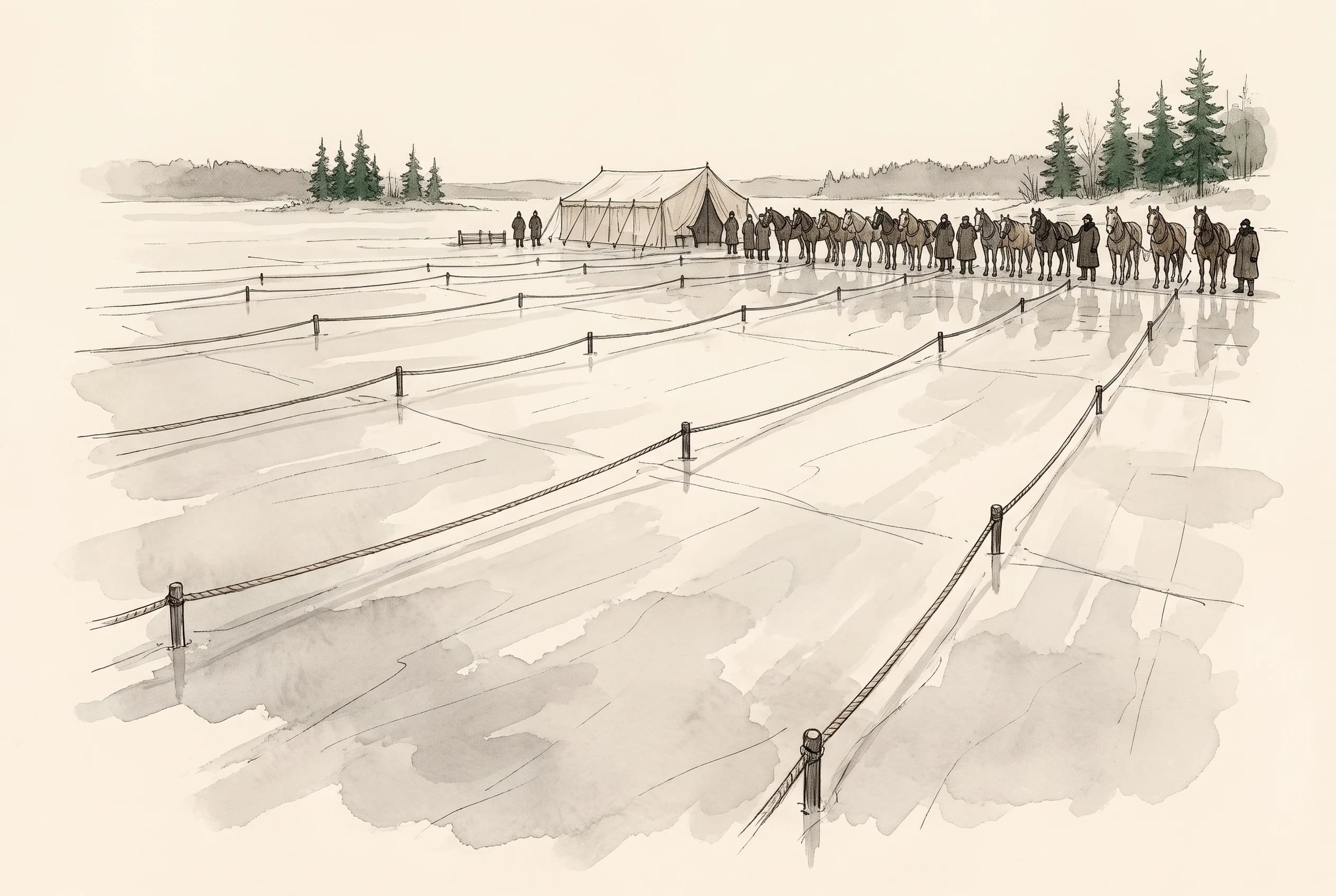
The day happens on the lake. Once the ice is judged ready, the frozen surface of Lake St. Moritz becomes the town's real piazza: roped lanes, marquees, horses, and a crowd in furs and loden standing on water. Few places in the Alps move their social centre from the street to the ice and back again with the seasons. Mornings belong to the mountain, midday to the lake, and the late afternoon to the slow climb back into the village, when the shadows lengthen and the pastry rooms fill with people who have been outside since nine.
- Before nine: the mountain on the Corviglia side, while the snow is still unmarked.
- Eleven: down to the lake, coffee taken standing, the ice crews still setting their lanes.
- One: lunch long and bright, outdoors if the wind allows it.
- Four: back into the village as the shadow crosses the ice and the cold sharpens.
- Eight: dinner early, the Engadin way, then a walk home in a cold that squeaks underfoot.
Two weekends define the winter. The Snow Polo World Cup St. Moritz plays high-goal polo on the frozen lake, and the 2026 tournament is billed as the 41st edition. Later in the season, White Turf brings racing to the same ice, with skijoring as its signature act: a rider on skis pulled behind a horse running loose, which is the reason people who care nothing for racing still come to watch. Neither is a spectator sport in the ordinary sense. You stand on the ice, within a few metres of it, and the sound of hooves reaches you before the horses do.
Then there is the Cresta Run, the natural ice run rebuilt each winter and operated by the St Moritz Tobogganing Club under its own rules, which are particular and are not negotiated. Riding it is a morning proposition, early and very cold, and the ritual matters as much as the run itself: the walk to the start, the talk afterwards, the sense of a club that has not modernised because it has never needed to. If you intend only to watch, watch from the side. If you intend to ride, let the club explain how, and give it a season's patience.
St. Moritz does not reward the visitor who lands late and asks what there is to do. It rewards the one who already knows what hour to be on the ice.
Atljet Editorial
Where does St. Moritz keep its secrets, Kulm, Badrutt's, or Suvretta?
Choose by temperament, not by star count, because all three houses that matter are faultless in their own register. Kulm Hotel St. Moritz stands at 1,856 metres on the terrace above the lake and is the oldest hotel in the resort, rated five-star superior, with the composure of an institution that has already seen everything twice. It looks straight down onto the ice, which in winter is the whole argument: you can follow the polo from a window, go out when it suits you, and be back indoors before your coat has stopped being cold. The families who have come for three generations tend to be here, and they do not mention it.
Badrutt's Palace Hotel, Via Serlas 27, has been the stage since 1896. It is the address people mean when they say they are in St. Moritz, which is both its charm and its price: you will be seen in the hall, you will be greeted, and the evening will have begun before you decided it should. Take it if you want the season at full volume, the furs, the piano, the long procession through the lobby at seven. Take something else if you would rather cross a hall at midnight unnoticed.
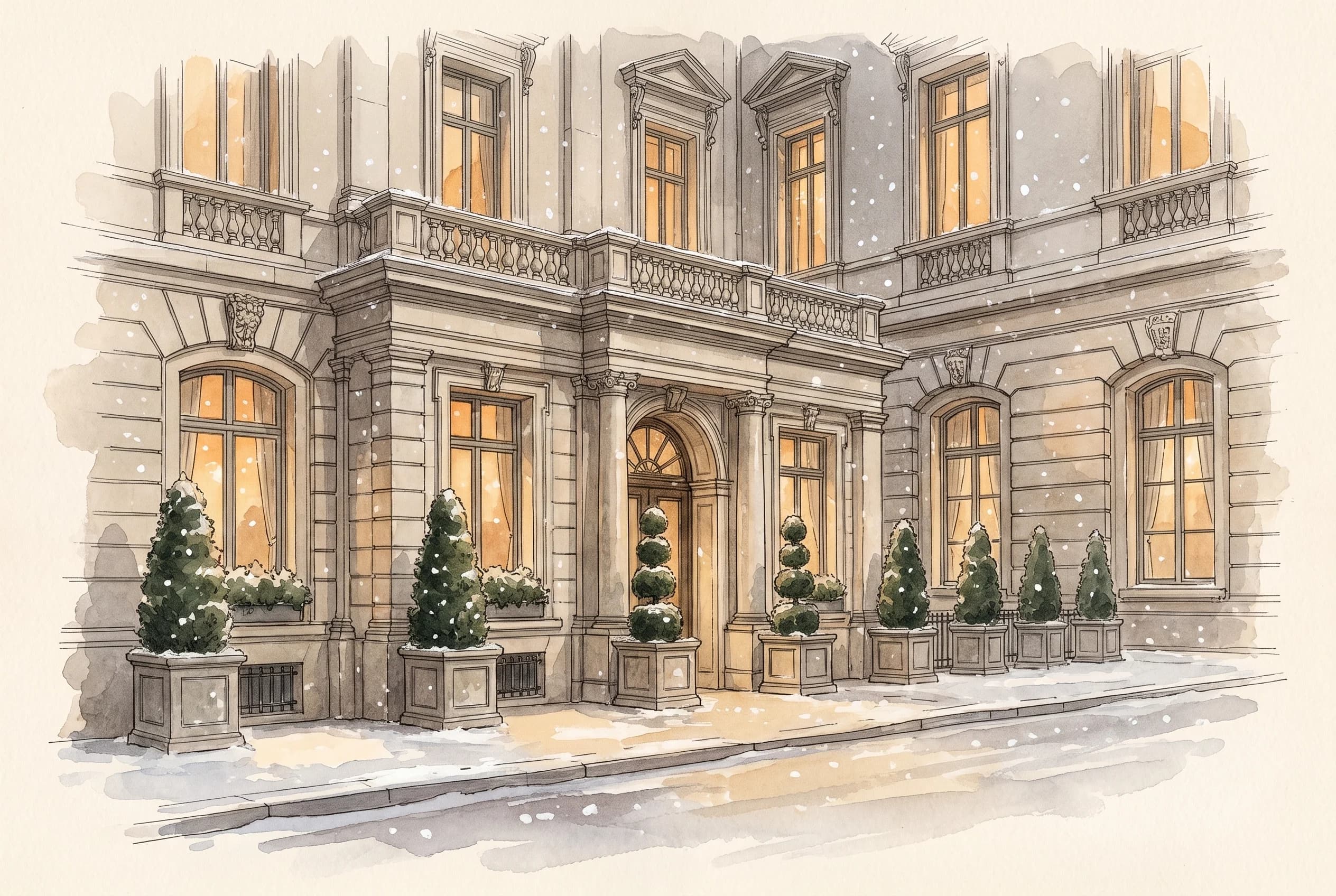
Suvretta House, Via Chasellas 1, inaugurated on 21 December 1912, sits apart from the village in its own pocket of forest and snow. It is the choice of people who want the Engadin without the performance: children in the snow outside the window, dinner taken in the house, the village a short drive away when it is wanted and invisible when it is not. Regulars book the same rooms for the same fortnight every year and would consider it an intrusion to be asked which ones. The quiet here is deliberate and well kept.
Where does St. Moritz eat well, quietly?
St. Moritz eats seriously, and it eats on mountain hours: lunch long and bright, dinner early by southern standards. The resort holds two tables with Two Stars in the MICHELIN Guide Switzerland 2025, Ecco St. Moritz and Da Vittorio St. Moritz, which is a remarkable density for a village of this size and a fair measure of what the winter population expects. Both are seasonal houses, open for the winter and then gone, which gives them the concentration of a residency rather than a restaurant. Reserve them before you decide anything else about the week.
Talvo holds One Star and is the intimate counterweight, an Engadine house of low ceilings and panelled rooms where the cooking is precise without raising its voice. For the other sort of evening, Chesa Veglia remains the village's great piece of theatre, a historic farmhouse with several rooms under one roof, from the pizzeria above to the grill below, where the dress code is whatever you wore all afternoon and the regulars order the same dish they ordered a decade ago. The full winter selection sits on the MICHELIN Guide.
The Atljet Edit
Five choices that decide a St. Moritz winter, each for one clear reason.
- Kulm Hotel St. Moritz, above the lake: the resort's oldest house, at 1,856 metres, with the ice and the polo directly below the windows.
- Da Vittorio St. Moritz, in the village: Two Stars in the MICHELIN Guide Switzerland 2025, and the warmest Italian welcome in the Alps.
- Snow Polo World Cup St. Moritz, on the frozen lake: the 41st edition in 2026, played on ice and watched from a few metres away.
- White Turf, on Lake St. Moritz: skijoring, a rider on skis pulled across the ice behind a horse running without a jockey.
- Suvretta House, Via Chasellas 1: inaugurated in 1912, a private world minutes from the village and a century from the noise.
What does a private jet to St. Moritz Samedan airport cost?
A private jet to St. Moritz Samedan airport runs, by Atljet market data for October 2026, from €4,500 to €5,400 in a Light Jet out of Zurich and from €10,100 to €12,800 out of London Farnborough, one way, per aircraft, as market estimates. Samedan, SMV or LSZS, is the airport of the Engadin and the only one that makes sense for St. Moritz. Its operator, Engadin Airport, describes it as the highest-altitude airport in Europe, and the run down the valley is the first good thing about the journey. From Zurich the block time is about 32 minutes in a Light Jet such as the Citation CJ3, from Munich about 41 minutes, from Geneva about 45, and from London Farnborough about 1 hour 41 minutes in the same class. Then a quarter of an hour by road into the village.
| From | Distance | Block time, Light Jet | Light Jet, Citation CJ3 | Super Midsize, Challenger 350 |
|---|---|---|---|---|
| London Farnborough (FAB) | 538 nm (996 km) | 1 h 41 min | €10,100 to €12,800 | €14,700 to €18,500 |
| Paris Le Bourget (LBG) | 354 nm (656 km) | 1 h 13 min | €7,800 to €9,800 | €11,200 to €14,000 |
| Geneva (GVA) | 167 nm (309 km) | 45 min | €5,500 to €6,800 | €7,800 to €9,500 |
| Munich (MUC) | 142 nm (263 km) | 41 min | €5,200 to €6,300 | €7,300 to €8,900 |
| Zurich (ZRH) | 83 nm (154 km) | 32 min | €4,500 to €5,400 | €6,200 to €7,500 |
The figures above are Atljet market data for October 2026, one way and per aircraft, and they are market estimates rather than quotes. What you finally pay depends on block time, the routing, the aircraft, fuel, airport charges, positioning and availability on the day. You pay for time, not for distance, which is why a short winter hop from Zurich reads so differently from a run out of London. Point to point charter covers the straightforward version of this trip; in the busiest weeks some travellers keep the last stretch by helicopter, for the same reason they choose it between Milan and Portofino: the view, and the quarter of an hour given back.
Airports
Arriving by air
Samedan is the one airport for St. Moritz, about a quarter of an hour by road from the village, with the approach running the length of the Engadin valley. Flight times and price bands below are Atljet market data for October 2026, one way, per aircraft, and are market estimates. The Atljet flight desk can arrange the last stretch as well, by chauffeured car or helicopter, so that the day continues without a pause at the apron.
- SMV
- Engadin Airport, Samedan (SMV/LSZS)The only sensible arrival for St. Moritz: fifteen minutes from the village, and the field every Engadin regular uses in winter.
| From | Distance | Light jet | Midsize jet | Heavy jet |
|---|---|---|---|---|
| London (FAB to SMV) | 538 nm (996 km) | 1h 41m, €10,100 to €12,800 | 1h 35m, €12,200 to €15,200 | 1h 30m, €18,100 to €24,200 |
| Paris (LBG to SMV) | 354 nm (656 km) | 1h 13m, €7,800 to €9,800 | 1h 09m, €9,400 to €11,500 | 1h 06m, €13,800 to €18,200 |
| Geneva (GVA to SMV) | 167 nm (309 km) | 0h 45m, €5,500 to €6,800 | 0h 43m, €6,500 to €7,900 | 0h 42m, €9,500 to €12,300 |
| Zurich (ZRH to SMV) | 83 nm (154 km) | 0h 32m, €4,500 to €5,400 | 0h 32m, €5,400 to €6,400 | 0h 31m, €7,500 to €9,600 |
| Munich (MUC to SMV) | 142 nm (263 km) | 0h 41m, €5,200 to €6,300 | 0h 40m, €6,200 to €7,500 | 0h 39m, €8,900 to €11,600 |
The best hour in St. Moritz is still the one you land in. A quarter past eleven, the door open, the cold arriving first, the valley white and flat below the apron and an entire afternoon of thin gold light not yet spent. Everything after that is a question of choosing well: which house, which table, which Sunday on the ice. The town has been receiving people who arrive this way since before anyone thought to call it winter tourism, and it still makes the same quiet request of them all: be in time for the light.
Questions people ask
- What airport do you fly into for St. Moritz?
- Samedan, SMV or LSZS, operated by Engadin Airport AG. It is the only airport that serves the Engadin valley and sits about fifteen minutes by road from St. Moritz.
- How do you get from Samedan airport to St. Moritz?
- By chauffeured car, in roughly a quarter of an hour down the valley and up to the village. A helicopter transfer is possible and is occasionally preferred on deep winter weekends; the Atljet flight desk can arrange either with the flight.
- Is Samedan the highest airport in Europe?
- Engadin Airport describes itself on its official site as Europe's highest-altitude airport. The approach runs down the valley floor and is, for most passengers, the first memorable part of the trip.
- Where should you stay in St. Moritz, Suvretta House or Badrutt's Palace?
- Badrutt's Palace Hotel, Via Serlas 27, open since 1896, is the social stage of the season. Suvretta House, Via Chasellas 1, inaugurated on 21 December 1912, sits apart from the village and suits those who want the Engadin without the performance. Kulm Hotel St. Moritz, the resort's oldest house at 1,856 metres, overlooks the lake and the polo.
- What is the Cresta Run?
- A natural ice run rebuilt each winter in St. Moritz and operated by the St Moritz Tobogganing Club, which governs access and conduct under its own rules. Riding is an early morning matter, and the ritual around it is half the point.
Questions on this guide? The flight desk answers within the hour.
Request options