Summary
- A villa with staff sells time and unshared space; the best lake hotels sell a kitchen and a memory you cannot assemble privately.
- Passalacqua in Moltrasio divides its rooms into three ways of staying, described by the hotel as Villa, Palazzo and Casa al Lago.
- Il Sereno Al Lago in Torno, under chef Raffaele Lenzi, is the Michelin-starred reason some very private travellers book a hotel anyway.
- Choose the villa for long stays with children, dogs and people you love; choose the hotel for three nights that should feel like a holiday from your own household.
Seven twenty on a Thursday morning in Moltrasio. The lake is still the colour of slate and the water has not yet decided to move. A gardener crosses a terrace with a watering can, careful not to wake anybody. Below, a shutter opens from the inside and is left open. Coffee arrives on a tray nobody ordered the night before, because the person carrying it already knows the hour. Across the water a wooden boat is being uncovered, its canvas folded into quarters. Until nine, no one on either shore speaks above a murmur.
The villa or hotel Lake Como question comes down to one thing: how much of your day you are prepared to spend in rooms that belong to other people as well. A villa with staff buys unshared time, meals at the hour you invent, and a silence no corridor can match. A hotel of the calibre of Passalacqua in Moltrasio, Villa d'Este in Cernobbio or Il Sereno in Torno buys a kitchen you could not run at home, and the relief of deciding nothing.
Is it better to stay in a villa or a hotel on Lake Como?
The villa or hotel Lake Como question is decided by a single calculation, and it has nothing to do with square metres or service levels. It is this: how many hours of your day are you willing to spend in rooms that belong to other people as well. Breakfast beside strangers, a pool with a second family at the far end, a lift that stops on the way down. For some travellers that background noise is part of the pleasure of being away. For others it is the one thing they came to the lake to escape.
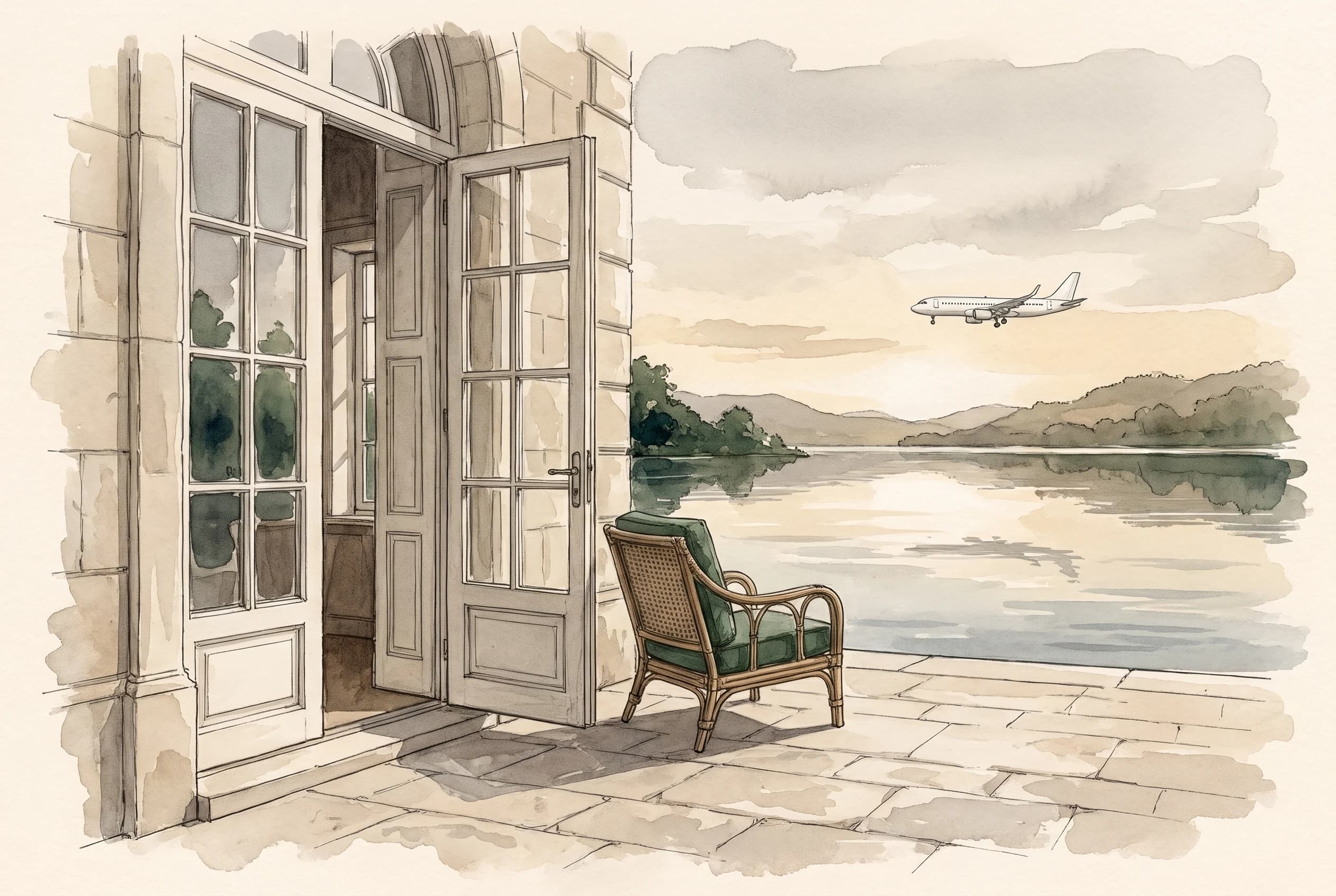
The people who decide fastest are the ones who already know their own temperament. They do not ask which address is better. They ask how long they are staying, who is coming, and whether the trip is meant to feel like a holiday from work or a holiday from running a household. Five nights with children, a dog and two sets of grandparents points one way. Three nights with one other person, an anniversary and no intention of thinking about lunch points firmly the other.
There is a second question underneath, and it is the honest one. A villa makes you the host. Somebody has to say what time dinner is, how many are coming, whether the boat goes out at six or at seven. A good house manager absorbs almost all of it, but not the deciding. A hotel removes the deciding entirely, which is either a relief or a small loss of control, depending on who you are. Nobody can answer that for you, and the best travel advisors know not to try.
The hotel that behaves like a private house
The finest lake hotels have spent the last decade learning to behave like private houses, which is why the choice is harder than it used to be. Passalacqua in Moltrasio is the clearest case: rather than numbering rooms along corridors, the hotel divides the stay into three distinct ways of inhabiting one address, described as Villa, Palazzo and Casa al Lago. One is formal and high above the water, one is closer to the kitchen gardens, one is at the lake's edge. Guests do not choose a room category. They choose a mood, and then a terrace.
Villa d'Este in Cernobbio works the other way round and arrives at a similar discretion. It is large, and its scale is the point: grounds deep enough that you can walk for twenty minutes without meeting a soul, and centuries of practice at a particular kind of unseeing. The house describes itself as a place people have come to for beauty, tranquillity and inspiration, which sounds like marketing until you watch the staff recognise a guest's preference on the second morning and never mention it again. That is institutional memory, and no rented villa can manufacture it in a week.
What the great hotels cannot give you is the hour. However considerate the service, there is a moment when breakfast ends, a moment when the pool fills, a rhythm set by other people's flights. Passalacqua's own writing about the lake treats every season as a different register, from spring blossom to the truffle months of autumn, and that is true of the days as well. The hotel knows the rhythm better than you do. Staying there means agreeing to it, which most guests are happy to do.
What only a villa can give you
A villa with staff sells one thing that no hotel sells at any price: unshared time. The cook works for your table and nobody else's. Breakfast can happen at noon, twice, for different people, without anyone noting it. The pool is yours at the hour the light falls across it, which on the western shore means late afternoon, when the stone has been warm all day and the water goes the colour of olive oil. Children can be loud. Dogs can be present. The only audience is the household, and the household has seen everything.
Staffing is agreed before arrival, and the conversation worth having is not about how many people but about how visible they should be. Some guests want the house manager at the door each morning with the day laid out. Others want provisions in the kitchen, fresh linen appearing while they are out on the water, and no conversation at all before eleven. Both are normal requests. Say which you are, in writing, two weeks ahead. A house that has been told nothing defaults to attentiveness, and attentiveness is exhausting when you did not ask for it.
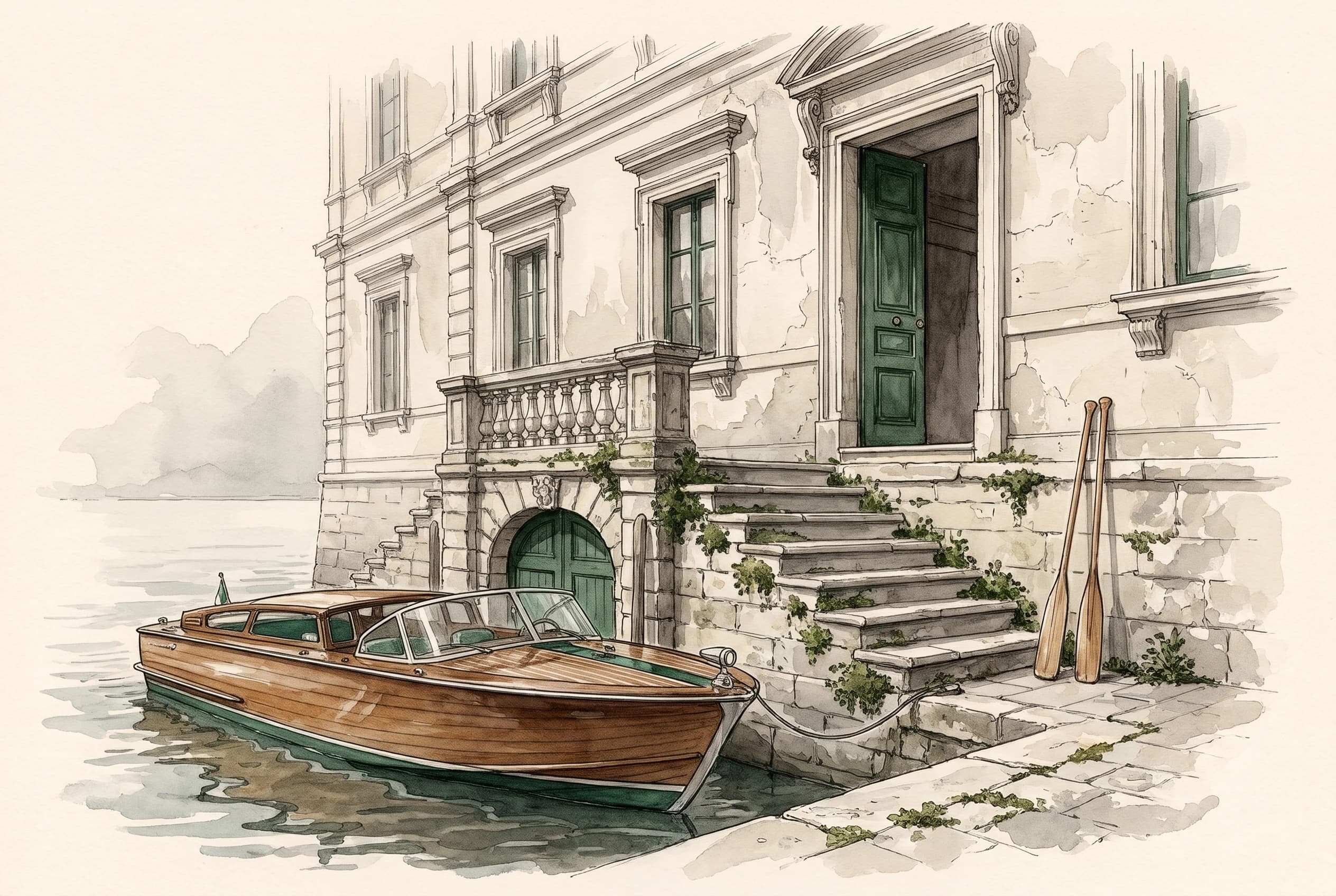
The other villa advantage is the water door. Most of the serious houses on the lake were built facing the water, back when the road was an afterthought, and the correct arrival is still by boat. Coming in from the lake at the end of the afternoon, with the engine cut twenty metres out and the hull drifting the last stretch to the mooring, resets the whole stay. Our note on the private boat tour at sunset explains why the hour between six and eight belongs to people with their own boatman.
| What it buys | Villa with staff | Hotel of the first rank |
|---|---|---|
| Your hours | Set by you, including meals at odd times | Set by the house, gently and well |
| Who else is there | Only your party and the household | Other guests, however few and quiet |
| Cooking | A private cook who learns you in two days | A kitchen you could not run at home |
| Best length of stay | Five nights and up | Two to four nights |
| Best for | Families, groups, dogs, long summers | Couples, short stays, celebration dinners |
| The arrival | By water, through a door built for boats | By car or boat, with the staff expecting you |
Where the table decides the choice
Sometimes the restaurant settles the argument, and the villa loses. Il Sereno in Torno describes its restaurant Il Sereno Al Lago as serving Michelin-starred Italian cuisine, with chef Raffaele Lenzi in the kitchen and a tasting menu that runs to seven courses. That is not a dinner you can import into a rented house, no matter how good your cook. It depends on a brigade, a pass, a sequence built over a season, and on being served at a table a few metres above water that is moving very slightly in the dark.
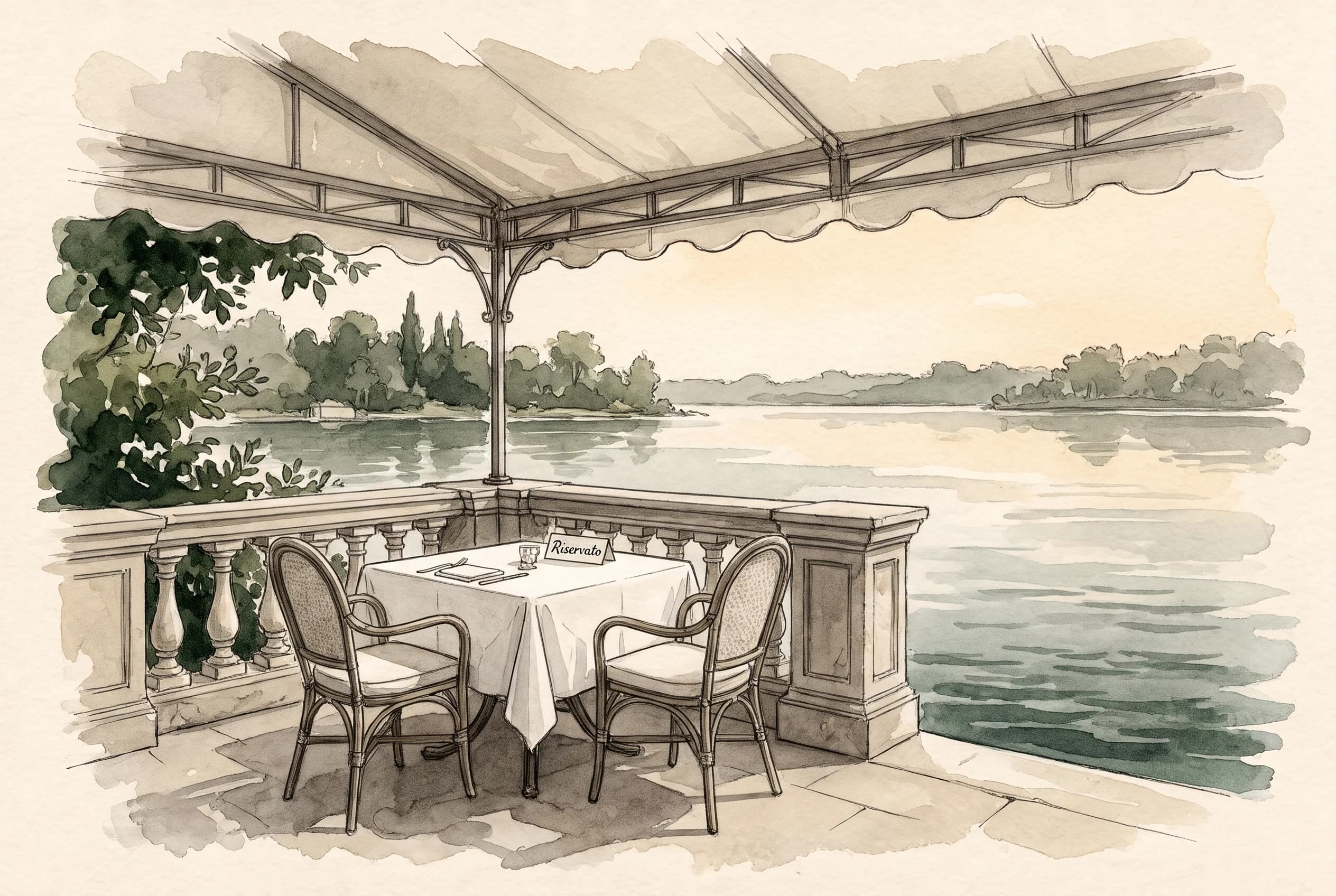
This is why the most private travellers often split the week. Four nights in a house with a cook and a boatman, then two nights in a hotel chosen for its table. The villa handles the part of the holiday that is about family and hours. The hotel handles the one evening that is meant to be remembered in detail: the cutlery, the sequence, the glass that arrives before you realise you wanted it. The Guida MICHELIN exists precisely to mark the difference between a good dinner and a constructed one.
The villa gives you your own hours. The hotel gives you one evening you could not have invented. Most people want both, in that order.
Atljet Editorial
If you do book the villa for the whole stay, book the restaurant from the villa. A house manager who calls the week before, names the party size, the hour and the preferences, and sends a boat that arrives at the right pontoon at the right minute, is worth more than any concierge app. Dinner by water on this lake is a different evening from dinner by road. You step out onto stone, the engine falls quiet behind you, and the walk to the table is thirty seconds long.
The Atljet Edit
Five choices our editors would make on this lake, in the order we would make them.
- Passalacqua, Moltrasio: Villa, Palazzo or Casa al Lago, so you choose a temperament rather than a room number, and Casa al Lago is the right answer for two people with three nights.
- Villa d'Este, Cernobbio: for grounds deep enough to disappear into and a staff with centuries of practice at not noticing anybody.
- Il Sereno Al Lago, Torno: the Michelin-starred table under chef Raffaele Lenzi, and the seven-course menu that justifies dressing properly on holiday.
- A villa taken with its own boatman: the water door stops being a detail and becomes the way you come and go all week.
- The truffle months, Lake Como: autumn keeps the light and loses the crowds, which is when the houses and the kitchens are both at their best.
How discreet travellers arrive at Lake Como
They arrive at the airport closest to the shore they are staying on, and they finish the journey on the water. Lake Como has no airport of its own, which is the single best thing about it. The practical consequence is that your last hour is chosen rather than endured: a chauffeured car down through Como, a helicopter when the day is short, or a wooden motorboat waiting at a pontoon with the canvas already folded. Our piece on choosing between helicopter and car applies here almost word for word.
Lugano sits nearest the northern reach, Linate is the civilised choice for anyone coming from a European city with business the same morning, Bergamo suits the eastern branch, and Malpensa carries the long-haul arrivals. Italian aviation is regulated by ENAC, and the only thing a traveller needs to know about it is that the smaller fields work on a reservation rhythm that rewards booking early in high summer. Our charter desk handles that part, and how it works sets out the rest in plain language.
The flights themselves are shorter than people expect. Atljet market data for November 2026 puts Geneva to Lugano in a Light Jet, the Citation CJ3, at 39 minutes of block time and an estimated €5,100 to €6,100 one way. From Dubai the lake is a single night flight in a Gulfstream G550, about five hours and fifty-seven minutes, and breakfast still happens on a terrace.
| From | Distance | Aircraft | Block time | Estimate, one way |
|---|---|---|---|---|
| London Farnborough (FAB) | 527 nm / 976 km | Light Jet, Citation CJ3 | 1 h 39 min | €9,900 to €12,600 |
| London Farnborough (FAB) | 527 nm / 976 km | Heavy Jet, Falcon 900 | 1 h 29 min | €17,900 to €23,900 |
| Paris Le Bourget (LBG) | 336 nm / 622 km | Light Jet, Citation CJ3 | 1 h 10 min | €7,600 to €9,500 |
| Geneva (GVA) | 124 nm / 230 km | Light Jet, Citation CJ3 | 39 min | €5,100 to €6,100 |
| Zurich (ZRH) | 94 nm / 174 km | Light Jet, Citation CJ3 | 34 min | €4,700 to €5,600 |
| Dubai International (DXB) | 2,692 nm / 4,986 km | Ultra Long Range, Gulfstream G550 | 5 h 57 min | €90,300 to €122,400 |
Airports
Arriving by air
Lake Como has no airport, and the way you cover the last stretch sets the tone of the stay. Four fields serve the lake, and the choice depends on which shore you are sleeping on and where you have come from. The Atljet flight desk can arrange the final leg as well, by wooden motorboat, helicopter or chauffeured car, so that the transfer feels like the first hour of the holiday rather than the last of the journey.
- LSZA
- Lugano AirportThe closest approach for the northern reach and the Swiss side of the drive, and the quietest arrival of the four.
- LIML
- Milano Linate AirportThe civilised default for European arrivals, with the shortest road run down to Como and Cernobbio.
- LIME
- Milan Bergamo Orio al Serio AirportSuits guests heading for the eastern branch and the Lecco shore, or arriving at busy summer hours.
- LIMC
- Milano Malpensa AirportThe practical choice for long-haul arrivals from the Gulf or North America, with a helicopter leg available onward.
| From | Distance | Light jet | Midsize jet | Heavy jet |
|---|---|---|---|---|
| London (FAB to LUG) | 527 nm (976 km) | 1h 39m, €9,900 to €12,600 | 1h 34m, €12,100 to €15,000 | 1h 29m, €17,900 to €23,900 |
| Paris (LBG to LUG) | 336 nm (622 km) | 1h 10m, €7,600 to €9,500 | 1h 07m, €9,100 to €11,200 | 1h 04m, €13,400 to €17,700 |
| Geneva (GVA to LUG) | 124 nm (230 km) | 0h 39m, €5,100 to €6,100 | 0h 37m, €5,900 to €7,100 | 0h 36m, €8,400 to €10,800 |
| Zurich (ZRH to LUG) | 94 nm (174 km) | 0h 34m, €4,700 to €5,600 | 0h 33m, €5,500 to €6,500 | 0h 32m, €7,700 to €9,800 |
| Dubai (DXB to LUG) | 2,692 nm (4,986 km) | Not non stop | Not non stop | 6h 11m, €68,700 to €93,700 |
Whichever you choose, the test comes on the second morning, not the first. If you wake without checking the hour, if the coffee reaches the terrace before you have asked for it, if somebody is uncovering a boat across the water and you can hear the canvas being folded into quarters, the decision was the right one.
Questions people ask
- Is it better to stay in a villa or a hotel on Lake Como?
- A villa is better for stays of five nights or more, for groups and families, and for anyone who wants meals and hours decided privately. A hotel is better for two or three nights, for couples, and when the point of the trip is to be looked after rather than to run a household.
- What is the most private way to stay on Lake Como?
- A villa taken with its own staff, approached from the water rather than the road. Nobody shares your terrace, your pool or your breakfast hour, and the only people who see you arrive are the ones who work for you.
- Do Lake Como villas come with staff?
- The serious ones do. Expect a house manager, a cook, daily housekeeping and often a boatman. The staffing is agreed before arrival, which is also when you should say how invisible you want them to be.
- Is Il Sereno Al Lago Michelin starred?
- Yes. Il Sereno in Torno describes its restaurant Il Sereno Al Lago as serving Michelin-starred Italian cuisine, with chef Raffaele Lenzi leading the kitchen and a seven-course tasting menu.
- Which Lake Como hotel offers the most privacy?
- Passalacqua in Moltrasio comes closest to a private house, because its rooms are divided into three separate ways of staying rather than arranged along corridors. Villa d'Este in Cernobbio offers a different kind of discretion: scale, grounds and centuries of practice at not noticing anyone.
Questions on this guide? The flight desk answers within the hour.
Request options