
Summary
- An empty leg is the repositioning sector of a charter already booked by someone else: fixed date, fixed route, fixed time.
- Christmas is the hardest week of the year to find one, because operators have sold both directions of most rotations.
- Empty legs can move or disappear if the original booking changes, which happens more often in the holiday window than at any other time.
- When the date and the place genuinely matter, a confirmed point to point charter is the calmer purchase. Atljet market data, October 2026, puts Paris Le Bourget to Courchevel at €6,400 to €7,700 in a Very Light Jet, estimate, one way.
The twentieth of December, just after seven in the morning, and the desk is lit before the city is. Three screens: rotations, crew hours, weather at Sion. A Citation XLS is sitting in Geneva, due to fly home empty at half past eleven tomorrow because its passengers are staying through New Year. Somewhere in London a family would like exactly that aircraft, exactly then, in the opposite direction. The phone rings. The sector is already gone, taken by a client who said yes in four minutes. The screens refresh. This is the whole business of empty legs, compressed into one morning.
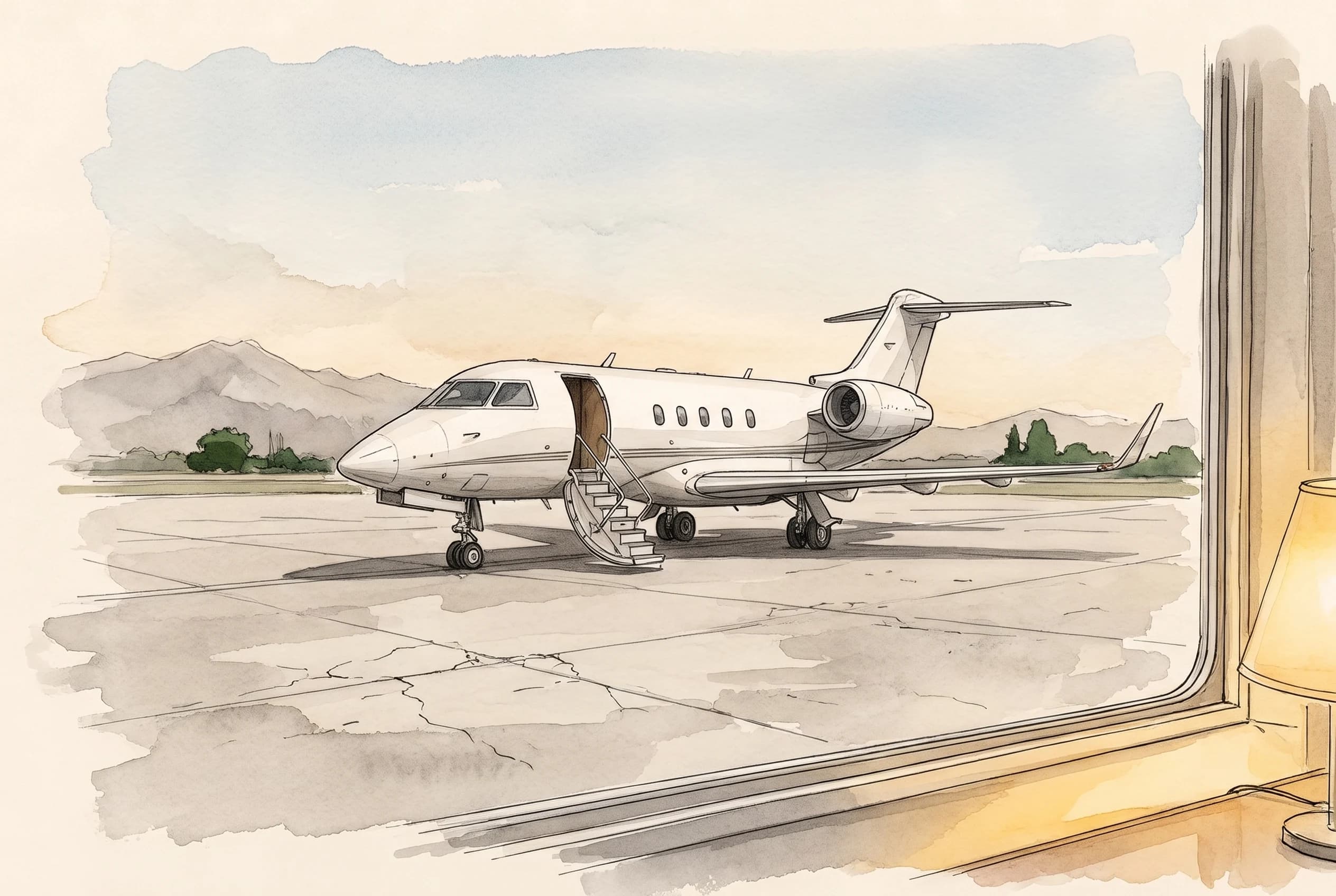
Empty leg flights at Christmas do exist, but they are rare, and they belong to someone else's schedule rather than yours. An empty leg is the unoccupied sector of a charter rotation, flown to reposition the aircraft to its next booked departure point or back to base, which means the date, the time, the departure airport and the destination are all fixed before you ever hear about it. In the window between 20 December and 2 January, when nearly every aircraft in Europe is already committed in both directions, the supply of those sectors thins out at precisely the moment the most people are looking for them.
Empty leg flights at Christmas do exist, but they are rare, and they belong to someone else's schedule rather than yours. An empty leg is the unoccupied sector of a charter rotation, flown to reposition the aircraft to its next booked departure point or back to base, which means the date, the time, the departure airport and the destination are all fixed before you ever hear about it. In the window between 20 December and 2 January, when nearly every aircraft in Europe is already committed in both directions, the supply of those sectors thins out at precisely the moment the most people are looking for them.
Do empty leg flights really exist at Christmas?
They do, and they are not a holiday promotion. The confusion comes from how the idea is sold: a listing page, a route, a price that looks like a gift. What sits behind that listing is an aircraft with an obligation. It has to be in Nice on Tuesday morning because a client is flying out of Nice on Tuesday morning, and today it is in Munich. That Munich to Nice sector is the empty leg. If your plans happen to want Munich to Nice on Monday evening, you have found a genuine opportunity. If your plans want anything else, no amount of searching changes the shape of the schedule.
The seasonal twist is simple arithmetic. Between the middle of December and the first days of January, the same aircraft are asked to do more work than in any other fortnight, and operators plan accordingly. A rotation that would sit idle in February gets sold in both directions in December. The sectors that remain empty tend to be the awkward ones: late evening departures, secondary airfields, a Friday morning when nobody wants to leave. They are real. They are simply not shaped like the week most people are trying to build.
How does an empty leg flight actually work?
An empty leg is created the moment a one way charter is confirmed. Picture a family flying Paris Le Bourget to Courchevel on 22 December. The aircraft does not live in Paris and it will not stay in Courchevel. It arrives from wherever it finished the day before, it carries the family for about an hour, and then it must go somewhere useful: back to base, or on to the next client. Those unoccupied sectors are flown regardless of whether anyone pays for them. Because the cost of flying them is already inside the original booking, the operator can release them separately rather than burning the hours for nothing.
What the traveller buys is therefore a fixed object, not a request. The aircraft type is set, which means the cabin and the luggage capacity are set. The departure airport is set, which may be Farnborough rather than Luton, or Le Bourget rather than the field twenty minutes closer to your house. The departure time is set, sometimes within a window of an hour or two, more often to the minute. And the sector is one way. There is no return unless a second, entirely separate empty leg happens to exist, which over the holidays is unusual enough that no plan should depend on it. We wrote about the underlying logic in The empty leg is a system.
One further point that rarely makes it into the listings: an empty leg is tied to the health of the booking that produced it. If the original client moves their departure by a day, if the aircraft goes unserviceable and is swapped for another, if the crew runs short of permitted duty hours, the repositioning sector changes shape or vanishes. That is true in May. In the last ten days of December, when operators are reshuffling aircraft constantly to cover delays and weather in the Alps, it is true more often. Honest expectation is part of the product.
Why does holiday demand make empty legs harder to find?
Because the whole of Europe wants to move in the same direction on the same four days. The pattern is familiar to anyone who works a flight desk in December: outbound to the Alps and the Gulf between 19 and 24 December, a brief lull, then a dense exchange of traffic around 26 to 28 December as one set of families leaves and another arrives, then New Year's Eve, then the return wave in the first days of January. Operators know this calendar better than their clients do, and they price and plan both directions of every rotation around it.
The result is a market where the empty sector is the exception rather than the rule. Add the physical constraints of the destinations themselves. Alpine airfields are small. Courchevel Altiport (LFLJ) has a short, steeply sloped runway and requires pilots to hold a specific altiport qualification before landing, which narrows the pool of aircraft and crews able to serve it at the busiest moment of its year. Sion (LSGS) and Innsbruck (LOWI) are mountain airports with their own weather behaviour. Geneva (LSGG) and Nice (LFMN) handle the overflow, and their business aviation aprons fill. Rules on crew duty and rest, set out by EASA in Europe and the FAA in the United States, cap how long a crew can work in a day no matter how much anyone is willing to pay.

In December the aircraft are not the scarce resource. The hours, the slots and the crews are.
Atljet Editorial
What should you actually expect from a Christmas empty leg?
Expect a fixed route, short notice, a narrow decision window and a real possibility of change. That is not a discouraging summary, it is an accurate one, and it allows an empty leg to be used well rather than hoped for badly. The travellers who get value from them in December share one trait: the flight is not load bearing. They were going to the mountains anyway, by car or on a confirmed charter, and the empty sector improved the day rather than defining it.
- The route is not negotiable. If the sector is Zurich to Sion, it is not Zurich to Courchevel, even though the two destinations sit an hour apart by road.
- The timing is not negotiable either, and holiday sectors are often released for departure the same day or the next morning.
- The aircraft is whatever the original booking used. A Falcon 900 on a short Alpine hop is lovely. A Citation Mustang with six passengers and ski bags is not.
- The price advantage is real but variable. There is no fixed percentage, and in peak week it narrows, because the operator has paying alternatives for almost every hour.
- The sector can move or cancel if the original charter changes. Over the holidays, that risk is at its annual high.
There is one scenario where the holiday empty leg is genuinely excellent, and it is worth naming because it is so often overlooked: the return. Families arrive in the Alps on a fixed date and leave on a loose one. If you are relaxed about coming home on 3 January rather than 2 January, and relaxed about landing at Farnborough rather than Luton, you are exactly the client an operator wants for a sector that would otherwise be flown with nobody on board. Flexibility on the way back is far easier to grant than flexibility on the way out.
How does a flight desk actually find a usable one?
By watching rotations every day and knowing, in advance, precisely what the client will accept. The work is unglamorous. Each morning the desk reviews which aircraft are where, which bookings have just been confirmed and therefore which repositioning sectors have just been born, and which of them could be matched to a standing request. The matching is the skill. A sector is only useful if it fits a route the client wants, a day they can move to, and an aircraft that takes their party and their luggage. Most do not fit. One in many does.
Which is why speed of decision matters more than price hunting in December. A good Alpine empty leg released on 21 December is typically claimed within the hour, sometimes within minutes, and the client who wins it is the one who has already said: this route, these two days, this airport, yes without a further conversation. The desk's job is to have that mandate in hand before the sector exists. Current availability is published on Empty legs, but the sectors that matter in peak week are frequently placed before they are ever listed anywhere.
The second part of the desk's work is verification, and it is the part that protects the trip. Every aircraft is checked for the operator's certificate and insurance, every crew for the qualifications the destination requires, every destination for slots and ground handling on the day in question. International standards for this sit with ICAO and are applied by the national authorities. On a quiet Tuesday in March this is routine. On 23 December, with Alpine weather moving and aprons full, it is the difference between a flight and a long drive from Geneva.

When does booking a confirmed charter make more sense than waiting?
Whenever the date and the destination genuinely matter, which over Christmas is almost always. A confirmed point to point charter buys you the thing an empty leg cannot: your departure airport, your hour, an aircraft sized for your party, and a seat at the table when slots are allocated. The repositioning cost is inside the price, which is the honest reason it costs more. You are paying for the aircraft's whole working sequence rather than borrowing half of someone else's.
The figures below are Atljet market data, October 2026, one way, per aircraft, and they are market estimates rather than quotes. They exist to show the real shape of the decision. Price follows block time, routing, aircraft type, fuel, airport charges, positioning and availability. You pay for time, not for distance, which is why the Milan to Courchevel line reads the way it does.
| Route | Class and type | Block time | Estimated price, one way |
|---|---|---|---|
| London Farnborough (FAB) to Geneva (GVA) | Midsize Jet, Citation XLS | 80 min | €10,500 to €13,100 |
| London Farnborough (FAB) to Courchevel (CVF) | Light Jet, Citation CJ3 | 93 min | €9,400 to €11,900 |
| Paris Le Bourget (LBG) to Courchevel (CVF) | Very Light Jet, Citation Mustang | 71 min | €6,400 to €7,700 |
| Paris Le Bourget (LBG) to Nice (NCE) | Super Midsize Jet, Challenger 350 | 73 min | €12,100 to €15,000 |
| Zurich (ZRH) to Sion (SIR) | Very Light Jet, Citation Mustang | 37 min | €4,200 to €4,900 |
| Milan Linate (LIN) to Courchevel (CVF) | Light Jet, Citation CJ3 | 38 min | €5,000 to €6,000 |
| Geneva (GVA) to Innsbruck (INN) | Midsize Jet, Citation XLS | 53 min | €7,600 to €9,300 |
Read that table beside the empty leg question and the sensible strategy becomes clear. Book the outbound you cannot afford to lose, early, as a confirmed charter. Keep the return loose, and let the desk watch for a repositioning sector in the first days of January. If one appears, you have gained something. If none does, nothing has broken. How a confirmed price is actually built, line by line, is set out in Anatomy of a real charter quote, and the way peak dates behave at the other end of the map is covered in Dubai, New Year's Eve and the price of a date.
When a confirmed charter is booked, the last stretch is part of the same conversation: the Atljet flight desk can arrange the chauffeured car waiting at the apron in Geneva, the helicopter transfer on to the valley, or the boat at the dock on the Riviera. It is a short sentence in an itinerary and it removes the hour that otherwise ruins an arrival.
Back to the desk on the twentieth of December. The screens refresh again at ten past eight, and there it is: Sion to Farnborough, tomorrow, eleven thirty, a Citation XLS that would otherwise fly home with nobody in the cabin. A client said yes before the coffee cooled. That is what an empty leg is at Christmas. Not a discount, not a promise, not a route you can summon. A rare, well timed piece of luck, available to people who decided in advance exactly what luck would have to look like.
Questions people ask
- Do empty leg flights exist at Christmas?
- Yes, but fewer than at any other time of year. An empty leg appears when an operator has one side of a rotation unsold. In the week of Christmas and New Year, most operators have sold both sides, so the sectors that do appear are short notice, oddly timed, and gone within hours.
- How do empty leg flights work?
- Someone books a one way charter. The aircraft still has to get back to base or on to its next client, and that unoccupied sector can be released for sale. You are buying a seat in someone else's schedule: the date, the time, the two airports and the aircraft type are already set.
- Are empty leg flights cheaper over the holidays?
- They can be priced below a dedicated charter on the same route, because the aircraft is flying anyway. There is no fixed percentage and no guaranteed saving. In the holiday window the price advantage narrows, because operators have paying options for almost every hour of the day.
- Can you book an empty leg flight in advance?
- Only once the original charter that creates it has been confirmed, which is usually days rather than weeks ahead. You cannot request an empty leg for a future date of your choosing. What you can do is register the route and the window you want, so the desk recognises a match the moment it appears.
- Why are private jets harder to book at Christmas?
- Demand concentrates into a handful of days and a handful of airfields. Aircraft are committed in both directions, crews run close to their permitted duty hours, Alpine airports release limited slots, and ground handling is full. The aircraft exist. The hours and the permissions are what run out.
Questions on this guide? The flight desk answers within the hour.
Request options