Summary
- Van Nuys (VNY) is the private aviation gateway to Los Angeles: no airline gates, three dedicated private terminals, same operating authority as LAX.
- New York Teterboro to Van Nuys runs about 5 hours 2 minutes on a Gulfstream G550, estimated at €76,600 to €103,800 one way, Atljet market data, October 2026.
- Stay in Bel-Air for silence and gardens, Beverly Hills for proximity and theatre. Both are twenty to thirty-five minutes from the ramp depending on the hour.
- The day has a direction: canyons in the morning, the coast after lunch, a table over Surfrider Beach at sunset.
Four in the afternoon at Van Nuys, and the Valley heat sits on the ramp like a hand. The Gulfstream turns off the runway and keeps rolling, past the hangars, past nothing resembling a gate, and stops at a low building with no airline name on it. The door opens. There is a car on the apron, engine running, a driver holding the rear handle. Someone takes two bags. The whole transaction lasts under four minutes, and then the car is already climbing toward the hills, air conditioning on, the Valley falling away behind.
For a private jet to Los Angeles, the airport is Van Nuys (VNY), not LAX. Van Nuys carries no scheduled airline traffic, is operated by Los Angeles World Airports, the same authority that runs LAX, and holds three separate private terminals, including the Van Nuys airport private terminal at Signature VNY-East, open around the clock. From the ramp, Bel-Air and Beverly Hills are a short drive over the Santa Monica Mountains.
Why do private flights to Los Angeles land at Van Nuys instead of LAX?
Because Van Nuys was built for exactly this and LAX was not. Van Nuys Airport (VNY) is a public airport owned by the City of Los Angeles and operated by Los Angeles World Airports, the same agency that runs LAX, but it carries no scheduled airline traffic. There are no concourses, no carousels, no arrivals hall. There are three separate private terminals operated by Signature at the same field, VNY-East, VNY-West and VNY-North, and the first of those runs 24 hours a day, every day of the year.
The field opened on 17 December 1928, when the San Fernando Valley was still orchards and dust, and it has spent the century since in the quiet working half of Californian aviation. It sits inside the city limits, ringed by the Valley's low grid, with the Santa Monica Mountains between it and the Westside. That barrier is the whole point. You land on the practical side of the hills and come out twenty minutes later on the other, where the canyons are green, the roads narrow and the houses disappear behind gates.
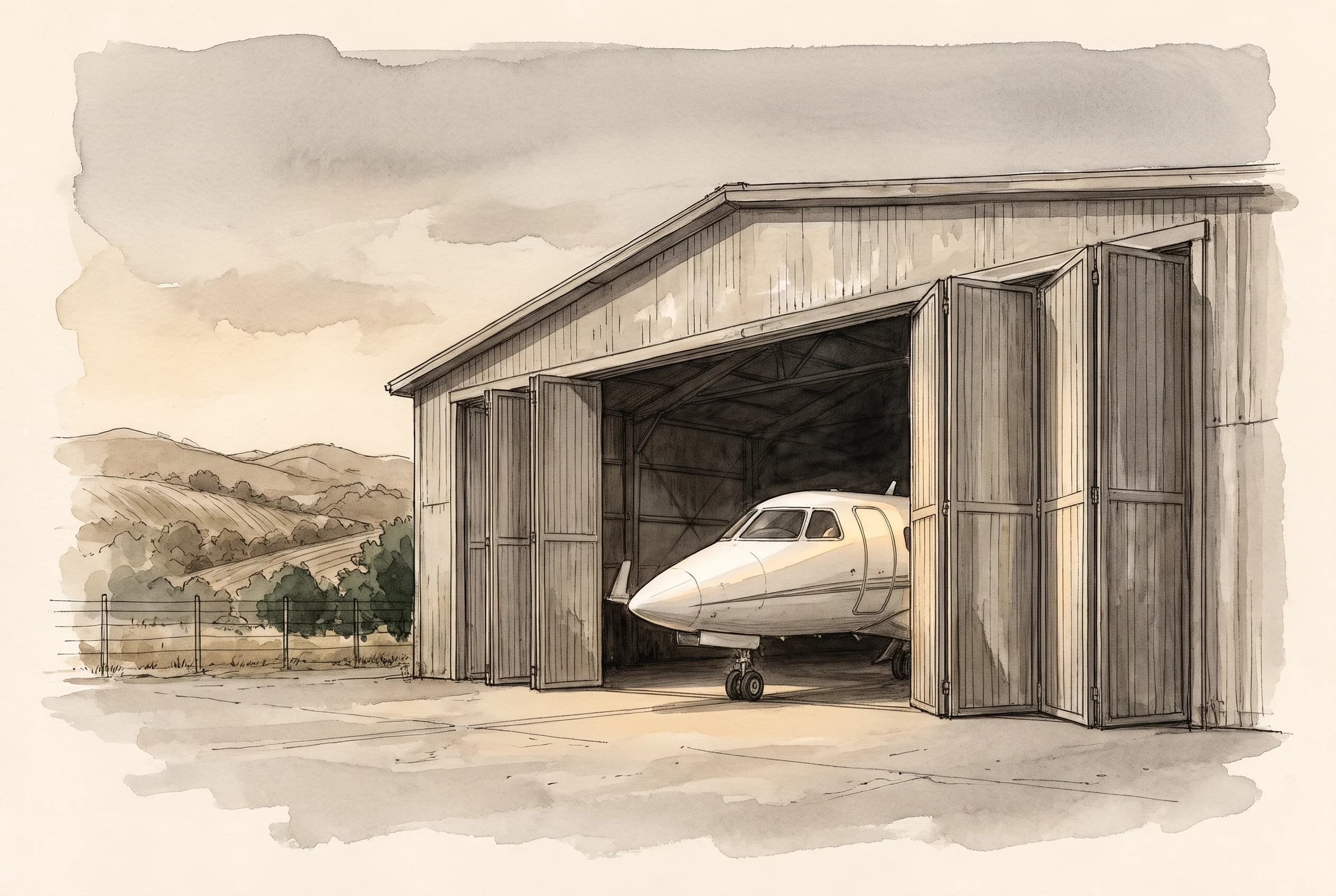
LAX remains an option, and the air time barely moves: from London Farnborough it is 5,001 nm (9,262 km) to Van Nuys against 5,013 nm (9,284 km) to LAX, a difference of two minutes of block time. Everything that changes, changes after the wheels stop. At LAX you are a small private movement inside a full commercial airport and you keep its rhythm. At Van Nuys you are the reason the field exists. Our guide to what sits inside a real charter quote explains where the ground time quietly goes.
Bel-Air or Beverly Hills: where should you stay?
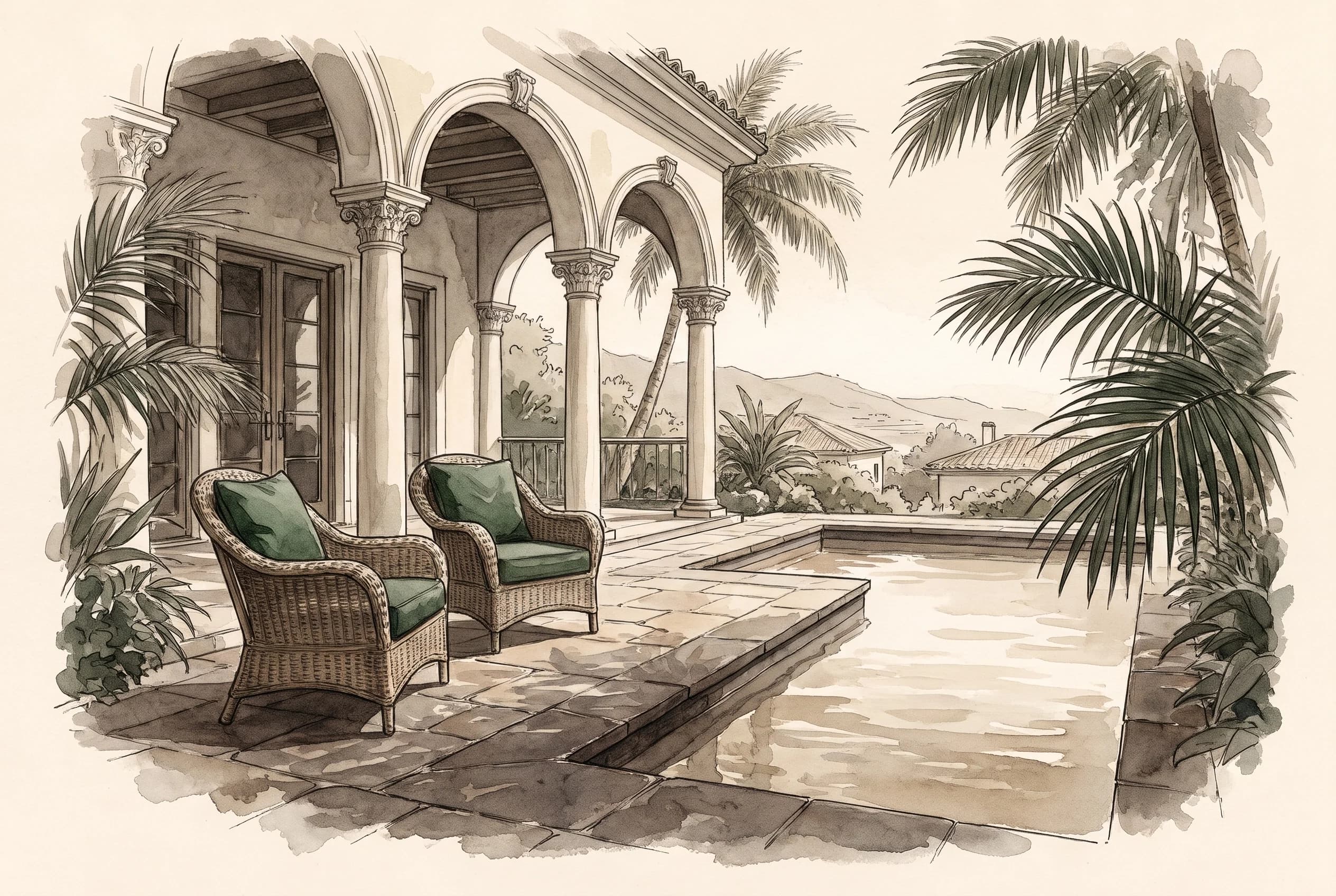
Choose Bel-Air if you want the city to vanish, Beverly Hills if you want to be inside it. They are ten minutes apart and belong to different centuries of Los Angeles. Bel-Air is a canyon address, reached by a road that narrows and curls under old sycamores until the noise of Sunset Boulevard is simply gone. Hotel Bel-Air, at 701 Stone Canyon Road, is the reference point: a landscaped estate with a lake, swans on it, gardens that were planted long enough ago to have weight, and an arrival across a stone bridge rather than through a lobby.
Beverly Hills is the opposite instinct. The Beverly Hills Hotel stands at 9641 Sunset Boulevard, Mediterranean Revival in style, pink against the palms, and it has been the city's living room since long before anyone used that phrase. Staying there means you are five minutes from the shops on Rodeo, ten from the restaurants of West Hollywood, and permanently in the current of the city. You will see people, and be seen, and some mornings that is exactly the correct ambition. Bel-Air gives you silence; Beverly Hills gives you access.
There is a third way, and for families and longer stays it is often the right one: a private house with staff, in the flats of Beverly Hills, above Benedict Canyon or out along the coast. The city is unusually well supplied with estates that come with a cook, a house manager and a pool that has the afternoon sun until seven. Taken by the week, a house changes the texture of a Los Angeles stay: breakfast on your own terrace, nobody in the corridor, the car arriving at your own gate.
Whichever you take, think about which direction you will be travelling each morning. A Bel-Air base points you naturally at the canyons, the Getty hill and the ocean road. A Beverly Hills base points you east, at the restaurants, the galleries and the studios. Choosing badly costs you an hour a day in a city where distances are measured in traffic lights, not miles.
What does a day in Los Angeles actually look like from the air down?
It runs west, and it runs with the light. The best Los Angeles days move from the canyons in the morning, to the flats around lunch, to the coast by late afternoon, because that is the order in which the light improves. Begin early: the hour after sunrise in Bel-Air or Mandeville Canyon is the one nobody photographs, when the marine layer is still on the hills, the eucalyptus smells like cold medicine and the roads belong to runners. Breakfast outside, under a jacaranda if it is May, is the single most underrated pleasure in the city.
Season matters more here than visitors expect. May and June bring the marine layer, grey until noon on the coast and clear in the canyons by ten, which is why the hills are the better base in early summer. The jacarandas turn whole streets violet for a few weeks in late spring. September and October are the city at its best and its most highly strung: hot, dry, the air polished by the Santa Ana winds, the ocean still warm enough to swim at six in the evening. Winter is green, short and often brilliant, with snow visible on the far mountains from a terrace in Bel-Air.
Mid-morning belongs to the hills above the Westside, where the museums and private collections sit with views back over the basin. Los Angeles rewards the appointment: collections viewed by arrangement, studios opened by a call, architecture that is otherwise a gate and a hedge. The city's great modernist houses are mostly private, and the ones that can be seen are seen quietly, with someone who knows the owner's schedule. A good local fixer is worth more here than any itinerary, and arranging one before you land is the difference between seeing Los Angeles and driving past it.
Eating well here is a matter of knowing the registers. The city does three things better than anywhere: the small Japanese counters where the chef works in near silence for ten seats, the Mexican tradition that runs from the family kitchens of the east side to the dining rooms of the Westside, and the Californian table built entirely out of the morning market, citrus, olive oil and whatever came out of the water that day. The right version is almost always the one that needed a call a month earlier, or a table arranged by someone who eats there weekly.
Lunch is late and light, somewhere with a courtyard. Then the afternoon turns toward the ocean. Pacific Coast Highway north from Santa Monica is the drive the city is built around, the hills on one side, the water flattening out on the other, and by four o'clock the light has gone the colour that explains why the film industry settled here rather than anywhere else. Malibu at that hour is not a beach town, it is a long window.
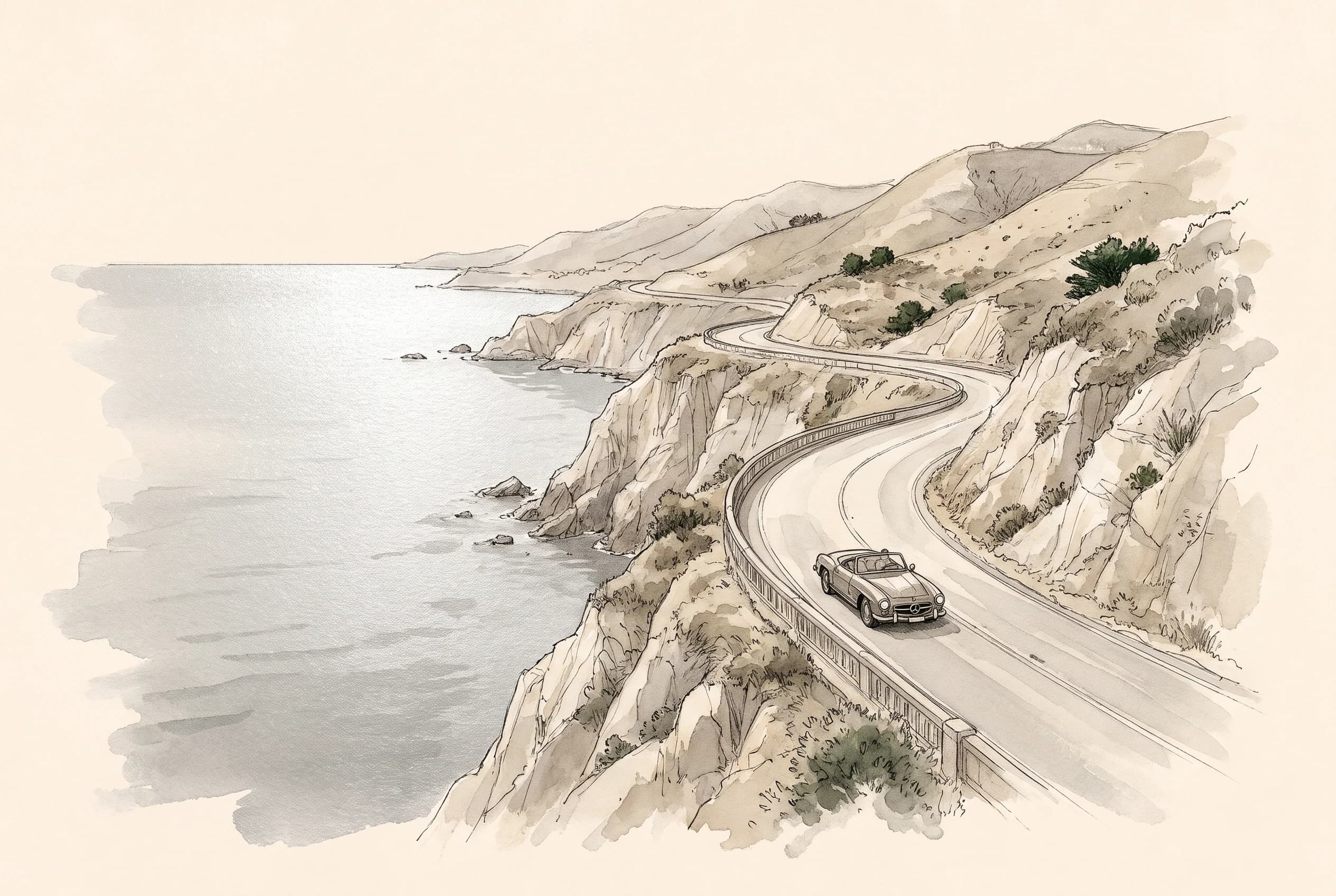
Dinner should be on the water. A table at Nobu Malibu, set above Surfrider Beach with the Pier in frame, is the version of the evening that people remember years later: the sea going silver, the kitchen sending out the cold dishes first, the temperature dropping fast enough that someone asks for a jacket around eight. Book it far ahead, request the terrace, and arrive for the last forty minutes of sun rather than after it. The sequence matters more than the menu.
If you are staying through the weekend, give one day entirely to the desert or the coast north of Point Dume and treat it as a different trip. Los Angeles is not a city you exhaust, it is a city you ration. The visitors who leave happiest are the ones who did four things properly rather than eleven things badly, and who understood that the drive between them is part of the experience, not a tax on it.
The Atljet Edit
Five addresses and terminals that settle most of the decisions before you land.
- Hotel Bel-Air, 701 Stone Canyon Road: an estate with a lake, swans and gardens old enough to feel inherited, reached across a bridge rather than through a lobby.
- The Beverly Hills Hotel, 9641 Sunset Boulevard: Mediterranean Revival, pink among the palms, and still the most efficient place in the city to be found by the people who need to find you.
- Nobu Malibu, Pacific Coast Highway: the terrace over Surfrider Beach and the Malibu Pier, booked ahead and timed for the last of the sun.
- Signature VNY-East, Van Nuys: the private terminal to request, open 24 hours a day and set on the side of the field closest to the Westside.
- Signature VNY-West and VNY-North, Van Nuys: the alternatives on the same airport when East is full or your hangar arrangement points elsewhere.
Los Angeles does not reward the grand gesture. It rewards knowing which side of the hills to land on.
Atljet Editorial
Arriving by air: the Van Nuys airport private terminal, flight times and the ride into the hills
Fly into Van Nuys (VNY) and request Signature VNY-East, which runs around the clock and sits nearest the Westside. From New York Teterboro the block time is about 5 hours 2 minutes on a Gulfstream G550; from London Farnborough it is roughly 10 hours 45 minutes nonstop on the same aircraft. The table below gives the current market picture by class, all figures estimates from Atljet market data for October 2026.
| Route | Class and type | Block time | Estimated price, one way |
|---|---|---|---|
| London Farnborough (FAB) to Van Nuys (VNY), 5,001 nm / 9,262 km | Ultra Long Range, Gulfstream G550 | 10 h 45 min | €161,500 to €219,600 |
| Paris Le Bourget (LBG) to Van Nuys (VNY), 5,197 nm / 9,625 km | Ultra Long Range, Gulfstream G550 | 11 h 10 min | €167,700 to €228,000 |
| Geneva (GVA) to Van Nuys (VNY), 5,431 nm / 10,058 km | Ultra Long Range, Gulfstream G550 | 11 h 39 min | €174,900 to €237,800 |
| New York Teterboro (TEB) to Van Nuys (VNY), 2,257 nm / 4,180 km | Midsize Jet, Citation XLS | 5 h 35 min | €38,100 to €48,600 |
| New York Teterboro (TEB) to Van Nuys (VNY), 2,257 nm / 4,180 km | Super Midsize Jet, Challenger 350 | 5 h 21 min | €46,700 to €59,700 |
| New York Teterboro (TEB) to Van Nuys (VNY), 2,257 nm / 4,180 km | Heavy Jet, Falcon 900 | 5 h 14 min | €58,400 to €79,600 |
| New York Teterboro (TEB) to Van Nuys (VNY), 2,257 nm / 4,180 km | Ultra Long Range, Gulfstream G550 | 5 h 02 min | €76,600 to €103,800 |
| Miami Opa-locka (OPF) to Van Nuys (VNY), 2,157 nm / 3,995 km | Super Midsize Jet, Challenger 350 | 5 h 08 min | €44,900 to €57,300 |
| Miami Opa-locka (OPF) to Van Nuys (VNY), 2,157 nm / 3,995 km | Heavy Jet, Falcon 900 | 5 h 01 min | €56,100 to €76,400 |
| Miami Opa-locka (OPF) to Van Nuys (VNY), 2,157 nm / 3,995 km | Ultra Long Range, Gulfstream G550 | 4 h 50 min | €73,700 to €99,800 |
Two readings of the table are worth making. On the transatlantic sectors, the choice between Van Nuys and LAX is worth two minutes and a few hundred euro, so choose on the ground experience, not the air time. On the domestic runs, a midsize and an ultra long range aircraft from Teterboro are separated by about thirty-three minutes of block time and a very different price, so the decision is about cabin and comfort across five hours rather than speed. Our comparison of light, midsize and heavy jets sets out how each class feels, and the heavy jet fleet covers the aircraft most used coast to coast.
Dubai is its own conversation. At 7,653 nm (14,173 km) to Van Nuys it is one of the longest sectors flown privately, and it is priced aircraft by aircraft according to payload, winds and whether a technical stop is wanted. Atljet market data carries no standing estimate for it in October 2026, so it is quoted individually.
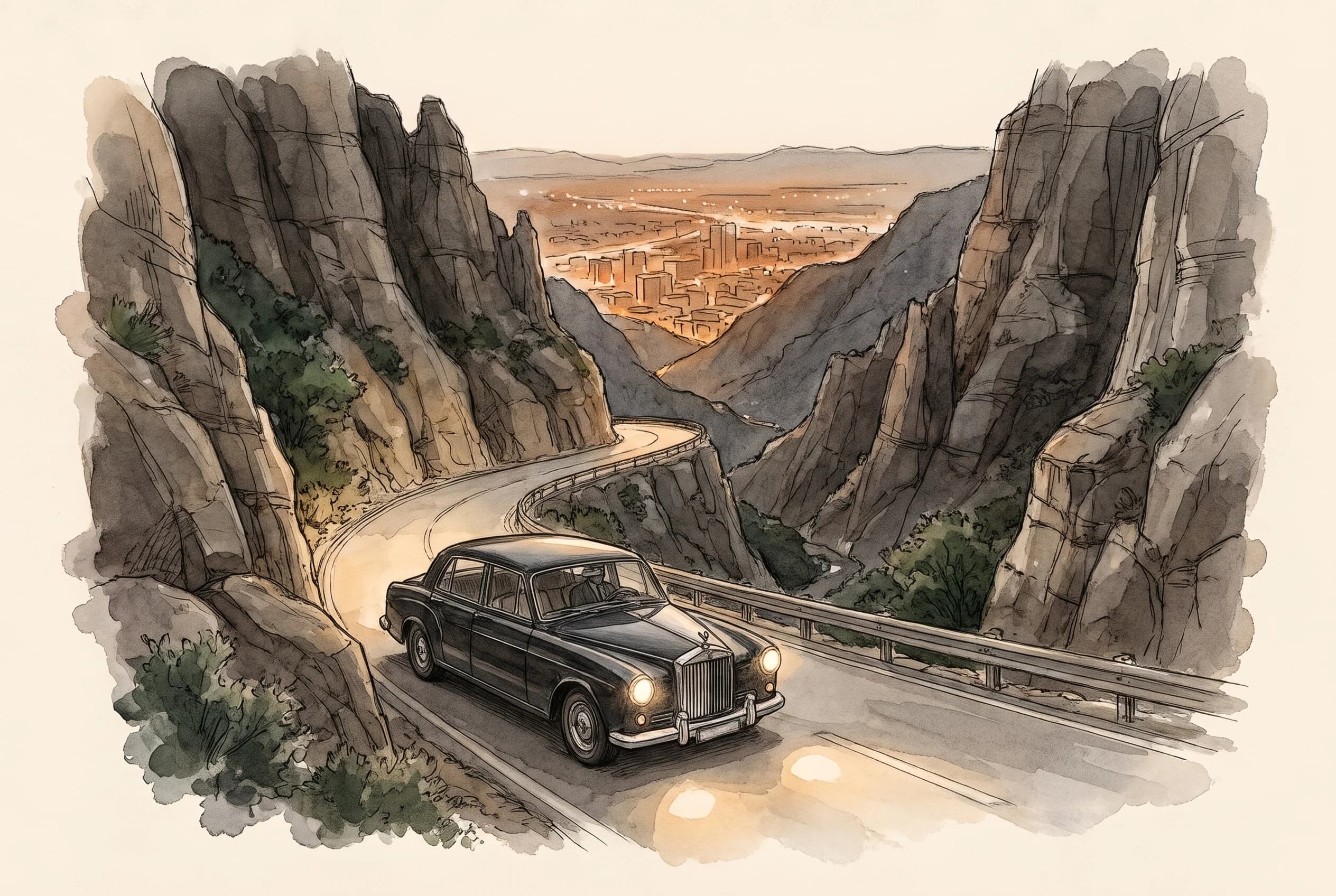
The last stretch is where Los Angeles is won or lost. From the ramp, a chauffeured car over Sepulveda Pass puts you in Bel-Air in about twenty minutes outside peak hours, or Beverly Hills in twenty-five to thirty-five. For Malibu, Montecito or a same-day move up the coast, a helicopter from the field removes the Pacific Coast Highway problem entirely. The Atljet flight desk can arrange that last stretch along with the flight, whether it is the car at the wingtip or the helicopter waiting beside it. For routing and timing, start at point to point charter.
Airports
Arriving by air
Los Angeles has one obvious answer for private arrivals and one default for everything else. Van Nuys handles the private traffic on its own field, with three dedicated terminals and no airline gates; LAX exists if a specific reason puts you there. The Atljet flight desk can hold the car on the ramp or a helicopter beside it for the run to the coast.
- VNY
- Van Nuys AirportThe private gateway to Los Angeles: no scheduled airline traffic, three private terminals, twenty to thirty-five minutes by car to Bel-Air and Beverly Hills.
- LAX
- Los Angeles International AirportThe commercial hub, operated by the same authority as Van Nuys. Worth two minutes of block time and little else for private arrivals.
| From | Distance | Light jet | Midsize jet | Heavy jet |
|---|---|---|---|---|
| London (FAB to VNY) | 5,001 nm (9,262 km) | Not non stop | Not non stop | Not non stop |
| Paris (LBG to VNY) | 5,197 nm (9,625 km) | Not non stop | Not non stop | Not non stop |
| Geneva (GVA to VNY) | 5,431 nm (10,058 km) | Not non stop | Not non stop | Not non stop |
| Dubai (DXB to VNY) | 7,653 nm (14,173 km) | Not non stop | Not non stop | Not non stop |
| New York (TEB to VNY) | 2,257 nm (4,180 km) | Not non stop | 5h 35m, €38,100 to €48,600 | 5h 14m, €58,400 to €79,600 |
| Miami (OPF to VNY) | 2,157 nm (3,995 km) | Not non stop | 5h 21m, €36,600 to €46,700 | 5h 01m, €56,100 to €76,400 |
Six days later, the same ramp at the same hour, the heat unchanged. The car stops at the wing, the bags go up, the door closes, and the Valley lets you go without comment, which is precisely the courtesy you came here for.
Questions people ask
- Which airport should I use for a private jet to Los Angeles?
- Van Nuys (VNY). It has no scheduled airline service, three private terminals and direct road access over the hills to Bel-Air, Beverly Hills and Hollywood. LAX works for private flights, but it puts you inside a full commercial airport for no gain.
- What is Van Nuys Airport used for?
- It is a public airport owned by the City of Los Angeles and operated by Los Angeles World Airports, given over almost entirely to business and private aviation. It opened on 17 December 1928 and sits in the Van Nuys neighbourhood of the San Fernando Valley.
- How long is a private flight from London to Los Angeles?
- About 10 hours 45 minutes nonstop from London Farnborough to Van Nuys on a Gulfstream G550, with an estimated price of €161,500 to €219,600 one way. Atljet market data, October 2026.
- How do you get from Van Nuys to Bel-Air or Beverly Hills?
- By chauffeured car over Sepulveda Pass or through Coldwater Canyon, roughly twenty to thirty-five minutes depending on the hour. For Malibu or a same-day return to the coast, a helicopter from the field is the cleaner answer.
- Is Dubai to Los Angeles possible nonstop?
- It is a very long sector at 7,653 nm (14,173 km) to Van Nuys and is flown case by case depending on aircraft, payload and winds. Atljet market data carries no standing estimate for that routing in October 2026, so it is quoted individually.
Questions on this guide? The flight desk answers within the hour.
Request options