Summary
- Block time on Le Bourget to Geneva runs from 61 minutes in a Citation Mustang to 49 minutes in a Gulfstream G550, an Atljet market data estimate for November 2026.
- Price bands for the same 234 nm (433 km) leg span €5,700 at the very light end to €18,400 at the ultra long range end, one way, per aircraft, Atljet market data, November 2026, estimate.
- Le Bourget is the only Paris field genuinely set up for business aviation; Orly and Charles de Gaulle save a minute of block time at best and cost far more in ground friction.
- Price moves with positioning, day of week and availability rather than distance, which is why the same aircraft on the same route quotes across a spread of several thousand euros over a year.
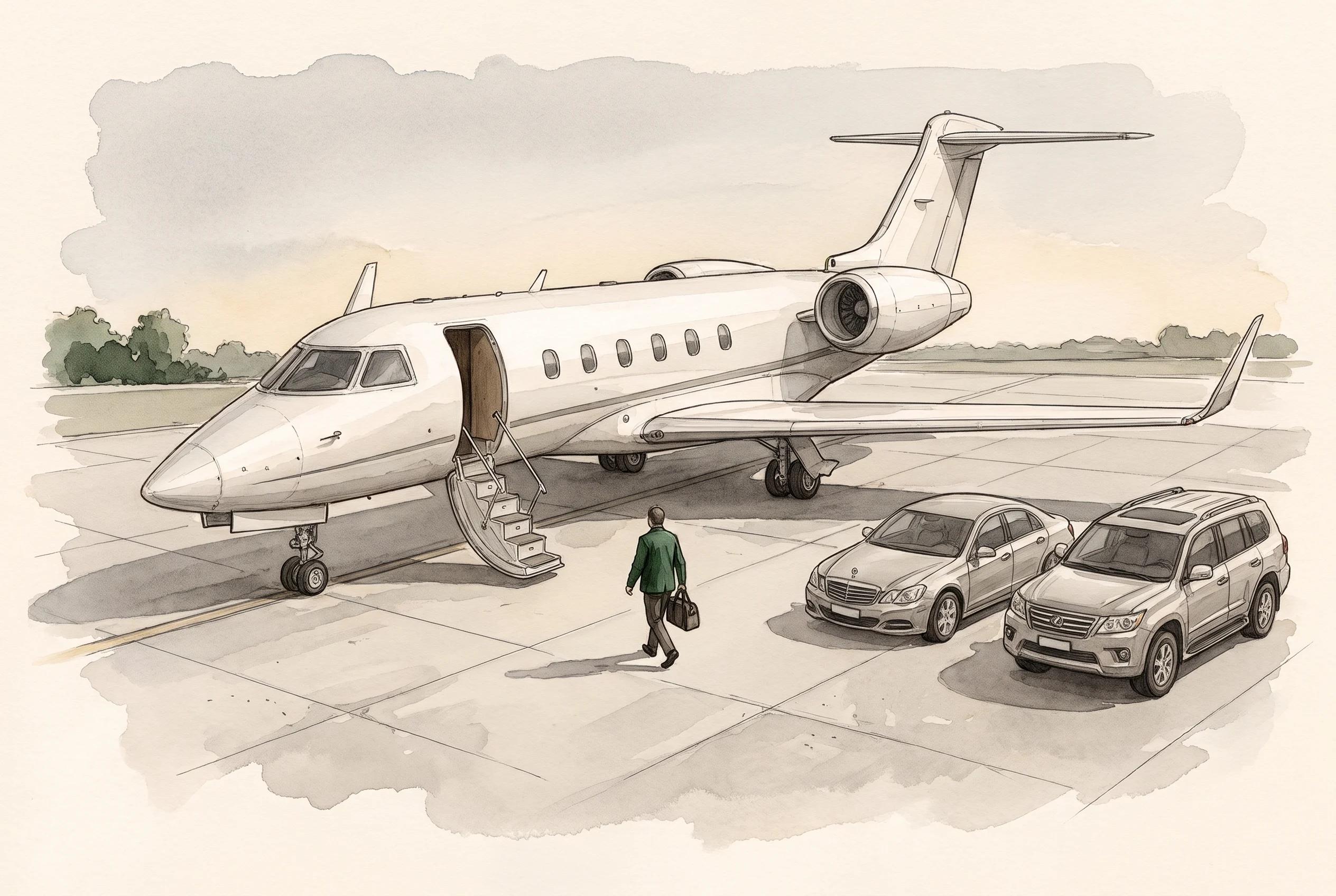
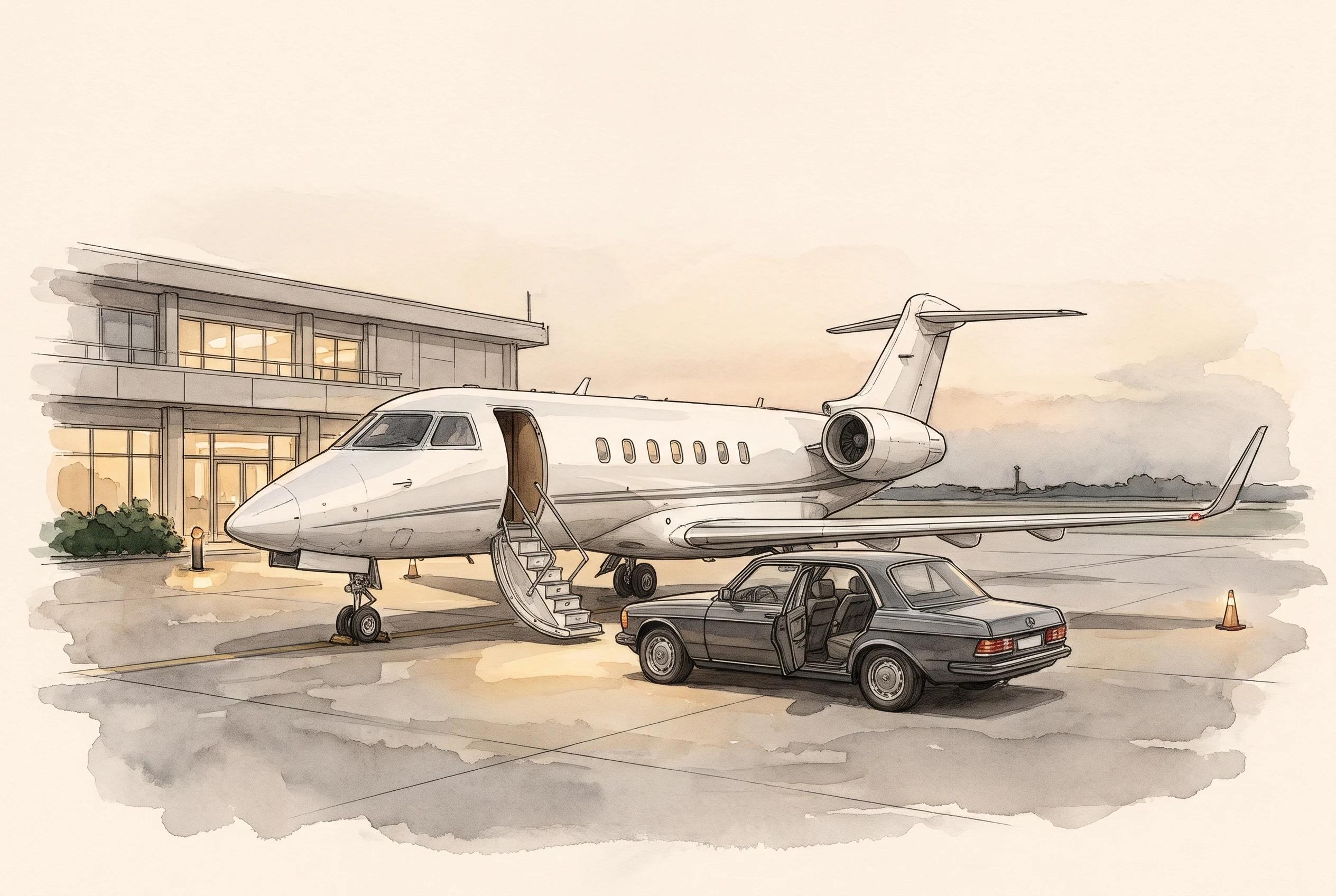
Seven fifteen on a Tuesday morning at Le Bourget, and the ramp is already working. A Challenger sits with its door down in the grey light, two cars drawn up at the wing, a handler walking the last bag across fifteen metres of wet apron. Inside the terminal nobody is queuing because there is nothing to queue for. At 07:31 the aircraft turns onto the taxiway. At 08:22 it is on the stand in Geneva, four kilometres from the centre of the city, and the first meeting of the day has not yet started. Fifty-one minutes, gate to gate. This is the shortest serious route in European business aviation, and the most instructive.
A private jet from Paris to Geneva takes roughly 49 to 61 minutes of block time depending on aircraft class, flying 234 nm (433 km) from Paris Le Bourget (LFPB) to Geneva (LSGG). Atljet market data for November 2026 puts the one way estimate between €6,400 and €7,800 for a light jet such as the Citation CJ3, and between €9,000 and €11,100 for a super midsize Challenger 350. Le Bourget is the departure field that matters: Charles de Gaulle and Orly are commercial airports where general aviation access is permit based and rarely worth the friction.
A private jet from Paris to Geneva takes roughly 49 to 61 minutes of block time depending on aircraft class, flying 234 nm (433 km) from Paris Le Bourget (LFPB) to Geneva (LSGG). Atljet market data for November 2026 puts the one way estimate between €6,400 and €7,800 for a light jet such as the Citation CJ3, and between €9,000 and €11,100 for a super midsize Challenger 350. Le Bourget is the departure field that matters: Charles de Gaulle and Orly are commercial airports where general aviation access is permit based and rarely worth the friction.
How long does it actually take to fly Paris to Geneva?
Between 49 and 61 minutes of block time, which is less spread than most people expect. Atljet market data for November 2026 gives 61 minutes for a Citation Mustang, 55 for a Citation CJ3, 53 for a Citation XLS, 51 for a Challenger 350 and a Falcon 900, and 49 for a Gulfstream G550. The leg is 234 nm (433 km) by the routing the market prices against; the great circle line between the two fields is shorter still, around 221 nm (409 km), calculated from the coordinates both airports publish. That gap of thirteen nautical miles is the air traffic system doing its job.
On a sector this short the aircraft barely finishes climbing before it starts down. A G550 and a Mustang are separated by twelve minutes, not by the hour and a half their cruise speeds would suggest over an Atlantic crossing. Speed stops paying on short legs. What you buy with the larger cabin is standing height, a proper lavatory and the ability to hold a conversation at the back without raising your voice, none of which shows up on the clock. For a single passenger with a briefcase, those twelve minutes separate two price bands that start around €8,300 apart in the November 2026 estimates.
The figures are block times, not flight times, which is the distinction that catches people out. They include taxi at both ends. Le Bourget's apron to runway run is short by the standards of a commercial hub; Geneva's single runway means arrivals and departures share one strip, and in the winter season, when Alpine traffic peaks, holding can add minutes that no table predicts. Treat the numbers as a planning estimate, not a timetable. Our comparison of light, midsize and heavy jets explains where those minutes go.
Which Paris airport should the aircraft use: Le Bourget, Charles de Gaulle or Orly?
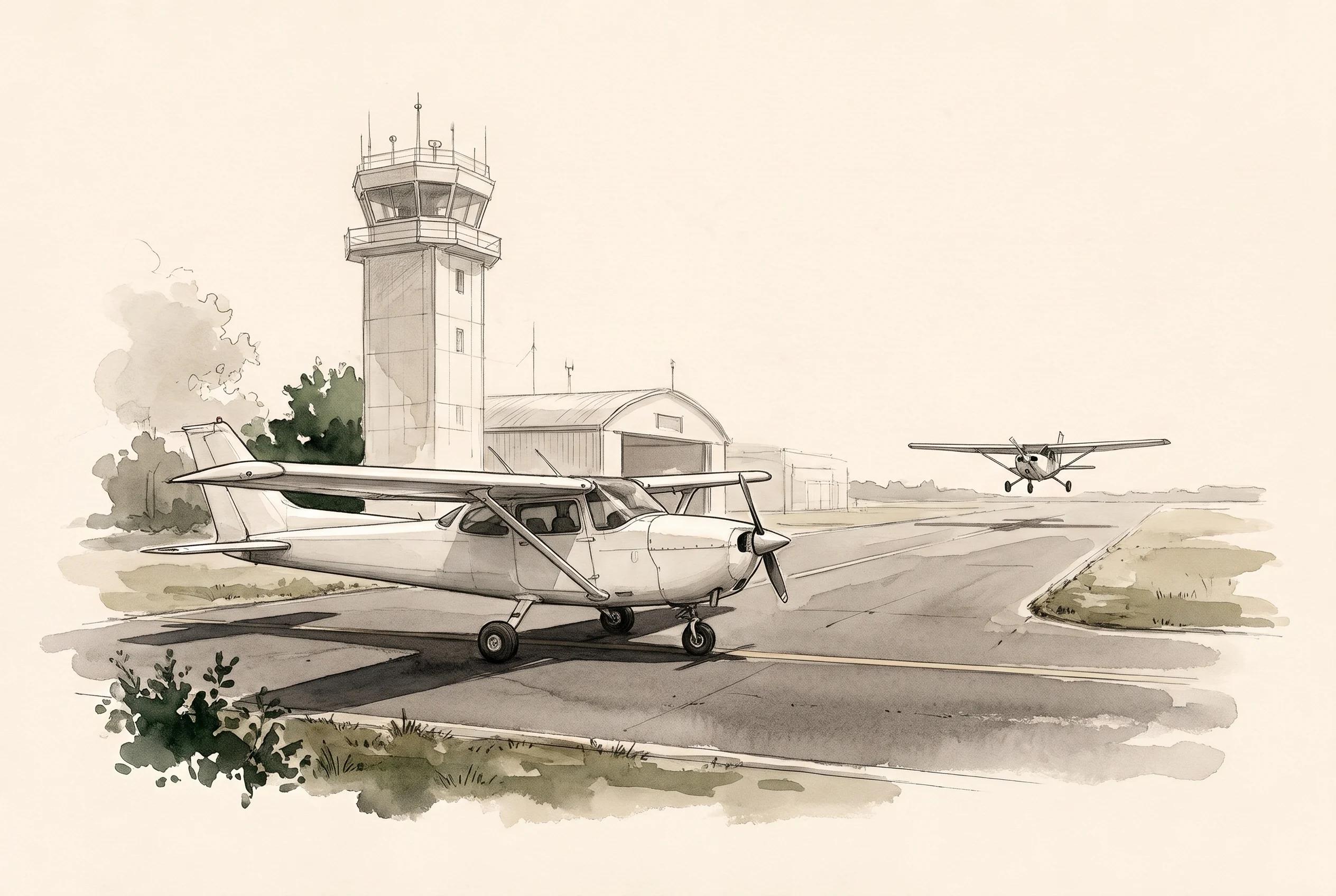
Le Bourget, in almost every case. Paris Le Bourget (LFPB, IATA LBG) sits 13 km northeast of central Paris, across Seine-Saint-Denis and Val d'Oise, and is managed by Groupe ADP, as the French airport noise authority ACNUSA records. It is the only Paris field fully dedicated to general aviation. Three runways, 2,665 m, 3,000 m and 1,845 m, cover everything from a very light jet to a large-cabin airliner. Several FBOs compete on the same apron, which keeps the ground experience sharp.
Charles de Gaulle (LFPG) and Orly (LFPO) are built around scheduled traffic. General aviation access at Charles de Gaulle is limited to passengers connecting onto airline flights or to special permits, and Orly applies comparable restrictions. A large-cabin charter can sometimes be accommodated with a permit and a valid operational reason, but the paperwork, the parking scarcity and the walk through a commercial environment undo the point of flying privately in the first place. Paris Aéroport runs all three fields; only one of them is designed for this.
The ground side is where the real variance hides. The drive between central Paris and Le Bourget or Charles de Gaulle can take twenty minutes or an hour and a half depending on traffic, a spread wider than the flight itself. A client leaving the eighth arrondissement at eight in the morning and a client leaving at eleven are buying two different journeys. On a same-day return to Geneva, the car is the variable worth managing, not the aeroplane.
What does a private jet from Paris to Geneva cost by aircraft class?
Atljet market data for November 2026 estimates one way prices on Le Bourget to Geneva from €5,700 for a very light jet to €18,400 at the top of the ultra long range band. The figures below are per aircraft, one way, and are market estimates rather than firm quotes: the price of any single flight depends on which aircraft is where on the day. The return leg, Geneva to Le Bourget, prices identically in the same dataset, which tells you something about how balanced the traffic on this corridor is.
| Class | Representative type | Block time | Estimate, one way |
|---|---|---|---|
| Very Light Jet | Citation Mustang | 61 min | €5,700 to €6,800 |
| Light Jet | Citation CJ3 | 55 min | €6,400 to €7,800 |
| Midsize Jet | Citation XLS | 53 min | €7,600 to €9,300 |
| Super Midsize Jet | Challenger 350 | 51 min | €9,000 to €11,100 |
| Heavy Jet | Falcon 900 | 51 min | €11,100 to €14,500 |
| Ultra Long Range | Gulfstream G550 | 49 min | €14,000 to €18,400 |
Read the table as a curve, not a ladder. The step from very light to light costs around €700 at the bottom of each band and buys you four to six passengers in comfort instead of three in tolerance. The step from light to midsize costs another €1,200 and buys a cabin you can stand in. After that the curve steepens sharply: super midsize to heavy adds €2,100 at the low end, heavy to ultra long range another €2,900, for a sector of fifty minutes where neither range nor speed can be used. On this route, the midsize is the commercial sweet spot.
The Orly variant is worth noting for the return. Geneva to Orly measures 226 nm (419 km) in the same dataset, one minute quicker in a light jet at 54 minutes, with a band of €6,300 to €7,700. Geneva to Charles de Gaulle runs 233 nm (432 km) and matches Le Bourget on time and price in most classes. The differences are inside the noise. Choose on ground access, never on the fare.
Why does the same route price differently from one week to the next?
Because you pay for time and position, not for distance. The 234 nm between Le Bourget and Geneva is a constant; everything else moves. If the aircraft you want is already in Paris on Tuesday evening, the quote sits at the bottom of the band. If it has to fly empty from Nice to collect you, the positioning sectors can exceed the revenue leg and the quote climbs toward the top, or past it. Over a year, the same Challenger 350 on the same route will quote across a spread of several thousand euros, and nothing about the route will have changed.
- Positioning: the empty sectors before and after your flight, usually the largest single variable on a short European leg.
- Day and hour: Friday afternoons out of Paris and Sunday evenings out of Geneva are the two tightest windows in the corridor.
- Season: the winter Alpine months pull heavy traffic into Geneva, which thins the pool of aircraft available at short notice.
- Crew duty: a late Geneva departure may require the crew to night-stop, and that cost lands in your quote.
- Geneva parking: when the ramp fills, an operator that has to reposition after dropping you off builds that sector into the price.
On a fifty minute sector, the aircraft is the smallest part of the problem. Where it slept last night is the biggest.
Atljet Editorial
This is why a quote that arrives within the hour is worth more than a published rate card. Rate cards average away the one thing that actually determines your price. Our piece on why private jets cost more on Fridays takes the demand side of the same mechanism apart in detail, and the structure of point to point charter shows where positioning sits in the final number.
What happens on the Geneva side of the route?
Nothing complicated, which is the route's quiet advantage. Geneva Airport (LSGG, IATA GVA) is a single-field city: there is no second airport decision on arrival, no trade-off between convenience and capability. It sits at 430 m elevation, roughly 4 km from the city centre, is owned by the Canton of Geneva and operated by Genève Aéroport. One concrete runway, 04/22, 3,900 m long, which accommodates the entire spectrum of business jets up to ultra long range types without qualification.
That single runway is also the constraint. Arrivals and departures share it, and in the high Alpine season the ramp fills with aircraft that have come for the mountains rather than the city. Parking becomes the scarce resource, not runway capacity, and operators plan around it by dropping passengers and repositioning elsewhere. For the passenger this is invisible; for the price it is not, because a repositioning sector after drop-off is billed somewhere.
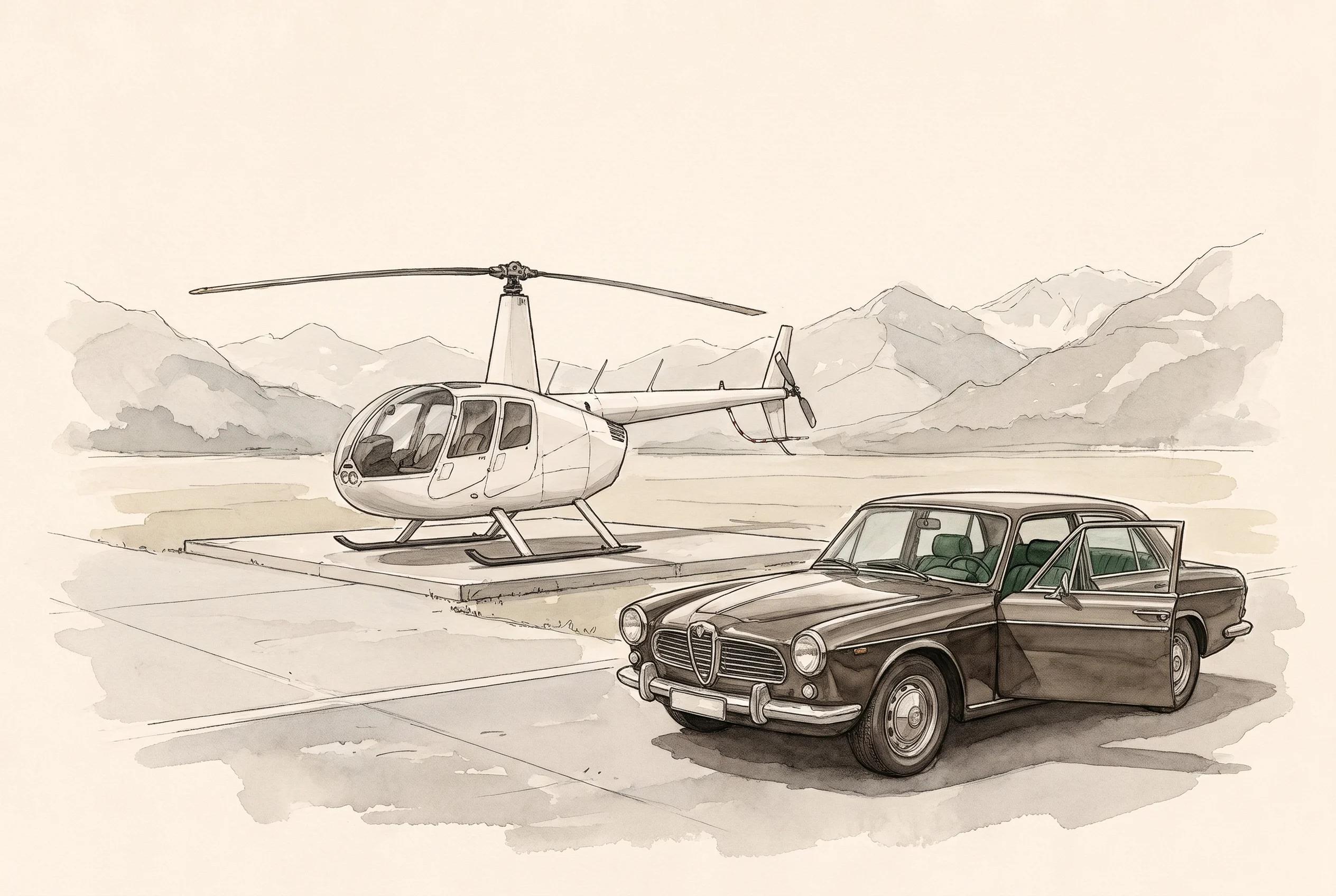
Four kilometres from the stand to the centre of Geneva means a car covers the last stretch quickly outside rush hour. For those continuing into the Alps, the helicopter transfer straight off the field is the standard move. Our flight desk can arrange that final leg as part of the booking, whether it is a helicopter into the mountains, a chauffeured car to the lakeside or a boat if the house sits on the water.
Is Paris to Geneva a realistic empty leg route?
More realistic than almost any other European city pair. The corridor carries dense corporate and private traffic in both directions, year round, which means aircraft are constantly finishing a job at one end and needing to be at the other. Atljet market data for November 2026 prices the two directions identically, 234 nm (433 km) and the same bands by class, and that symmetry is exactly the condition under which empty legs appear with regularity rather than as a lottery.
The trade is fixed terms. An empty leg comes with the operator's date, the operator's departure window and the operator's aircraft. You may be offered a Falcon 900 when you wanted a CJ3, or an 11:40 departure when you wanted 09:00. For a passenger with a flexible morning, the saving against the standard band is substantial. For a passenger with a board meeting at noon, it is a distraction. We keep a running view of what is moving on the corridor at empty legs, and the mechanics of the system are explained in full elsewhere in the Journal.
One practical note for anyone treating this route as a commuter line. The economics improve markedly when the same aircraft waits for you. A same-day return, Paris out at eight and Geneva back at six, is billed as one aircraft day rather than two separate charters, and the ground time in Geneva costs a fraction of two positioning cycles. The heaviest users of this corridor worked that out years ago, which is why the Le Bourget apron empties and refills on the same rhythm every weekday.
Back on the ramp at Le Bourget, the Challenger that left at 07:31 is on the schedule to return at 18:50. The handler who walked the bags across in the morning will be there again, the cars will be drawn up at the wing in the same place, and the whole day will have cost a little under three hours of actual travel. Fifty-one minutes each way, and Geneva treated as a suburb. That is what the numbers on this route are really describing.
Questions people ask
- How long is a private jet flight from Paris to Geneva?
- Between 49 and 61 minutes of block time on the 234 nm (433 km) leg from Le Bourget (LFPB) to Geneva (LSGG), depending on class. Atljet market data for November 2026 estimates 61 minutes in a Citation Mustang, 55 in a Citation CJ3, 51 in a Challenger 350 and 49 in a Gulfstream G550. Time in the air is shorter; the figures include taxi at both ends.
- How much does a private jet from Paris to Geneva cost?
- Atljet market data for November 2026 estimates €5,700 to €6,800 one way for a very light jet, €6,400 to €7,800 for a light jet, €7,600 to €9,300 for a midsize, €9,000 to €11,100 for a super midsize, €11,100 to €14,500 for a heavy jet and €14,000 to €18,400 for ultra long range. Prices are per aircraft, not per seat, and are market estimates rather than quotes.
- Which Paris airport should I use for a private jet to Geneva?
- Le Bourget (LFPB), 13 km northeast of central Paris. It is the one Paris airport fully dedicated to general aviation, with multiple FBOs, three runways and apron parking. Charles de Gaulle and Orly handle mainly scheduled traffic and restrict general aviation access to permits or connecting passengers.
- Is an empty leg realistic on the Paris to Geneva route?
- Yes, more so than on most European city pairs. The corridor carries dense corporate and private traffic in both directions, so aircraft frequently need to reposition between the two fields. The trade is flexibility: the date, departure time and aircraft are fixed by the operator's schedule.
- Does flying into Orly instead of Le Bourget change the numbers?
- On the return leg, marginally. Atljet market data for November 2026 shows Geneva to Orly at 226 nm (419 km) and 54 minutes in a light jet against 234 nm (433 km) and 55 minutes to Le Bourget, with bands up to €500 lower in the larger classes. The access restrictions at Orly usually cancel out that advantage.
Questions on this guide? The flight desk answers within the hour.
Request options