
Summary
- A private jet changes where the pet check happens, usually at the FBO beside the aircraft, not what is checked.
- The microchip must be implanted before the rabies vaccination. Reversed, the vaccination does not count and the clock restarts.
- Great Britain requires an approved route, 21 full days after the primary rabies vaccination and tapeworm treatment for dogs 24 hours to 5 days before arrival.
- Switzerland clears third country pets through Geneva or Zurich only, and the UAE caps personal pet imports at two animals per person per year.
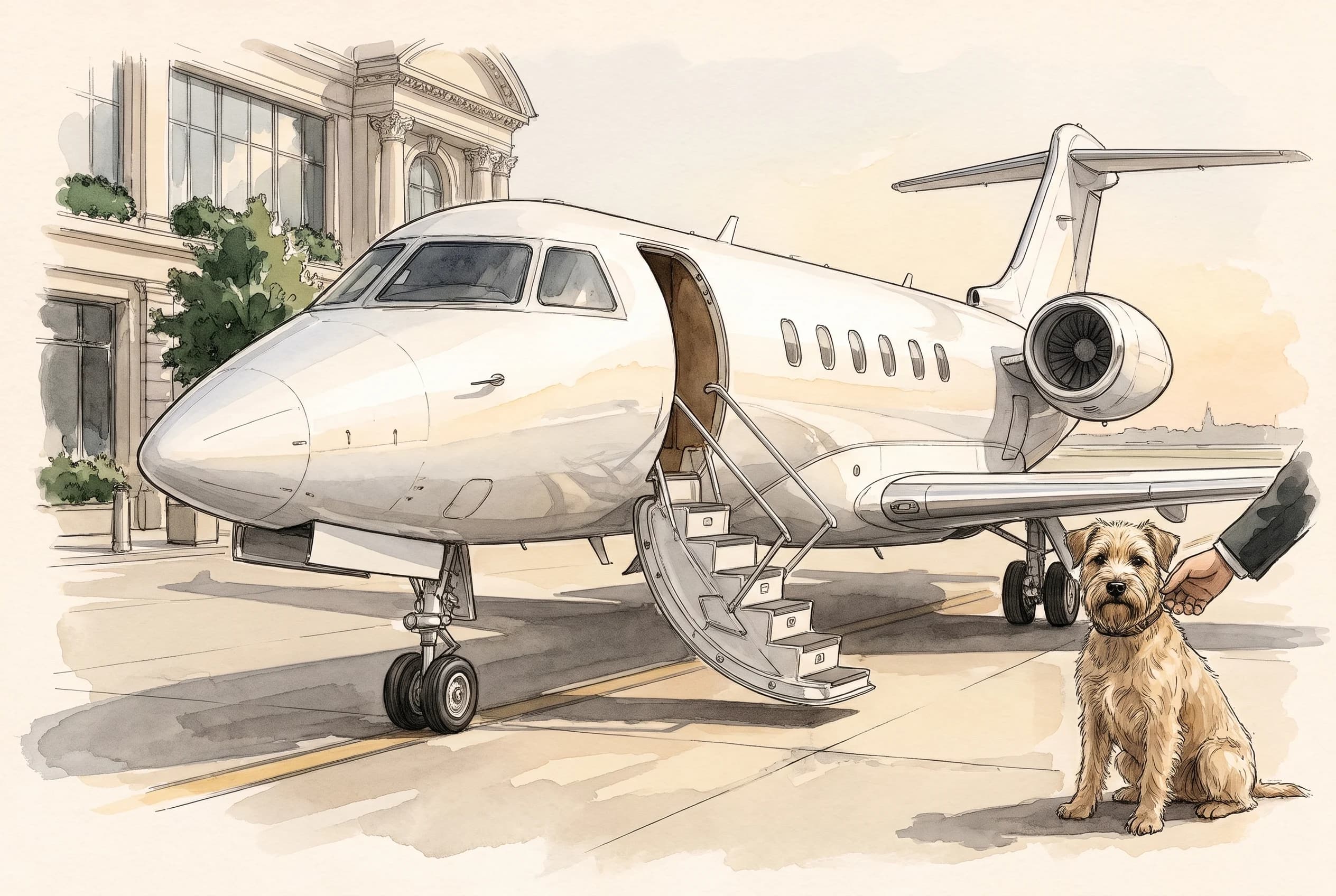
Seven minutes past nine at a London private terminal. The jet's door is open, the steps are down, and nobody is moving yet. A Border Force officer holds a scanner against the shoulder of a wheaten terrier, waits for the beep, reads fifteen digits off the screen and matches them, one by one, against the line on the animal health certificate. The dog yawns. Four minutes later the car pulls away towards the M25. The whole thing was settled three weeks earlier, in a veterinary surgery in the 7th arrondissement, by the order in which two procedures were carried out.
Flying with pets on a private jet removes the cargo hold, the terminal and the queue, but it does not remove the destination country's import regime. Great Britain, the EU, Switzerland, the United States and the UAE each require their own combination of microchip, rabies vaccination, waiting period and certification, and an aircraft cannot shorten any of it. In practice the travel date is set by your veterinary calendar, not by the charter desk.
What rules actually control flying with pets on a private jet?
Three separate rule sets decide whether the animal travels. First, the import regime of the country you are landing in, which is set by government and is not negotiable. Second, the policy of the operator whose aircraft you have chartered. Third, on a managed aircraft, the consent of the owner. The first is the one that ruins travel dates. The second and third are usually settled in a single phone call at the quoting stage, which is why the pet should be named in the request from the beginning, with breed, weight in lb and kg, and whether it will travel loose or in a crate.
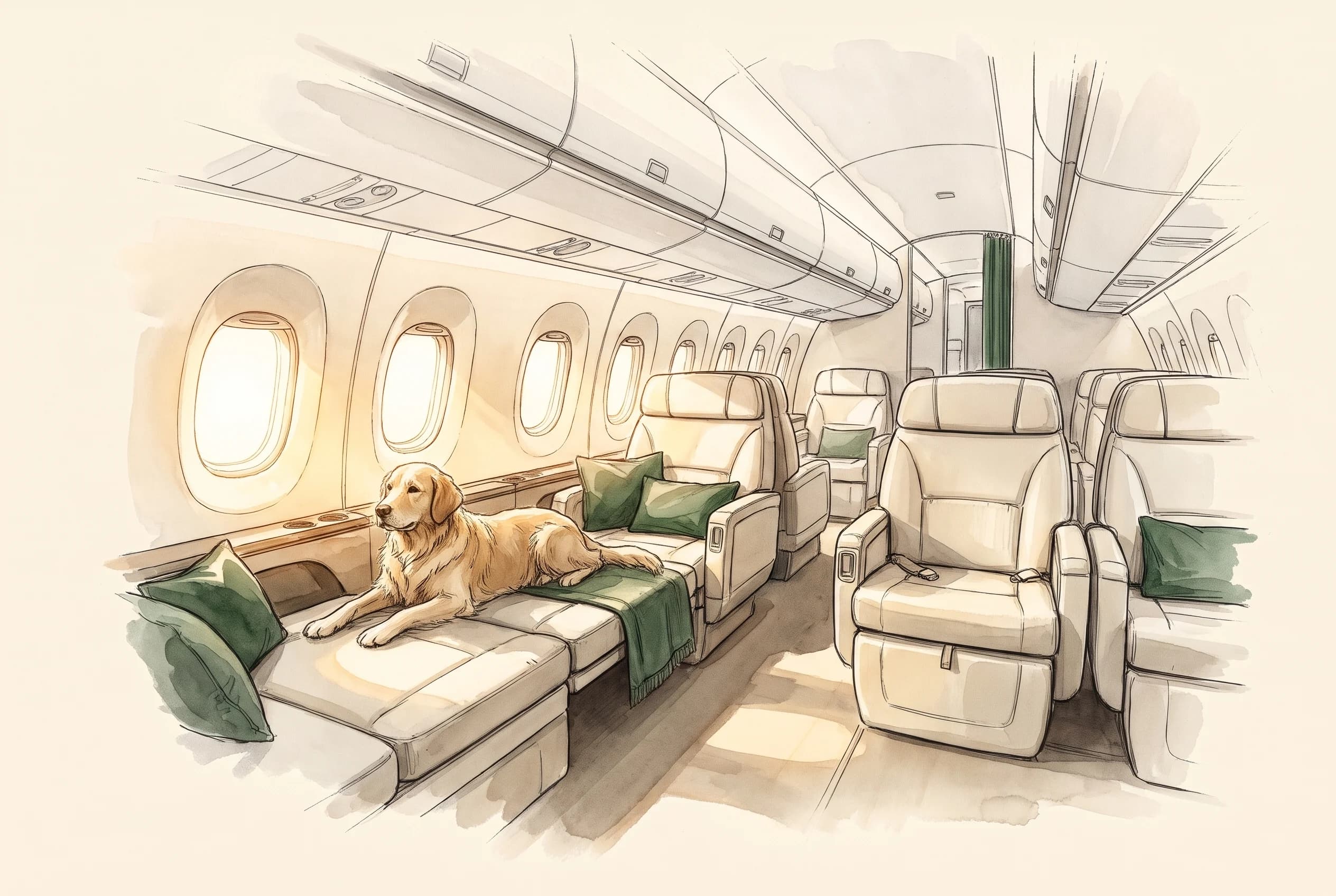
What the aircraft genuinely changes is the experience. There is no cargo hold, no separate check-in, no hours in a crate on a ramp. The animal walks to the aircraft with the family, usually travels in the cabin, and the border and veterinary checks take place beside the steps at the private terminal rather than in a public arrivals hall. For a nervous dog, or an elderly cat, that difference is the whole reason people charter in the first place. For a full picture of how the morning runs, see our guide to the departure day timeline, and how an Atljet charter is arranged.
What the aircraft cannot change is the calendar. Nearly every regime in this guide rests on the same sequence: the microchip first, the rabies vaccination second, then a waiting period, then the documents. Reverse the first two and the vaccination is not recognised at the border, whatever the vet's stamp says. It has to be given again, after a new chip, and the waiting period starts from zero.
What does the UK require before a pet can land?
Great Britain is the most prescriptive of the destinations in this guide, and the most expensive to get wrong. To bring a dog, cat or ferret in, the animal must travel on an approved route, be microchipped before its rabies vaccination, wait at least 21 full days after that primary vaccination, and carry the correct travel document for the country it is departing from. Dogs additionally need tapeworm treatment administered by a vet between 24 hours and 5 days before arrival, with a short list of exceptions. All of this is published by the UK government, and the officer at the aircraft is working from exactly that list.
The penalty is the point. A pet that does not comply can be placed in quarantine for up to four months, can be refused entry if arriving by sea, and the owner pays the fees. Banned dog breeds cannot enter at all without a valid Certificate of Exemption, and no amount of charter arrangement alters that. The 21 day rule in particular catches families who buy a puppy abroad in the spring and expect to bring it home the following weekend.
There is a second trap, and it is administrative rather than medical. If more than five pets travel together, if an animal is being sold or rehomed, or if it arrives more than five days apart from its owner, the movement stops being pet travel and becomes a commercial import under the stricter Balai rules, with different paperwork and different checks. A household relocating with six animals is in that category. So is a dog sent ahead with the staff while the family follows on a later flight.
How does the EU Pet Passport work for private travel?
Inside the European Union the system is deliberately simple: a microchip, a rabies vaccination given by an authorised vet, an EU pet passport for dogs, cats and ferrets, and the animal travelling with its owner. The European Commission sets the framework and member states apply it. Once the passport is issued, it covers onward movement across the Union, which is why a family spending a week between Le Bourget, Linate and Ibiza presents one booklet rather than three files.
The complication arrives from outside. Certain entries into the EU from third countries additionally require a rabies antibody titration test, a blood test proving the vaccination worked, with the laboratory result attached to the EU health certificate. The sample has to be drawn after the vaccination, the laboratory has to process it, and the result has to be transcribed correctly. This is the requirement that most often moves a departure from one month to the next, and it is the first thing to check when the itinerary starts anywhere other than an EU member state.
A charter can be arranged in four hours. A rabies vaccination that counts cannot.
Atljet Editorial
Why are Switzerland and Spain stricter cases?
Switzerland sits outside the EU and runs its own version of the scheme. Coming from an EU country, a pet generally needs a microchip, a valid rabies vaccination and a recognised pet passport. Coming from a third country, the requirement steps up: a health certificate and an ownership declaration issued by the official veterinary service of the country of origin, and a border veterinary check that can only be carried out at Geneva or Zurich airport. The rules are published by the Swiss Federal Food Safety and Veterinary Office.
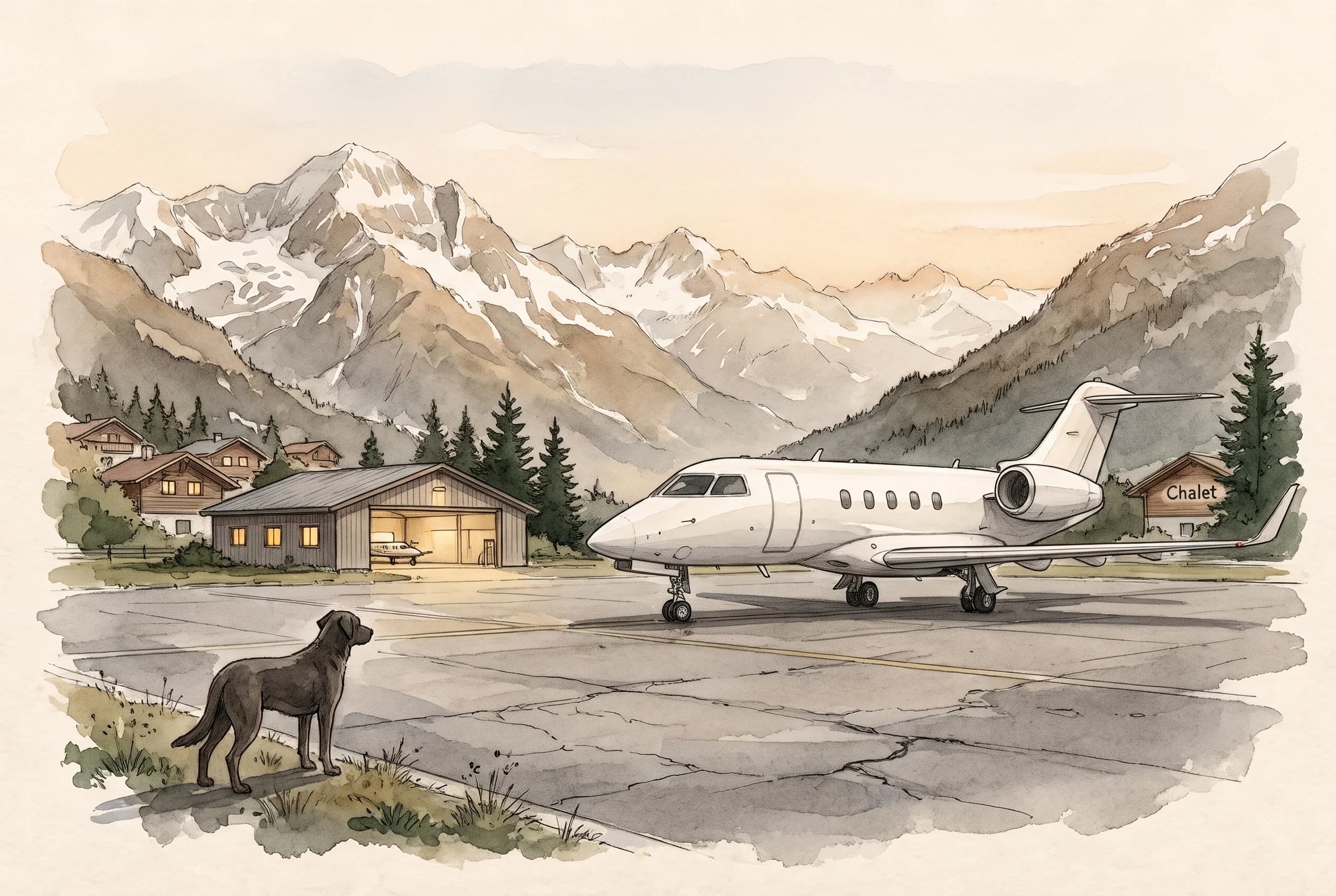
That last detail is the one with operational consequences. If you are arriving from outside the EU with a dog and had planned to land at a smaller Swiss field closer to the chalet, the pet requires Geneva or Zurich, and the final leg becomes a drive or a helicopter. Owners who settle in Switzerland have a further obligation that has nothing to do with the flight: dogs must be registered with the municipality, which levies the dog tax. It is a small formality, and it is the one newcomers forget.
Spain's strictness is narrower but absolute. The country refuses entry to any dog, cat or ferret under 15 weeks old that does not hold a valid rabies vaccination, with no exceptions and no discretionary waiver. Since the vaccination itself cannot be given at birth and is followed by a waiting period, a very young animal simply cannot fly to Spain yet. Families collecting a puppy before the summer should plan the first journey, not the second, around that single number.
- Microchip first, vaccination second. Get the two dates confirmed in writing by the vet.
- Great Britain: approved route, 21 full days after the primary rabies vaccination, tapeworm treatment for dogs 24 hours to 5 days before arrival.
- European Union: one pet passport covers onward travel between member states when the animal is with its owner.
- Switzerland: third country arrivals clear the veterinary check at Geneva or Zurich, nowhere else.
- UAE: import permit obtained before departure, and no more than two animals per person per year.
What do the UAE and the United States require?
The UAE requires an import permit obtained before departure, not a document presented on arrival. The permit is issued by the ministry responsible for climate change and environment, and personal imports are capped at two pets per person per year. The Emirates are not part of the European scheme, so an EU pet passport does not substitute for the permit at any stage. Read the conditions written into the permit against your own animal before the date is fixed: the details have to match exactly.
On arrival at Dubai International the animal is inspected against the conditions written on that permit. This is a document exercise more than a veterinary one, which means the quality of the paperwork decides how long you stand on the apron. Families relocating with three dogs discover the two animal cap late and painfully, often after the furniture has already shipped.
For the United States the surprise is institutional. The lead authority for dog imports and returns is the CDC, not the Department of Agriculture, although the USDA's accredited vets do the certifying. A dog vaccinated in the United States that has spent time in a high risk rabies country within the previous six months needs a Certification of U.S.-Issued Rabies Vaccination, completed by a USDA-accredited vet and filed before departure. Guidance is published by USDA APHIS. A dog that summered in a listed country and is flying home in September falls squarely inside that rule, and the certification cannot be produced at the aircraft.
Arriving by air: airports, flight times and the real cost
The pet decides the airport more often than the passengers do. Around London, Biggin Hill (EGKB/BQH) and Farnborough (EGLF/FAB) are the usual private arrival points, with the border and document check carried out at the private terminal beside the aircraft. In Switzerland, third country pet arrivals go through Geneva (LSGG/GVA) or Zurich (LSZH/ZRH) because that is where the veterinary check exists. In the Emirates, Dubai International (OMDB/DXB) is the port of entry where the import permit is matched to the animal.
The animal itself has almost no effect on the price. What you pay for is block time, the aircraft class and the route, exactly as on any other trip, which we set out in detail in our piece on the anatomy of a real charter quote. A dog in the cabin adds no fuel worth measuring. What it can add is a cleaning charge, or the preference of an owner whose aircraft has pale wool carpet, which is one reason the fleet category is sometimes chosen for its interior rather than its range.
| Route | Distance | Class and type | Block time | Estimated price, one way |
|---|---|---|---|---|
| Paris Le Bourget (LBG) to London Biggin Hill (BQH) | 180 nm (333 km) | Light Jet, Citation CJ3 | 47 min | €5,700 to €7,000 |
| Milan Linate (LIN) to Zurich (ZRH) | 132 nm (244 km) | Light Jet, Citation CJ3 | 40 min | €5,100 to €6,200 |
| Geneva (GVA) to London Farnborough (FAB) | 431 nm (798 km) | Midsize Jet, Citation XLS | 1 h 20 min | €10,500 to €13,100 |
| Zurich (ZRH) to London Biggin Hill (BQH) | 430 nm (796 km) | Super Midsize Jet, Challenger 350 | 1 h 17 min | €12,600 to €15,800 |
| London Farnborough (FAB) to Dubai International (DXB) | 3,157 nm (5,847 km) | Heavy Jet, Falcon 900 | 7 h 12 min | €79,700 to €108,800 |
| Geneva (GVA) to Dubai International (DXB) | 2,816 nm (5,215 km) | Ultra Long Range, Gulfstream G550 | 6 h 12 min | €94,000 to €127,500 |
On the long sectors the comfort question becomes a real one. Seven hours to Dubai with a large dog in the cabin argues for a Heavy Jet or Ultra Long Range aircraft with a flat area away from the seats, rather than the lowest figure on the sheet. The Atljet flight desk checks the destination's pet entry requirements against your date before a quote is confirmed, and can arrange the last stretch as well, a chauffeured car to the house, a helicopter over the traffic, or a motorboat at the lake.
Back at the private terminal, the scanner beeps, the officer nods, and the terrier walks down the steps as though nothing had been decided at all. That is how it should look. Everything that mattered happened three weeks earlier, on a different continent, in the right order.
Questions people ask
- Can I bring my dog on a private jet to the UK?
- Yes, provided the trip meets the Great Britain requirements: an approved route, a microchip implanted before the rabies vaccination, at least 21 full days since that primary vaccination, the correct travel document for the country of departure and, for dogs, tapeworm treatment given 24 hours to 5 days before arrival, with a short list of exceptions. Pets that do not comply can be held in quarantine for up to four months at the owner's cost, and banned breeds cannot enter without a valid Certificate of Exemption.
- Do pets need a passport to fly privately in the EU?
- Within the European Union, dogs, cats and ferrets must travel with their owner and carry a microchip, a rabies vaccination given by an authorised vet and an EU pet passport. The same document covers onward travel to other member states, so a family moving between France, Italy and Spain in one week presents one booklet rather than three sets of papers.
- Does my dog need a rabies titer test for private jet travel?
- Not inside the EU, where the passport and a valid vaccination are enough. Some entries into the EU from outside the Union require a rabies antibody titration test, with the laboratory result attached to the health certificate. Because the blood sample has to be taken after the vaccination and the result then has to be issued, this is the single requirement most likely to move a travel date by weeks.
- What are the rules for flying with pets to Dubai?
- The UAE is outside the European scheme, so an EU pet passport alone is not sufficient. Every animal needs an import permit obtained from the UAE authorities before departure, and personal imports are capped at two pets per person per year. The permit's conditions are checked against the animal on arrival at Dubai International, so the details on the paperwork must match the animal exactly.
- Is my pet allowed in the cabin on a private jet?
- On most charters the animal travels in the cabin with the family rather than in a hold, but it is a decision for the operator and, on a managed aircraft, for the owner. Declare the pet when you request the quote, with breed, weight in lb and kg and whether it will be loose or in a travel crate. Declared early, it is almost never a problem. Declared on the morning of departure, it occasionally is.
Questions on this guide? The flight desk answers within the hour.
Request options