Summary
- Velana International Airport (MLE/VRMM) is the gateway for a private jet to the Maldives, and the seaplane is the final twenty minutes rather than the journey itself.
- Seaplanes land on open water with no lighting, so transfers run in daylight only and stop in the mid-afternoon. Land before midday and the day holds together.
- Atljet market data, November 2026: Milan Linate to Malé on a Gulfstream G550 is about 9 h 30 min block time, estimated at €143,000 to €194,300 one way.
- Gan International Airport serves the far southern atolls, a quieter arrival for travellers who prefer no terminal theatre at all.
Three fifteen in the afternoon. The Twin Otter is loaded, the pilot is already in the left seat, and the door is still open to the heat. Below the floats the water moves through its colours in bands: ink, then jade, then a shallow white that looks like nothing at all. Twenty minutes earlier the jet was cooling on the apron at Velana, cabin crew folding blankets. Now there is a jetty, a boat with a towel in it, and someone on the planks who already knows your name. The engines wind down. The last sound is water against aluminium.
A private jet to the Maldives lands at Velana International Airport (MLE/VRMM) in Malé, and the island itself is reached on the final stretch by seaplane, by boat, or by a short domestic hop and a boat, depending on which atoll you have chosen. Seaplanes fly only in daylight, with the last departures from Velana in the mid-afternoon, so the arrival time of the jet decides whether you sleep in your villa that night or near the airport. The sensible plan is to land before midday and let the last twenty minutes be the best part of the journey.
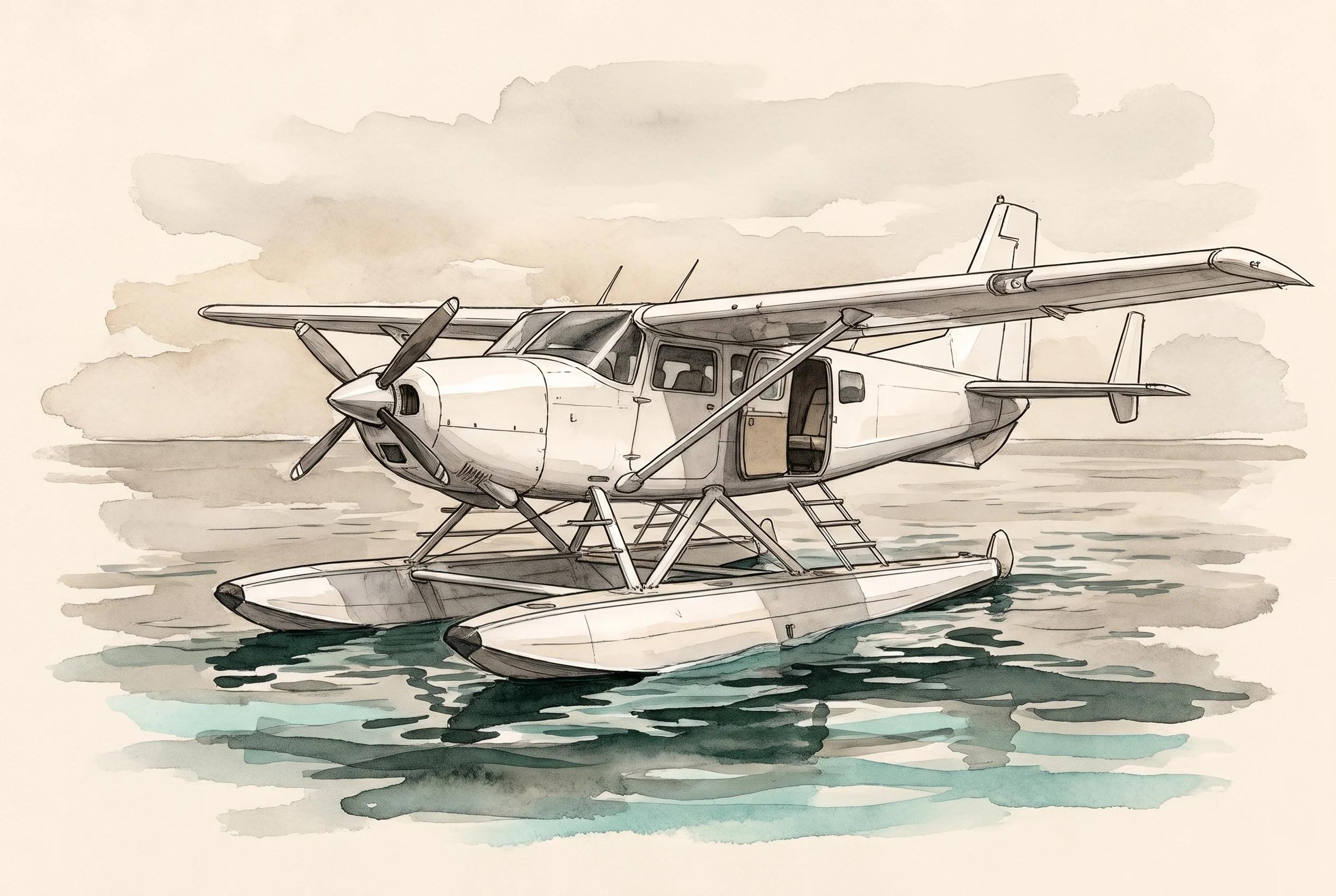
Why does the seaplane only fly in daylight?
Because it lands on open water, and water has no lights. No edge markers, no approach lighting, no instrument procedure to a lagoon. The pilot needs to read the surface, the swell and the dark line of the reef with his own eyes, so transfers run from early morning and stop in the mid-afternoon, as the official guidance from Maldives Airports Company Limited sets out. The country is 26 atolls scattered over roughly 90,000 square kilometres of ocean, with some islands more than 150 km (81 nm) from Velana. That distance is why the seaplane exists at all.
The consequence is quietly beautiful. A Maldives day is built backwards from a cutoff that nobody can move: not by paying more, not by knowing the right person. The clock that matters is the one in Malé, not the one at home. Experienced travellers set wheels-up in Europe the night before or very early, land before midday, and treat the whole departure as a single sequence rather than two separate journeys. Our departure day timeline exists for exactly this kind of arithmetic.
What does arriving on a private jet to the Maldives feel like?
It feels like being handed from one pair of hands to another, with nothing in between that asks anything of you. The jet stops, the heat arrives through the door like a held breath, and somebody walks you the short distance across the airport to the waterfront seaplane terminal. Bags are weighed and tagged, because a float aircraft counts every kilogram. There is iced water, a short wait with a view of the lagoon, and then a walk down a pontoon that moves slightly underfoot. Nothing about it resembles a terminal. Everything about it tells you the holiday has already begun.
The flight is the part people remember years later. The Twin Otter climbs slowly and never goes high. You can see the bottom of the sea for most of the journey: sandbanks that appear and vanish, a dive boat drawing a white line, a resort laid out like a comb against the blue. To a central-atoll island such as Veligandu the hop is about twenty minutes. Twenty minutes is nothing, and yet it does the work of a long afternoon, because it empties the head of everything that happened before.
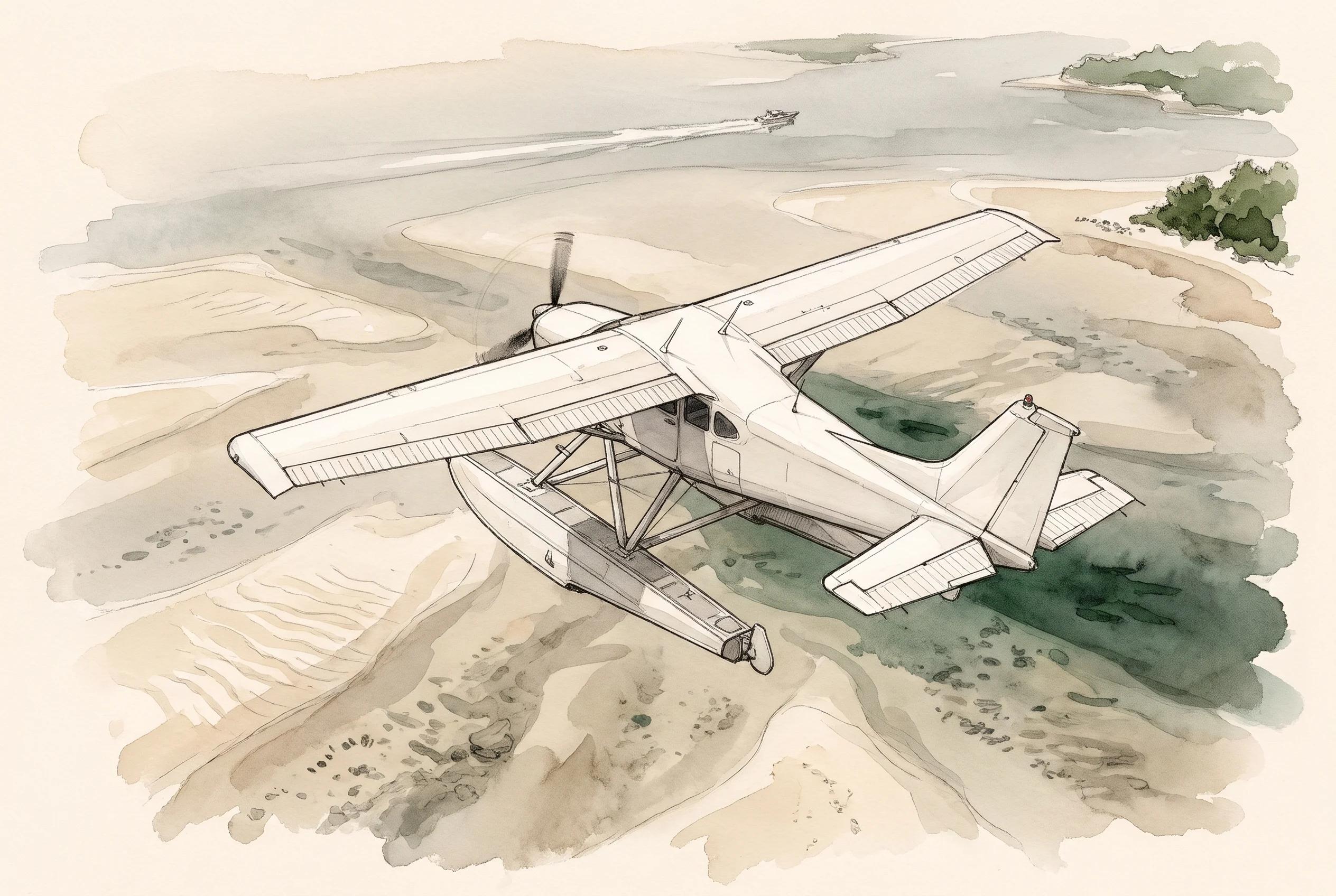
Then the descent, which is really a settling. The floats touch, throw their spray, and the aircraft becomes a boat. It taxis towards a jetty, swings, and stops. Somebody takes the bags without being asked. The first half hour on the island is usually silent, in the good sense: cold cloth, bare feet on warm wood, the sudden awareness that there is no car on the island and therefore no reason to hurry.
The seaplane is not the inconvenience before the holiday. It is the first hour of it.
Atljet Editorial
Which atoll, and which roof?
Distance is a feature here, not a penalty. The extra flying time that separates the outer atolls from Malé buys something money alone cannot: fewer boats on the horizon, darker nights, a lagoon with nobody else's wake in it. Soneva Jani sits in Noonu Atoll, north of the capital. Its Overwater Villas open directly onto the water, with the ocean beneath the floor and nothing but horizon in front.
The detail worth choosing for is the roof. Soneva Jani's Overwater Villas have retractable roofs above the bed, which turns the last gesture of the evening into a small ceremony. You press something, the ceiling slides away, and the sky arrives. There is little to light the sky for many kilometres around, so the stars are not a metaphor, they are a ceiling. The pattern tends to repeat itself: the first night you stay awake far too long, the second night you sleep better than you have in months.
Families calculate differently, and sensibly so. At Soneva Jani the children's world, The Den, has a zipline, a pirate ship and a swim-up mocktail bar, which is the kind of infrastructure that buys parents three unbroken hours in the middle of the day. That is the real luxury of an island with no roads: children can be let go, and the adults can stop counting heads. The official Maldives tourism board lists the atolls plainly, but the choice is emotional, not geographic. North for quiet, central for speed, south for solitude.
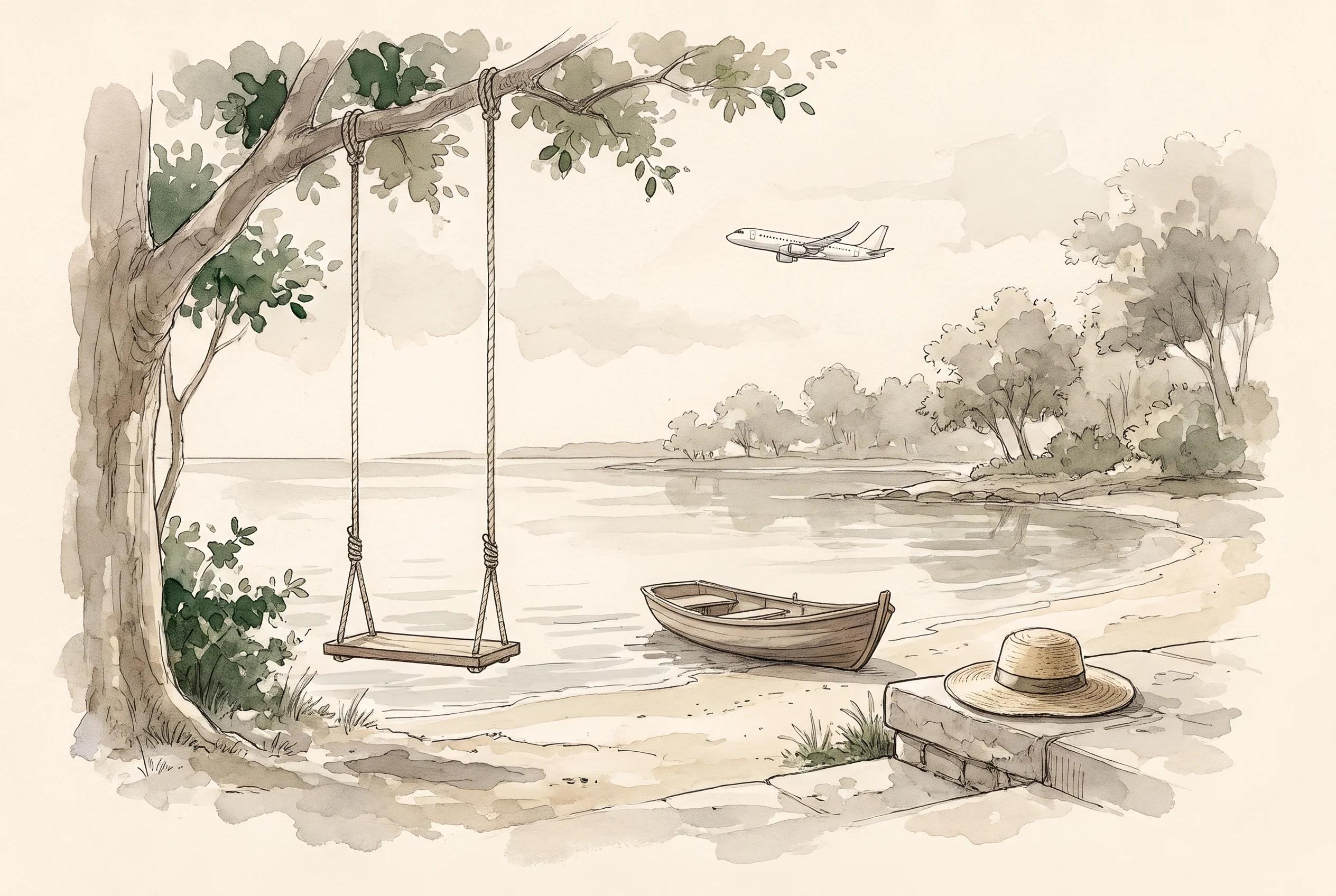
What the outer atolls are really selling is a different relationship with the clock. Nothing on the island is more than a few minutes away, so time stops being something you spend and becomes something you notice: the hour the light turns green under the villa, the hour the wind drops and the lagoon goes flat, the hour somebody lights the lamps along the sand. Guests who arrive wound tight usually take two days to stop checking a watch they have no use for. By the third morning they are asking what time the tide turns, which is the only schedule the place keeps.
The Atljet Edit
Five choices our editors would make for a first Maldives arrival, and for the fourth.
- Soneva Jani Overwater Villa, Noonu Atoll: direct water access and a retractable roof over the bed, which makes the sky part of the room.
- The Den at Soneva Jani, Noonu Atoll: a zipline, a pirate ship and a swim-up mocktail bar, which is to say three free hours for the adults.
- A Twin Otter transfer with Trans Maldivian Airways, from Velana: twenty minutes at low altitude over the reef, the best introduction to the country there is.
- The seaplane terminal at Velana International Airport, Malé: a waterfront handover a short distance from the jet, with the lagoon already in view.
- Gan International Airport, Addu Atoll: the southern gateway served since December 2016, for anyone who would rather arrive where almost nobody does.
What do the most discreet travellers choose instead?
They go south, or they go close. Gan International Airport, in Addu Atoll at the bottom of the country, has been served by Trans Maldivian Airways since December 2016 for resorts in Addu and Huvadhu Atoll, which means the whole Malé sequence can be skipped. The jet lands where the arrivals hall is almost empty, the air smells of rain on hot concrete, and the last leg is short. It is a longer flight from Europe and a smaller choice of islands. For a certain kind of traveller, both of those are arguments in favour.
The other quiet strategy is to stay near Malé and travel by boat. Resorts close to the capital are reached directly from the airport by water at any hour, which frees the day entirely from the daylight cutoff: land at eight in the evening, be on the island before ten, wake up in the right place. People who travel often for short stays tend to drift towards this option after their third or fourth visit. The spectacle of the seaplane is wonderful once. The freedom of arriving whenever you like is wonderful every time.
What both choices have in common is a refusal to let the journey dictate the mood. The discreet traveller does not fight the daylight rule and does not sulk about it. They either build the day around it, with a landing before noon and a villa by mid-afternoon, or they design it out of the trip altogether. Either way the decision is made weeks earlier, over a short conversation, and never again at the airport.
Arriving by air
Velana International Airport (MLE/VRMM) in Malé takes everything, from a light jet out of the Gulf to an ultra long range aircraft nonstop from northern Europe. From London, Paris, Geneva, Zurich or Milan the sensible aircraft is a Gulfstream G550 or similar, with around nine and a half to ten and a half hours of block time. From Dubai it is a short hop, and the choice becomes one of cabin rather than range.
| Route | Aircraft and class | Distance | Block time | Estimated one way |
|---|---|---|---|---|
| London Farnborough (FAB) to Malé (MLE) | Gulfstream G550, Ultra Long Range | 4,897 nm / 9,069 km | 10 h 32 min | €158,300 to €215,200 |
| Paris Le Bourget (LBG) to Malé (MLE) | Gulfstream G550, Ultra Long Range | 4,741 nm / 8,780 km | 10 h 13 min | €153,600 to €208,800 |
| Geneva (GVA) to Malé (MLE) | Gulfstream G550, Ultra Long Range | 4,549 nm / 8,425 km | 9 h 49 min | €147,700 to €200,700 |
| Zurich (ZRH) to Malé (MLE) | Gulfstream G550, Ultra Long Range | 4,467 nm / 8,273 km | 9 h 38 min | €145,000 to €197,000 |
| Milan Linate (LIN) to Malé (MLE) | Gulfstream G550, Ultra Long Range | 4,400 nm / 8,149 km | 9 h 30 min | €143,000 to €194,300 |
| Dubai (DXB) to Malé (MLE) | Challenger 350, Super Midsize Jet | 1,740 nm / 3,222 km | 4 h 12 min | €37,100 to €47,300 |
| Dubai (DXB) to Malé (MLE) | Gulfstream G550, Ultra Long Range | 1,740 nm / 3,222 km | 3 h 58 min | €60,800 to €82,200 |
These are estimates and they move. On a point to point charter you pay for time rather than distance, so the figure follows block time, the routing actually flown, the wind on the day, the aircraft, fuel, airport charges, positioning and what is free that week. People fly you. Data prices you.
Airports
Arriving by air
Almost every private jet to the Maldives lands at Velana International Airport (MLE/VRMM) in Malé, a short distance from the waterfront seaplane terminal where the final leg begins. Travellers heading to the far southern atolls can arrive at Gan instead and skip Malé entirely. The Atljet flight desk can arrange the last stretch too: a seaplane slot timed to the day's cutoff, a private boat for a late landing, or a car with a driver in Malé.
- MLE
- Velana International Airport (VRMM), MaléThe gateway for the whole country, and the right choice for the central and northern atolls. Land before midday and the seaplane still flies that afternoon.
- GAN
- Gan International Airport (VRMG), Addu AtollThe southern arrival, served since December 2016 for resorts in Addu and Huvadhu Atoll. Longer from Europe, far quieter on the ground.
| From | Distance | Light jet | Midsize jet | Heavy jet |
|---|---|---|---|---|
| London (FAB to MLE) | 4,897 nm (9,069 km) | Not non stop | Not non stop | Not non stop |
| Paris (LBG to MLE) | 4,741 nm (8,780 km) | Not non stop | Not non stop | Not non stop |
| Geneva (GVA to MLE) | 4,549 nm (8,425 km) | Not non stop | Not non stop | Not non stop |
| Zurich (ZRH to MLE) | 4,467 nm (8,273 km) | Not non stop | Not non stop | Not non stop |
| Dubai (DXB to MLE) | 1,740 nm (3,222 km) | 4h 41m, €24,700 to €32,200 | 4h 23m, €30,300 to €38,600 | 4h 07m, €46,400 to €63,000 |
| Milan (LIN to MLE) | 4,400 nm (8,149 km) | Not non stop | Not non stop | Not non stop |
Three fifteen in the afternoon, somewhere above a reef, with the water changing colour in bands and the island still ten minutes away: that is the hour the whole journey was arranged around, and it is the one you will describe when you get home.
Questions people ask
- How do you get to a Maldives resort by private jet?
- The jet lands at Velana International Airport (MLE/VRMM) in Malé. From there the resort arranges the final leg: a seaplane for the outer atolls, a boat for islands near Malé, or a short domestic flight plus a boat for the far south. The official transfer categories are published by Maldives Airports Company Limited.
- Why do seaplanes in the Maldives only fly during daylight?
- They land on open water, which has no lighting, no edge markers and no instrument approach. The pilot needs to see the surface, the swell and the reef, so transfers run from early morning until the mid-afternoon and stop.
- What time should the private jet land in Malé?
- Before midday is the comfortable answer. The last seaplane departures leave Velana in the mid-afternoon, and a late international arrival usually means a night near the airport and a flight to the island the following morning.
- How long does a seaplane transfer take?
- About twenty minutes to a resort in the central atolls, longer for the outer ones. Soneva Jani, for example, sits in Noonu Atoll, well north of Malé.
- Which Maldives arrivals avoid the Malé seaplane terminal?
- Resorts in Addu and Huvadhu Atoll in the far south are served from Gan International Airport, where Trans Maldivian Airways has operated since December 2016. Islands close to Malé are reached directly by boat, at any hour.
Questions on this guide? The flight desk answers within the hour.
Request options