
Summary
- The transfer is planned around weight and timing, not seat count: luggage is weighed, and soft bags travel better than hard cases.
- In Europe these flights sit under Regulation (EU) No 965/2012; in the United States, under FAA Part 135. You need no licence, the operator does.
- Heliport hours decide the day. London Heliport's permitted window runs 07:00 to 23:00, with normal hours far shorter and extensions by prior arrangement only.
- The jet leg is the predictable part. Atljet market data for November 2026 puts a Light Jet from London Farnborough to Nice at an estimated 10,700 to 13,700 EUR one way, 109 minutes block time.
The jet's airstair comes down and the noise is already there: a second set of rotors turning fifty metres away, a handler walking the first two cases across the painted line, the pilot's hand raised once in acknowledgement. Nobody has asked for a passport twice. Nobody has entered a building. Four minutes after the engines spooled down, the bags are in the helicopter's hold, the seatbelts click, and the horizon tilts. The airport that was the destination a moment ago is now simply a place the day passed through.
A helicopter transfer is a short charter flight that carries you from the airport where your jet lands to a heliport or private landing site near your final address, usually arranged as part of the same booking. In practice the handoff happens on the apron: the ground team moves the luggage directly between aircraft, there is no terminal to cross, and the helicopter leg is flown under the same commercial operating certificate that governs the jet. The limits that matter are weight, daylight, weather minima and the opening hours of the heliport at the other end.
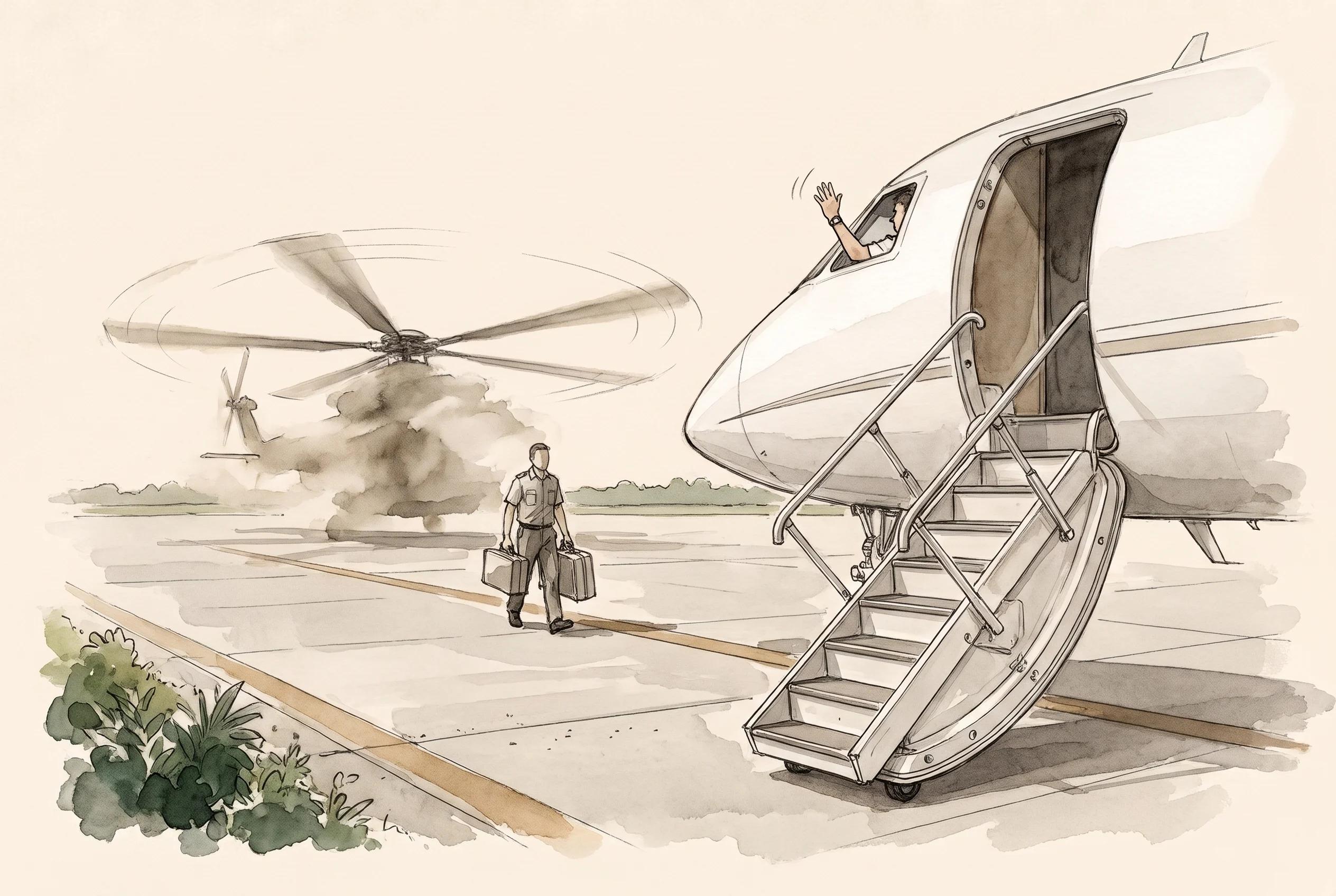
That handoff is the part of private aviation people understand least, and it is the part that decides whether an arrival feels effortless or merely expensive. What follows is how a helicopter transfer actually works: who is legally responsible, what the limits are, why your luggage gets weighed, and why the heliport at the far end often matters more than the aircraft.
How does a helicopter transfer actually work?
A helicopter transfer is a separate flight, flown by a separate crew, scheduled to meet your jet on the ground. In the best version it is booked at the same time as the jet and coordinated by the same desk, so the helicopter is turning before your aircraft has cleared the runway. The handling agent who meets the jet also meets the helicopter. Luggage moves apron to apron, under supervision, without touching a carousel or a public hall.
Sequence matters more than speed. The helicopter cannot depart until the jet has arrived, so every delay upstream moves the whole chain. Experienced desks build a buffer into the plan and brief the helicopter crew on the jet's actual airborne time rather than its scheduled one. At airports with a dedicated helicopter terminal, such as Nice Côte d'Azur, which publishes its own helicopter services to Monaco, Cannes, Saint-Tropez and Geneva, the walk between the two aircraft is measured in metres.
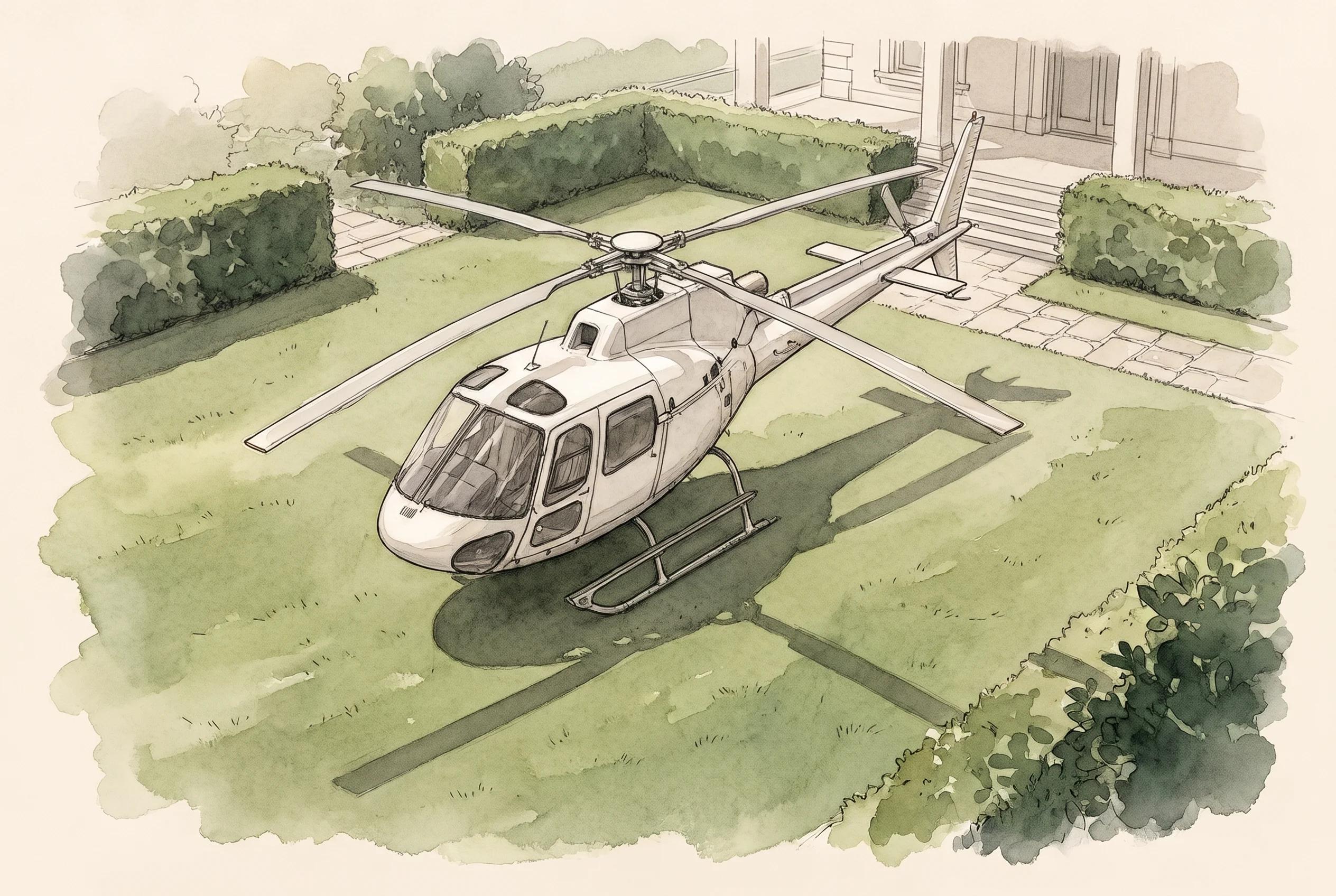
On arrival at the other end, the helicopter lands either at a licensed heliport or at a private site: a hotel pad, a villa lawn, a landing area on an estate. Private sites need the landowner's permission and a pilot's site survey, and both take time to arrange. A week's notice turns a complicated request into a routine one. Twenty four hours usually does not.
What licence or certificate covers the flight?
You need no licence of any kind. The certification sits entirely with the operator, and which certificate it holds matters, because that is what sets the standard of maintenance, crew training and oversight behind your flight. In the United States, on demand charter, which covers nearly all commercial helicopter work, falls under FAA Part 135 for aircraft with 30 or fewer seats or up to 7,500 lb (3,400 kg) payload. Private, non revenue flying sits under Part 91 instead, with lighter requirements.
In Europe the logic is the same with different numbers. Under Regulation (EU) 2018/1139, carrying passengers for remuneration is commercial air transport, and those operations, helicopters included, are governed by Regulation (EU) No 965/2012 on Air Operations. The practical consequence for a client is simple: a commercially certified operator works to published duty limits, approved maintenance programmes and documented crew checks. A private arrangement, however glamorous the aircraft, does not.
The question to ask is therefore not what kind of helicopter but under which certificate the flight is being sold. If the answer is vague, the flight is the wrong flight. This is the same discipline we apply to charter on the jet side, and there is no reason to relax it over the last twenty minutes of a journey.
Which heliports and airports make the handoff possible?
The transfer only works where the geography and the licensing agree. A handful of pairings do this well, and they explain the logic better than any general rule. Nice Côte d'Azur operates its own helicopter terminal on the airport, with scheduled links to Monaco, which has no airport of its own and reaches the rest of the world through its Fontvieille heliport. The Riviera's air network was built around that fact.
New York works differently. Teterboro is a general aviation only reliever field with no scheduled airline service, roughly 12 mi (19 km) from Midtown Manhattan, and the helicopter leg from its apron to a Manhattan heliport exists because the road version of that distance is unpredictable by an hour or more. Los Angeles follows the same reasoning from Van Nuys, about 20 mi (32 km) from Downtown across one of the most congested road networks in the country. We looked at that field in detail in the Van Nuys private terminal guide.
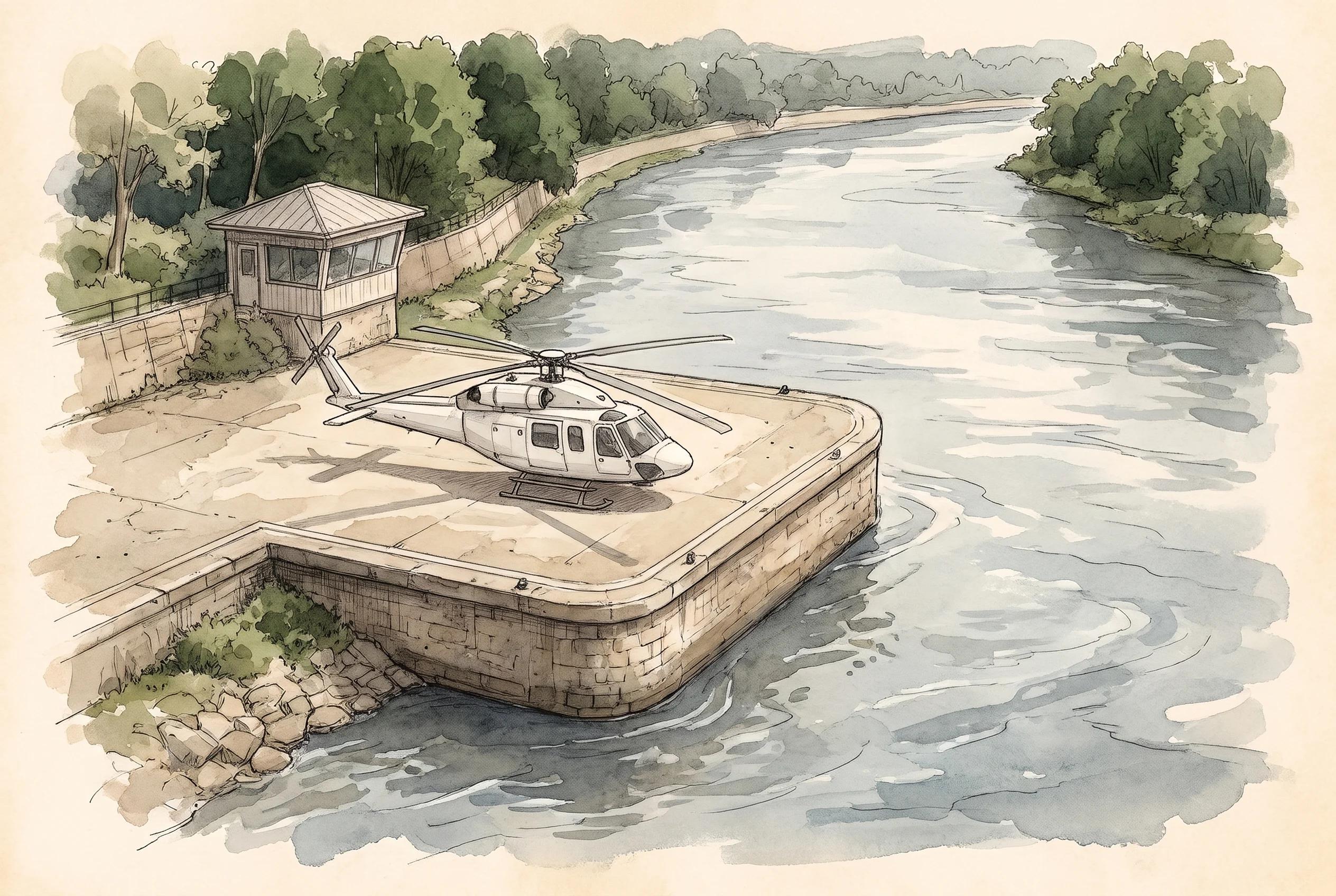
London is the strictest case. London Heliport at Battersea, ICAO code EGLW, is the capital's only CAA licensed heliport, with its own air traffic service and an on site fire and rescue cover that can be raised a category when a larger helicopter is expected, provided notice is given. It received its first aircraft on 8 April 1959 and has been the single front door ever since. Milan is the opposite situation: Linate and Malpensa are the jet arrival points for places with no airport of their own, Lake Como and the Ligurian coast among them, the same arithmetic we ran in helicopter or car from Milan to Portofino.
What are the real rules on timing, weather and night flights?
Three things govern whether the leg flies: the heliport's hours, the weather minima, and the local noise procedures. London Heliport is the clearest published example. Its permitted opening hours run 07:00 to 23:00 seven days a week, but its normal operating hours are 07:30 to 19:30 on weekdays and 08:00 to 18:00 at weekends and on bank holidays. Anything outside that requires prior arrangement, with notice deadlines. Aircraft departing must be airborne by 22:45, and aircraft arriving to park overnight must be on the ground by 22:55, or air traffic control refuses the movement.
Weather minima are more forgiving for helicopters than for jets, which is part of the point. Under 14 CFR 91.155 in the United States, a helicopter flying visually in Class G airspace needs only half a statute mile of visibility clear of cloud by day, rising to one statute mile at night. That is a lower bar than any fixed wing aircraft operates to. It does not make the helicopter weatherproof: a marginal coastal evening or a low cloud base over a lake still stops the flight, and a good crew says so early.
Noise procedures are the rule most often misunderstood. The FAA's own report to Congress on helicopter urban noise documents that New York operators have adopted voluntary noise abatement routes and altitude procedures. Voluntary, under current federal rule, not mandatory. The effect on your day is real anyway: a crew honouring a quiet routing may fly a slightly longer track, and some private sites impose their own evening cutoffs that have nothing to do with aviation law and everything to do with neighbours.
How much luggage and how many passengers fit on board?
A helicopter is planned around weight, not seats, and that is the single most useful thing a client can understand. The aircraft has a useful load: everything it can carry once fuel is aboard, meaning passengers, crew and baggage together. That figure drops on hot days and at altitude. Six seats do not guarantee six adults with luggage, and an operator who asks for passenger weights is not being impertinent: that arithmetic is what keeps the leg legal and the aircraft inside its limits.
Shape matters as much as mass. Helicopter baggage holds are narrow and often curved, so a soft holdall slides into space that a rigid case cannot use. There is no universal allowance to quote: the figure that counts belongs to that aircraft, that route and that day, which is why the operator asks for weights and dimensions before choosing the machine.
- Send weights and case dimensions when you book, not at the apron. It decides the aircraft type.
- Soft sided bags travel better than hard shells on every helicopter type.
- Golf bags, ski equipment and large art cases usually need a bigger aircraft or a separate road leg, arranged in parallel.
- If the party is close to the limit, splitting across two rotations is faster than renegotiating on the ramp.
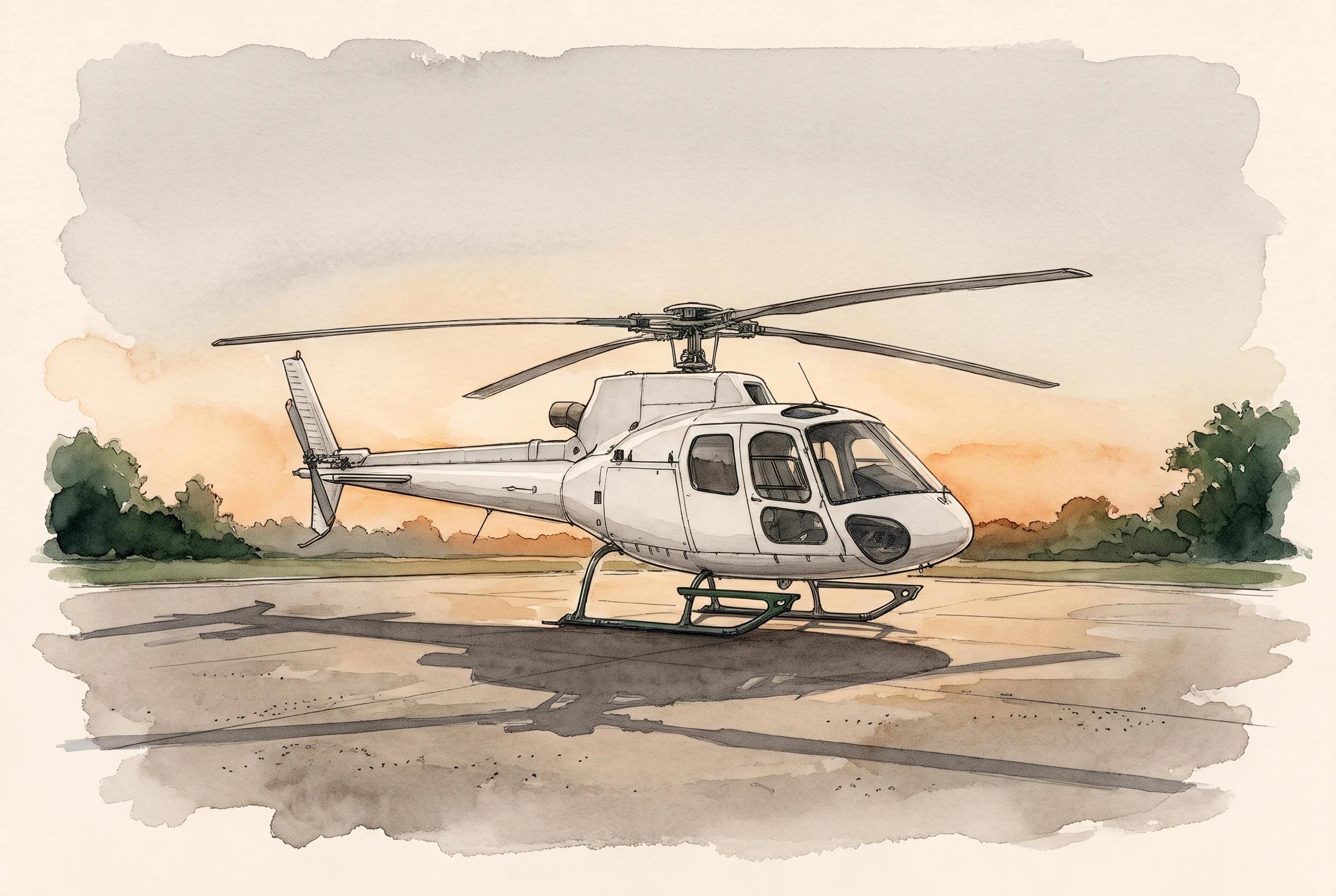
Aircraft types follow from that arithmetic. Light single engine machines of the Airbus H125 and H130 families cover short coastal and lakeside legs with a small party and modest bags. Twin engine aircraft such as the Airbus H145 or the Sikorsky S-76D take more weight, fly in a wider range of conditions and are the standard choice over water and above dense city centres. The categories are set out in the helicopter fleet pages.
Is a helicopter transfer safe?
Commercial helicopter charter is regulated to the same philosophy as jet charter: an approved operator, approved maintenance, trained and checked crews, enforced duty limits and national authority oversight, whether that authority is the FAA, EASA or a member state regulator. Those are the parts an outsider cannot inspect but can insist upon, by booking only through a certified commercial operation rather than a private arrangement.
What oversight does not do is remove judgement. Weather, light, landing site condition and the pilot's own assessment all sit outside any certificate. A crew that declines a marginal evening approach to an unlit private lawn is applying exactly the standard you are paying for. Treat a cancellation as evidence of a good operator, and have the car alternative agreed in advance so the decision costs you nothing but the view.
The measure of a good transfer is not how fast it was. It is that nobody on board ever had to ask what happened next.
Atljet Editorial
What the jet leg costs, and where the helicopter fits
The jet leg is the predictable part of the budget and the helicopter is the variable at the end, priced by aircraft type, flight time and positioning. Below are Atljet market data estimates for November 2026, one way, per aircraft, on routes where a helicopter transfer commonly follows the jet. Figures are market estimates, not quotes: price follows block time, routing, winds, fuel, airport charges, aircraft positioning and availability. You pay for time, not distance.
| Route | Class and type | Block time | Estimate one way, per aircraft |
|---|---|---|---|
| London Farnborough (FAB) to Nice (NCE), 594 nm / 1,100 km | Light Jet, Citation CJ3 | 109 min | 10,700 to 13,700 EUR |
| London Farnborough (FAB) to Nice (NCE), 594 nm / 1,100 km | Super Midsize Jet, Challenger 350 | 99 min | 15,700 to 19,700 EUR |
| London Farnborough (FAB) to Milan Malpensa (MXP), 538 nm / 996 km | Midsize Jet, Citation XLS | 95 min | 12,200 to 15,200 EUR |
| Geneva (GVA) to Nice (NCE), 172 nm / 319 km | Light Jet, Citation CJ3 | 46 min | 5,600 to 6,900 EUR |
| Milan Linate (LIN) to Nice (NCE), 147 nm / 272 km | Very Light Jet, Citation Mustang | 46 min | 4,800 to 5,600 EUR |
| New York Teterboro (TEB) to Los Angeles Van Nuys (VNY), 2,257 nm / 4,180 km | Heavy Jet, Falcon 900 | 314 min | 58,400 to 79,600 EUR |
| New York Teterboro (TEB) to Nice (NCE), 3,671 nm / 6,799 km | Ultra Long Range, Gulfstream G550 | 479 min | 120,500 to 163,600 EUR |
Read the table as a shape rather than a price list. The short European legs, Geneva to Nice at 46 minutes, Linate to Nice at 46 minutes, are cheap in time and expensive in coordination: on routes that short, the helicopter waiting at the far end is what determines whether the whole journey holds together. The transatlantic legs are the reverse. Nothing about the last twenty minutes changes the cost materially, but after nearly eight hours airborne, the difference between a rotor start and a queue of cars is the entire quality of the arrival.
The Atljet flight desk arranges the last stretch as readily as the flight itself, whether that means a helicopter from the apron, a chauffeured car, or a motorboat waiting at a lakeside jetty. People fly you. Data prices you.
Back on the apron, the second set of rotors is already winding down somewhere else, over a harbour or a lawn or a rooftop in a city centre. The bags came off in the order they went on. Nobody checked a screen. The best version of this craft is the one that leaves no story to tell afterwards, only the odd realisation, three hours later and over dinner, that the day had far more of itself left than it should have.
Questions people ask
- How does a helicopter transfer work?
- The helicopter is positioned at the airport where your jet lands, usually on the same apron or at an adjacent helicopter terminal. The handling team moves luggage straight across, passengers walk a short distance, and the helicopter departs for a heliport or private site near the final address. There is no terminal, no hall and no second check in.
- Do you need a licence to charter a helicopter?
- No. The passenger needs nothing beyond identification and, on international legs, the usual travel documents. The legal burden sits with the operator, which must hold an air operator certificate: Part 135 in the United States, Regulation (EU) No 965/2012 in Europe.
- How much luggage can you bring on a helicopter?
- There is no single legal figure. The limit is the aircraft's useful load on that day, with that fuel, at that temperature, and the shape of the baggage hold. Soft sided bags almost always fit where rigid cases do not. Send weights and dimensions in advance and the operator will size the aircraft accordingly.
- Can helicopters fly at night?
- Yes, within limits. Night visual minima are higher, some landing sites have no night lighting, and licensed heliports have declared hours. London Heliport's permitted window ends at 23:00, with departures airborne by 22:45 and overnight arrivals on the ground by 22:55.
- Is a private helicopter transfer safe?
- Commercial helicopter charter is flown under the same certification and oversight regime as jet charter, with approved maintenance, crew training and flight time limits. Oversight does not remove the honest variables: weather, daylight and landing site suitability. A good operator cancels or reroutes when those do not line up.
Questions on this guide? The flight desk answers within the hour.
Request options