Summary
- Cortina after the Olympics keeps the upgraded town and loses the crowd: late spring, September and the first half of December are the quietest windows.
- Two MICHELIN Stars sit inside the town, Tivoli and SanBrite, with Alajmo Cortina, Ristorante de LEN, Al Camin, Baita Fraina and El Brite de Larieto completing the map.
- Venice Marco Polo (VCE) is the default gateway, with Innsbruck (INN) better from Zurich and the north; the valley itself has no airport.
- Atljet market data, November 2026: Geneva to Venice runs about 59 minutes in a Citation XLS, estimated at €8,300 to €10,100 one way.
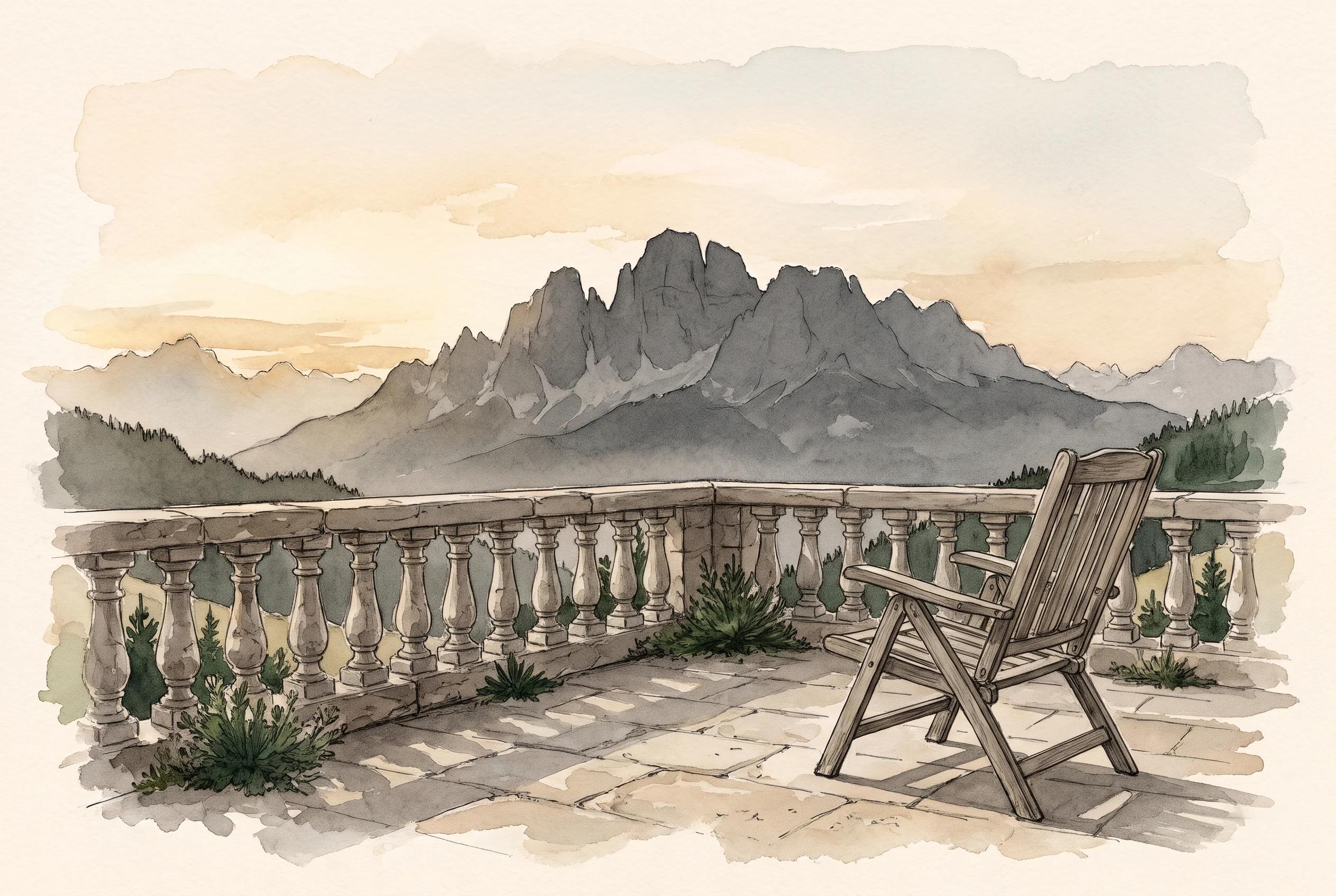
Six forty in the morning, early September, and the Tofane are still grey. From the terrace above Pocol the valley holds its night air, cold enough to feel on the back of the hands. Then the top of Tofana di Rozes catches, a narrow band of copper that slides down the wall faster than seems reasonable. Below, in the town, a delivery van turns into the Corso and a shutter goes up. The rock turns pink, holds it for four minutes, and lets go. The coffee on the table has stopped steaming.
Cortina d'Ampezzo after the Olympics is the version of the town worth flying for: the same valley, with renewed hotels and kitchens, and without the global audience standing in front of it. The MICHELIN Guide lists two starred restaurants inside the town itself, Tivoli and SanBrite, plus a deep bench of Alpine and regional tables. Most private arrivals come through Venice Marco Polo (VCE), about one hour and fifty minutes from London Farnborough in a Citation XLS, with the last stretch by chauffeured car or helicopter.
Cortina d'Ampezzo after the Olympics: what has changed?
Cortina d'Ampezzo after the Olympics is a town that has been rebuilt, photographed by the entire world, and then handed back to itself. That is the opportunity. Milano Cortina 2026 brought the valley the kind of spending that normally takes two decades: hotels renovated to their bones, kitchens reopened with ambition, roads resurfaced, service staff recruited and trained to a standard the town had not needed for years. All of that remains. The audience does not.
Mountain towns rarely improve quietly. They improve in bursts, around a reason, and then they settle. Cortina has done this before, generations ago, and lived off the result for decades: the rationalist buildings, the bobsleigh legend, the particular confidence of a place that was fashionable before most Alpine resorts were anything at all. What Milano Cortina 2026 leaves behind is less romantic and more useful. The infrastructure of a serious destination, in a valley that still empties the moment the season turns.
Which means timing is now the whole game. Come at Ferragosto or between Christmas and Epiphany and you are in a crowd, albeit a well dressed one. Come in the second half of June, when the meadows above Ra Stua are absurd with wildflowers and the high refuges are just waking up. Come in September, the best month in the Dolomites by a distance: hard light, cold mornings, warm afternoons, every path dry. Come in the first ten days of December, when the lifts are turning and the town is still deciding whether the season has begun.
Where to stay in Cortina d'Ampezzo
Where you stay in Cortina should be decided by the rhythm you want, because the valley splits cleanly into three. Above the town, on the Pocol side, you buy silence and the full elevation of the Tofane from your window, with a five minute descent into the Corso when you want it. In the centre, along Corso Italia, you are inside the evening passeggiata, that slow and faintly theatrical walk that starts around six and is the town's oldest sport. On the Cristallo side, towards Zuel and the eastern slopes, you are closest to the mountain in the morning.
The benchmark five-star address is the Grand Hotel Savoia, a Radisson Collection Hotel, which sits just above the centre with its restaurants, spa and a ski room that turns a nine o'clock departure into a matter of walking outside in warm boots. That last detail matters more than any brochure line. The difference between a good mountain hotel and an irritating one is measured in the twelve minutes you do not spend in a basement looking for your own equipment.
For families travelling together, or for anyone who would rather host than be hosted, the valley's private houses are the other route: chalets on the upper roads with their own cook, housekeeper and driver, taken for a week with the kitchen briefed in advance. These are arranged quietly and rarely advertised. Ask early, particularly for Christmas and for the second half of February, and ask for the Pocol or Cademai side if you want the view of the Tofane rather than the view of the road.
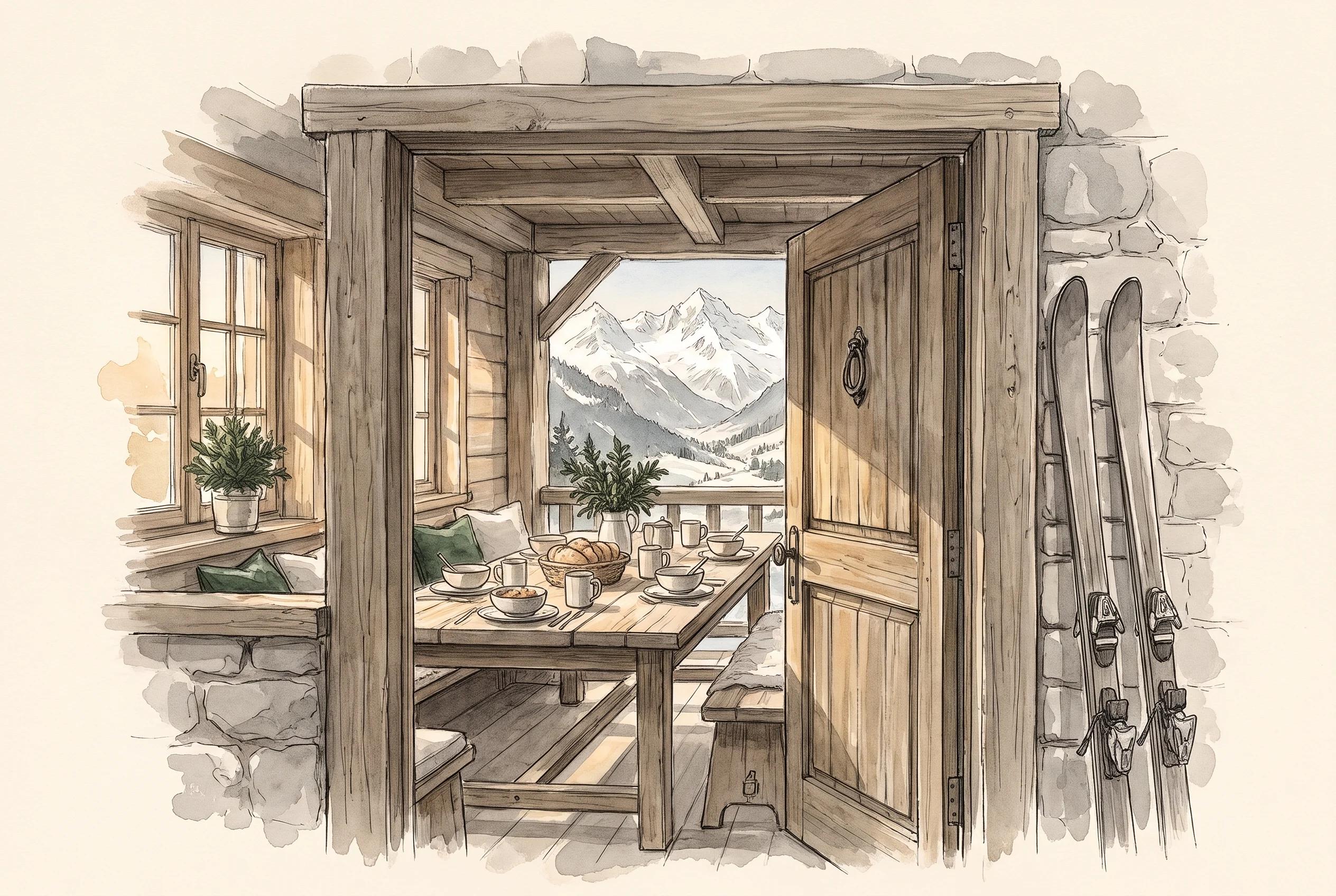
Where to eat: the MICHELIN tables of Cortina
Cortina holds two MICHELIN Stars inside the town itself, and that is unusual for a valley this size. Tivoli, awarded one Star for modern cuisine, is the formal evening: a dining room set in the late afternoon, valley light coming in low and long before service begins, cooking that is precise without being cold. SanBrite, also one Star, works the opposite register. Alpine cuisine built around what the family farm produces, which means the dairy on the plate was made within sight of the table. Both should be booked well before you leave home.
Underneath the Stars sits the part of the map most visitors never reach. Alajmo Cortina brings the contemporary cooking of a famous Veneto kitchen family into the mountains at the top price band. Ristorante de LEN, inside the De LEN hotel, does regional cuisine properly and solves the night you do not want to put a coat on. Al Camin and Baita Fraina are country cooking in the honest sense, the kind of rooms where the wine list is longer than the menu. El Brite de Larieto is the mountain lunch: Alpine, unhurried, and worth the drive out of town. The full listing is kept current by the MICHELIN Guide.
The Atljet Edit
Five addresses that justify the flight, chosen by the editors and confirmed against the MICHELIN Guide and the hotels' own listings.
- Tivoli, Cortina d'Ampezzo: one MICHELIN Star for modern cuisine and the most composed dining room in the valley, best taken at the first sitting while the light is still on the rock.
- SanBrite, Cortina d'Ampezzo: one MICHELIN Star for Alpine cooking that starts at the family farm, the clearest argument that mountain food can be ambitious without pretending to be French.
- Grand Hotel Savoia, a Radisson Collection Hotel: the five-star address above the centre, with spa and a ski room that buys back your mornings.
- El Brite de Larieto, above Cortina: the long mountain lunch, Alpine and unhurried, the one booking that should run past three in the afternoon.
- Tilia, Dobbiaco: one MICHELIN Star for modern cuisine, and the reason to give a whole day to the Val Pusteria rather than driving through it.
Day trips into the Dolomites
The best day trips from Cortina are decided by what time you are willing to leave. Lago di Braies, an hour north through the Val Pusteria, is the clearest example. At six in the morning the water is black and absolutely still, the wooden boathouse has its reflection to itself, and the only sound is the lake moving under the pontoon. By ten the shoreline belongs to everybody else. There is no clever workaround, only the hour, a driver already warm in the car park at the top of the road, and breakfast arranged for afterwards.
West, the Falzarego and Valparola passes climb out of the valley into Alta Badia, and the drive is the point: tight switchbacks, old fortifications in the rock, the whole Lagazuoi wall turning over your shoulder. The excuse at the other end is dinner. Porcino in Badia and La Stüa de Michil in Corvara in Badia, inside the La Perla hotel, both hold one MICHELIN Star; carry on to Selva di Val Gardena and Suinsom makes a third. None of these are Cortina addresses, and pretending otherwise is how people end up driving a mountain pass at midnight.
Closer to home, the circuit of the Cinque Torri and the old front lines above the Falzarego is a half day on foot that rewards a private guide rather than a map, and the Giau pass at sunset is the single best hour of driving in the eastern Dolomites. Take the Giau late, with the Nuvolau on one side and nothing on the other, and be back in the Corso in time for a table at eight thirty.
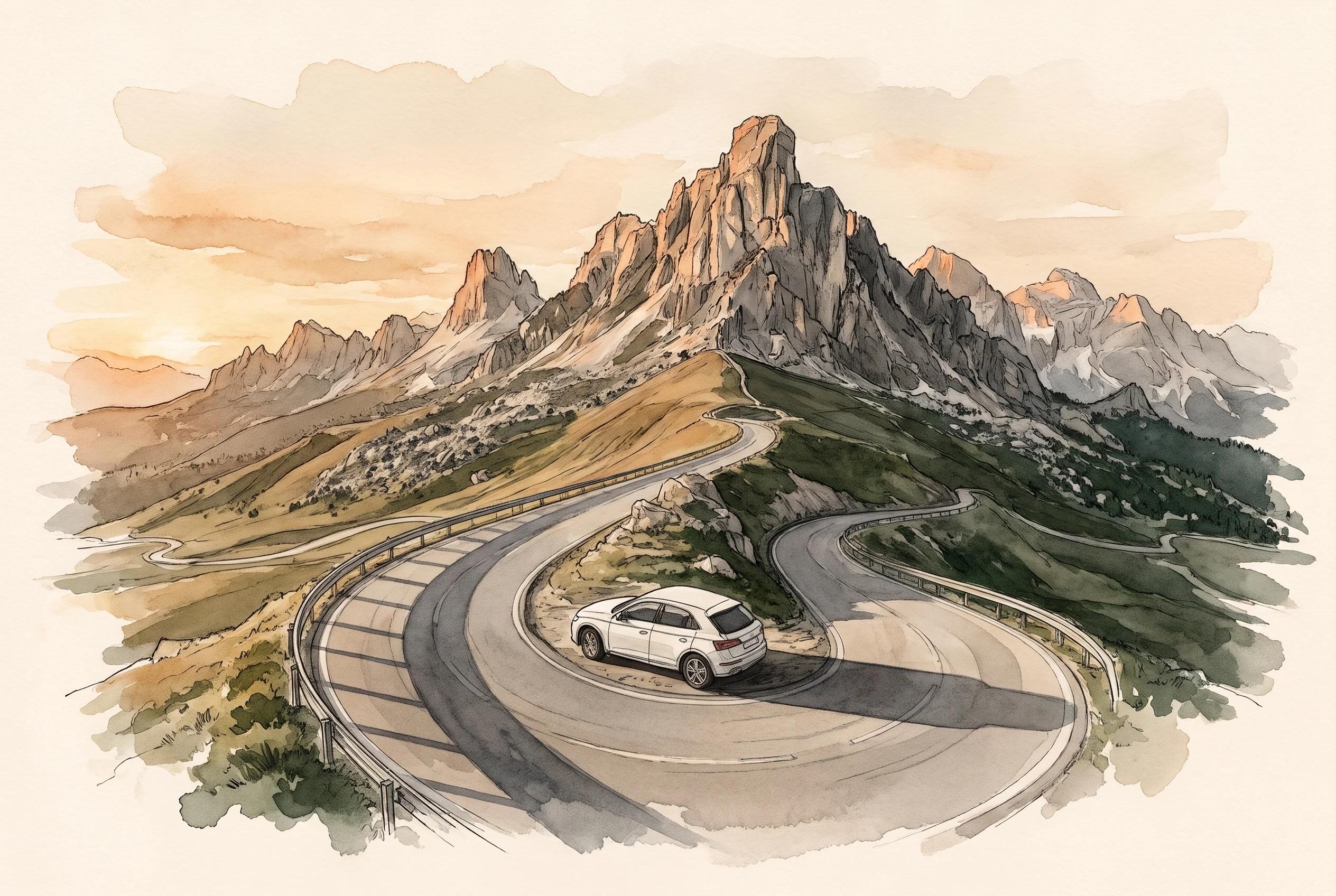
In the Dolomites the hour decides everything. The same lake, the same pass, the same rock: leave two hours earlier and you have been somewhere else entirely.
Atljet Editorial
How do you arrive in Cortina d'Ampezzo by private jet?
You do not land in Cortina. The valley has no airport, which is the quiet reason it has stayed the way it is, and the choice is between Venice Marco Polo (VCE), Treviso (TSF) and Innsbruck (INN), each followed by a road or a rotor. Venice is the default: the widest handling capability, the best onward options, and the most civilised place to be delayed if weather closes the passes. Innsbruck tends to win from Zurich and from anywhere north of the Alps. Treviso is the practical alternative when Venice is congested.
The numbers are short. Atljet market data for November 2026 estimates London Farnborough to Venice at one hour and fifty-three minutes in a Citation XLS, Geneva to Venice at fifty-nine minutes, and Milan Linate to Venice at thirty-nine minutes, all one way and per aircraft. Those block times are what you pay for: you buy the clock, not the map. A morning departure from London puts you on a terrace under the Tofane in time for a late lunch.
| Route | Light Jet (Citation CJ3) | Midsize (Citation XLS) | Super Midsize (Challenger 350) | Block time, midsize |
|---|---|---|---|---|
| London Farnborough to Venice | €11,600 to €14,900 | €14,100 to €17,700 | €17,100 to €21,500 | 1 h 53 min |
| Paris Le Bourget to Venice | €9,400 to €11,800 | €11,300 to €14,000 | €13,600 to €17,000 | 1 h 27 min |
| Geneva to Venice | €6,900 to €8,600 | €8,300 to €10,100 | €9,900 to €12,200 | 59 min |
| Zurich to Innsbruck | €5,000 to €6,000 | €5,900 to €7,100 | €6,900 to €8,400 | 37 min |
| Milan Linate to Venice | €5,200 to €6,300 | €6,100 to €7,300 | €7,200 to €8,700 | 39 min |
The last stretch is where the day is won or lost. A chauffeured car from Venice climbs out of the lagoon flatlands and into the mountains, and the change of register is genuinely worth watching through a window. In clear weather a helicopter does it faster and turns the transfer into the best part of the journey, with the Marmarole and the Sorapiss arriving from the side. Both are planned with the aircraft, not after it, which is the whole logic of point to point charter. Readers who know Samedan and Courchevel will recognise the pattern: the mountain sets the terms, and the flight arranges itself around them.
Airports
Arriving by air
Cortina d'Ampezzo sits in a valley with no airport of its own, so the arrival is always made of two parts: the flight, and the climb into the mountains. Venice Marco Polo handles most private traffic into the eastern Dolomites, with Innsbruck often quicker from Switzerland and the north and Treviso useful when Venice is busy. The Atljet flight desk can arrange the last stretch as well, whether that is a chauffeured car over the passes or a helicopter into the valley.
- VCE
- Venice Marco PoloThe default gateway for Cortina: strongest handling, best onward car and helicopter options, and the most pleasant place to wait out weather.
- TSF
- TrevisoThe practical alternative when Venice is congested, and marginally closer to the road north.
- INN
- InnsbruckUsually the faster choice from Zurich, Munich and anywhere north of the Alps, with an onward drive through the Val Pusteria.
| From | Distance | Light jet | Midsize jet | Heavy jet |
|---|---|---|---|---|
| London (FAB to VCE) | 664 nm (1,230 km) | 2h 00m, €11,600 to €14,900 | 1h 53m, €14,100 to €17,700 | 1h 47m, €21,200 to €28,400 |
| Paris (LBG to VCE) | 481 nm (891 km) | 1h 32m, €9,400 to €11,800 | 1h 27m, €11,300 to €14,000 | 1h 23m, €16,800 to €22,400 |
| Geneva (GVA to VCE) | 280 nm (519 km) | 1h 02m, €6,900 to €8,600 | 0h 59m, €8,300 to €10,100 | 0h 57m, €12,200 to €16,000 |
| Milan (LIN to VCE) | 137 nm (254 km) | 0h 41m, €5,200 to €6,300 | 0h 39m, €6,100 to €7,300 | 0h 38m, €8,700 to €11,300 |
| Zurich (ZRH to VCE) | 208 nm (385 km) | 0h 51m, €6,000 to €7,400 | 0h 49m, €7,200 to €8,700 | 0h 47m, €10,400 to €13,500 |
Back on the terrace above Pocol, the four minutes of copper light are over and the Tofane have gone flat white for the day. Nobody else saw it. That, after everything the valley has just been through, is still the best thing Cortina has to give.
Questions people ask
- What is Cortina d'Ampezzo like after the 2026 Olympics?
- Quieter, and better equipped. The hotels, kitchens and roads that were renewed for the Games remain, while the international audience moves on. The best windows for that version of Cortina are late spring, September and the first ten days of December.
- Which restaurants in Cortina d'Ampezzo have a MICHELIN Star?
- The MICHELIN Guide lists two 1-Star restaurants in Cortina d'Ampezzo: Tivoli, for modern cuisine, and SanBrite, for Alpine cooking. Within a day's reach there are four more: Tilia in Dobbiaco, Porcino in Badia, La Stüa de Michil in Corvara in Badia and Suinsom in Selva di Val Gardena.
- Where should I stay in Cortina d'Ampezzo?
- Choose by rhythm. Above the town, towards Pocol, you get silence and the full sweep of the Tofane; the Grand Hotel Savoia, a Radisson Collection Hotel, is the benchmark five-star address with spa and ski room. Along the Corso you get the evening passeggiata on your doorstep.
- How do you fly privately to Cortina d'Ampezzo?
- There is no airport in the valley. Most clients land at Venice Marco Polo (VCE), with Treviso (TSF) as an alternative and Innsbruck (INN) often faster from Switzerland and the north, then continue by chauffeured car or helicopter. Atljet market data for November 2026 estimates Paris Le Bourget to Venice at €11,300 to €14,000 one way in a Citation XLS.
- Can I visit Lago di Braies without the crowds?
- Only by going at an hour almost nobody keeps. Leave Cortina before dawn and you will have the water and the boathouse to yourself for an hour; by mid morning the lake belongs to everyone else. A private guide and a car waiting at the top of the road make the difference.
Questions on this guide? The flight desk answers within the hour.
Request options