Summary
- The constraint in late December is airport capacity, not aircraft availability: Geneva and Nice are fully slot-coordinated, Samedan runs on Prior Permission Required and Innsbruck coordinates winter Saturdays and Sundays plus 2 and 9 January.
- Each airport opens its window on its own calendar, from 28 days ahead at Innsbruck to 7 days at Nice, so a single Alpine itinerary has several separate deadlines.
- Lateness raises the final figure through positioning flights, curfew compromises and parking limits, not only through the hourly rate.
- Courchevel Altiport takes propeller aircraft up to 5.7 tonnes and helicopters only, which is why jet itineraries route through Geneva, Lyon or Chambéry first.
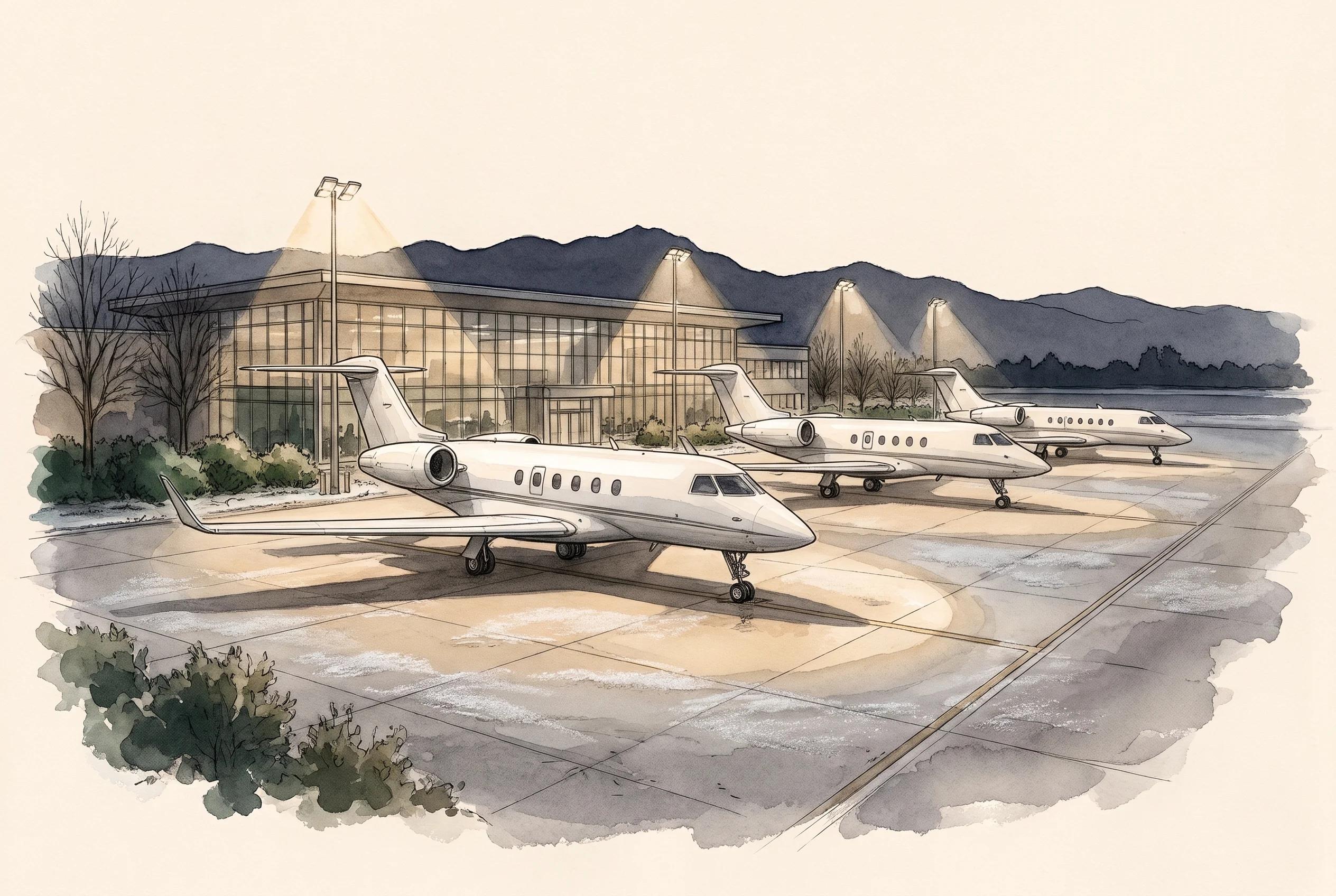
Geneva, the twenty-third of December, sixteen forty. The light has gone off the apron and the ramp lamps at T3 are burning, each aircraft under its own white cone. A handling agent reads down a printout: four departures to get airborne before the 2126 curfew, two still waiting on a confirmed slot. In the T3 lounge a family clears passport control and never sees the main terminal. Outside, a tug driver keeps checking his watch while a crew finishes de-icing. Nobody standing on that ramp is talking about the hourly rate.
Private jet Christmas week booking is governed by airport coordination windows rather than by fare curves, so the practical deadline arrives weeks before the flight. Geneva is a Level 3 fully slot-coordinated airport, Nice confirms slots only within seven days of arrival, Samedan works on Prior Permission Required, and Innsbruck coordinates IFR traffic on winter weekends with requests opening 28 days ahead. Atljet market data estimates for the period are quoted per route, per aircraft class and dated to the month, because a late request is priced against what is left, not against what was available.
Private jet Christmas week booking: when is the real deadline?
Book against the airport's calendar, because that is the deadline that actually closes. Aircraft availability in late December is finite but tradeable; runway and apron capacity at the Alpine and Riviera fields is neither. Geneva requires an allocated slot for every arrival and departure. Nice confirms slots only inside a seven day window before arrival. Samedan grants Prior Permission Required case by case. Innsbruck coordinates IFR traffic on winter Saturdays and Sundays and on 2 and 9 January, with general and business aviation requests opening 28 days ahead at the earliest. Five destinations, five separate clocks.
The practical consequence is that a Christmas week itinerary should exist on paper by the end of November, even if the final passenger count moves later. That is not a sales deadline, it is sequencing. The Innsbruck request has to be lodged when its window opens. The Samedan permission has to be sought before the Engadin fills. The Nice slot cannot be confirmed until seven days out, which means everything either side of it has to be built so that it still works if the Nice timing shifts by an hour.
The congestion itself is not in dispute. The US Federal Aviation Administration described the 2025 Thanksgiving period as the busiest in fifteen years, with more than 360,000 flights and a single peak day above 52,000 movements, according to the FAA holiday travel forecast. Checkpoint figures published in the TSA passenger volumes data show 27 December 2024 as the busiest day of that holiday stretch, just under 2.85 million people screened, with 20 and 23 December also above 2.7 million. Those are commercial numbers from another continent, but they describe the same calendar pressure that squeezes the business aviation apron.
Why do Alpine airports limit how many jets can land during Christmas?
Because the runway, the taxiways and the parking stands are the scarce asset, and in the Alps they are often hemmed in by terrain, weather and noise rules. Geneva is a Level 3 fully slot-coordinated airport, coordinated by Slot Coordination Switzerland, with a stated peak season from December to March. Its published allocation curfew runs 2400 to 0604 CET for arrivals and 2126 to 0559 CET for departures. Nice Côte d'Azur is fully coordinated for both arrivals and departures. Neither airport is rationing out of preference; it is simply how a finite surface is shared.
Samedan works differently. It does not use airline-style slots at all but Prior Permission Required, granted by the airport itself, with December to March as its declared peak and the heaviest pressure around Christmas, New Year, the February events and the World Economic Forum week in Davos. At 5,600 ft (1,707 m) it is the highest airfield in Europe, and a runway of roughly 5,900 ft (1,800 m) keeps operations to lighter jets. Altitude and runway length decide the aircraft there long before the passenger list does.
| Airport | Coordination regime | When the window moves | What it means for the booking |
|---|---|---|---|
| Geneva GVA (LSGG) | Level 3, fully slot-coordinated by Slot Coordination Switzerland | Peak season December to March | Every arrival and departure needs an allocated slot; departures stop at 2126 CET, arrivals at 2400 CET |
| Nice NCE (LFMN) | Fully coordinated, arrivals and departures | Slots confirmed within 7 days of arrival | The final timing is only fixed in the last week, so the rest of the trip must tolerate movement |
| Samedan SMV (LSZS) | Prior Permission Required, granted by the airport | Peak December to March, hardest at Christmas, New Year and Davos week | Permission is case by case; altitude and runway length keep traffic to lighter jets |
| Innsbruck INN (LOWI) | IFR slot coordination on winter Saturdays and Sundays and on 2 and 9 January | Requests from 28 days ahead at the earliest | Weekend arrivals must be lodged early; apron time is tightly managed |
| Courchevel CVF (LFLJ) | Altiport, no jet access | Not applicable | Propeller aircraft up to 5.7 t (12,566 lb) and helicopters only; jets route elsewhere |
What does Christmas week actually cost, by aircraft class?
There is no single Christmas week number, and any publication that offers one is describing a market that does not exist. Atljet market data estimates are built per route, per aircraft class and dated to the month in which they are issued: a London to Geneva light jet estimate quoted in November 2026 is a November 2026 estimate for that class on that route, and nothing more. In peak week those estimates are rebuilt daily, because the input that moves most is not fuel or distance but what the aircraft has to do before and after your sector.
The mechanics are consistent across classes. You pay for block time, the minutes from first movement to final stop, plus the empty sectors flown to bring the aircraft to you and take it away again. Add crew duty limits, which in a week of compressed curfews turn one long day into two, overnight positioning and de-icing. A light jet and an ultra long range aircraft are priced on the same logic; what changes is the size of each component and, in the Alps, which fields will take the aircraft at all.
| Class | Typical Christmas week role | Alpine access in practice | What moves the estimate most in peak week |
|---|---|---|---|
| Light jet | Short European sectors, four to six guests | The practical choice for Samedan, where the runway and altitude favour lighter aircraft | Positioning, because small aircraft move more often and sit less |
| Midsize jet | London, Paris or Munich into Geneva or Innsbruck | Comfortable at Geneva, Nice and Innsbruck; not the Engadin aircraft | Curfew timing and crew duty on compressed days |
| Heavy jet | Transcontinental arrivals with skis, luggage and staff | Geneva and Nice; apron parking becomes the constraint | Parking and ground time at saturated fields |
| Ultra long range | Dubai or New York direct into the Alps or the Riviera | Geneva and Nice; the last Alpine stretch is by helicopter or car | Slot availability at both ends plus overnight crew positioning |
In Christmas week you are not buying a flight. You are buying a place in a queue that closes.
Atljet Editorial
This is also the week in which repositioning works in the traveller's favour as often as against it. Aircraft are moved empty in volume across the Christmas and New Year fortnight, and the sectors that result are dated and limited in number. We cover how that inventory behaves in the period in empty leg flights at Christmas, and current availability sits on empty legs. The trade is flexibility: an empty sector rewards a traveller who can move a departure by three hours, and punishes one who cannot.
Which airport should you fly into for which Alpine resort?
Match the airport to the valley, then to the aircraft. Geneva is the principal arrival airport for the French and Swiss resorts, and it keeps a dedicated business aviation terminal, T3, apart from the main passenger buildings, which in the last week of December is the whole difference. Innsbruck serves Kitzbühel, St. Anton and the Tyrol, with slot coordination on winter Saturdays and Sundays. Nice is the Riviera door for Monaco, Cannes and Saint-Tropez. Samedan sits in the Engadin, a short drive from St. Moritz, which is why it carries so much Christmas and New Year traffic despite its altitude.
Courchevel is the exception that shapes everyone's itinerary. The altiport's paved runway is about 536 metres (1,759 ft) with a gradient reaching roughly 18.5 percent, and it accepts propeller aircraft up to 5.7 tonnes (12,566 lb) and helicopters only. No jet lands there, in any season. Christmas week itineraries therefore arrive at Geneva, Lyon or Chambéry and continue upward. We set out the detail in landing at Courchevel Altiport and the Engadin alternative in flying private to St. Moritz and Samedan.
The last stretch deserves the same planning as the sector before it. A helicopter from Geneva towards the Tarentaise is a different afternoon from a chain-fitted road crossing on 23 December, and the helicopter has its own daylight and weather limits in winter. The Atljet flight desk can arrange that final leg as well, whether it is a helicopter into the altiport, a chauffeured car to the Engadin or a tender on the Riviera, so that the itinerary is booked as one movement rather than three.
Why does booking late cost more than the fare itself?
Because the price you are eventually quoted contains everything the aircraft has to do to be available to you. In a normal week an operator solves that with one empty sector. In the last ten days of December, with curfews closing, aprons full and crews near their duty limits, the same problem is solved with two empty sectors, a night stop for the crew and a departure time that suits the airport rather than the family. None of that appears as a surcharge. It appears as a larger number, built from more block time.
Parking is the quiet multiplier. At the busiest Alpine fields, aircraft that drop guests in the morning are expected to clear the apron rather than wait, which means the jet that brought you in climbs out empty and comes back for you later, flying four sectors to deliver two. The same arithmetic applies to peak days generally, as we set out in why private jets cost more on a Friday. Weekends and holiday peaks simply make the pattern visible to everyone at once.

Then there is the cost that is not financial. A late request does not produce a worse price so much as a worse day: a 0700 departure because it was the only slot, an arrival at Geneva rather than the field nearest the chalet, a connection by road through holiday traffic on the shortest afternoon of the year. Those compromises are permanent once the window closes. They cannot be bought back in December at any figure, which is the strongest argument for treating November as the month in which the trip is decided.
- Fix the dates before the aircraft: the airport window is the binding constraint, not the cabin.
- Build the itinerary around the earliest closing window, usually Innsbruck at 28 days.
- Treat Samedan as a permission to be obtained, not a slot to be bought.
- Allow for the Nice slot to move by an hour inside the final week.
- Decide the last stretch, helicopter or car, at the same time as the flight, not after it.
Back on the Geneva ramp, the printout clears. The two pending departures get their slots with room inside the 2126 curfew, by a margin nobody will mention afterwards. The de-iced aircraft taxis out, the tug driver stops looking at his watch, and the families who planned in November are already somewhere above the Rhône valley with the lights of the lake behind them. The ones who planned in December are still in the lounge, being told, politely, about tomorrow morning.
Questions people ask
- When should I book a private jet for Christmas?
- Work backwards from the airport, not the date. Innsbruck opens general and business aviation slot requests for coordinated winter weekend days 28 days ahead at the earliest, Nice confirms slots only within 7 days of arrival, Samedan requires Prior Permission Required well before peak dates, and Geneva requires an allocated slot for every movement. In practice a Christmas week itinerary should be under discussion by late November so each window can be worked in its own order.
- Why do private jet prices rise during Christmas week?
- Because the aircraft that serves you is rarely where you are. When airports are saturated and curfews bite, operators add empty positioning sectors, overnight crew stops and compromises on departure timing, all of which appear in the final figure. Atljet market data estimates for the period are therefore quoted by route, class and month, and rebuilt as the window moves.
- What is a slot-coordinated airport?
- An airport where a coordinator allocates each movement a defined time window. Geneva is Level 3, meaning fully coordinated for all arrivals and departures. Nice is also fully coordinated for both. Without an allocated slot the flight does not operate, whatever the aircraft contract says.
- How does Samedan Airport handle winter demand?
- Samedan/Engadin (SMV/LSZS), the airport for St. Moritz, works on Prior Permission Required rather than airline-style slots: approval comes from the airport itself, case by case. Its declared peak season runs December to March, with the heaviest pressure around Christmas, New Year, the February events and the World Economic Forum week in Davos. At 5,600 ft (1,707 m) it is the highest airfield in Europe, and a runway of roughly 5,900 ft (1,800 m) keeps traffic to lighter jets.
- Can private jets land at Courchevel?
- No. Courchevel Altiport has a paved runway of roughly 536 metres (1,759 ft) with a gradient of up to about 18.5 percent and accepts only propeller aircraft up to 5.7 tonnes (12,566 lb) and helicopters. Jet itineraries route into Geneva, Lyon or Chambéry, then continue by helicopter or chauffeured car.
Questions on this guide? The flight desk answers within the hour.
Request options