Summary
- Event pricing is a capacity problem, not a surcharge: the airport runs out of parking and slots before operators run out of aircraft.
- The 2026 Monaco Grand Prix, run 5 to 7 June 2026 at the Circuit de Monaco, concentrated demand on Nice Côte d'Azur (NCE), the single airport serving the Principality.
- Book six months out for a race weekend, not six weeks: by spring, choice of aircraft and arrival hour is gone before price becomes the issue.
- Cannes Mandelieu (CEQ) absorbs the overflow, and a repositioning leg scheduled a day either side of the peak is where the real saving sits.
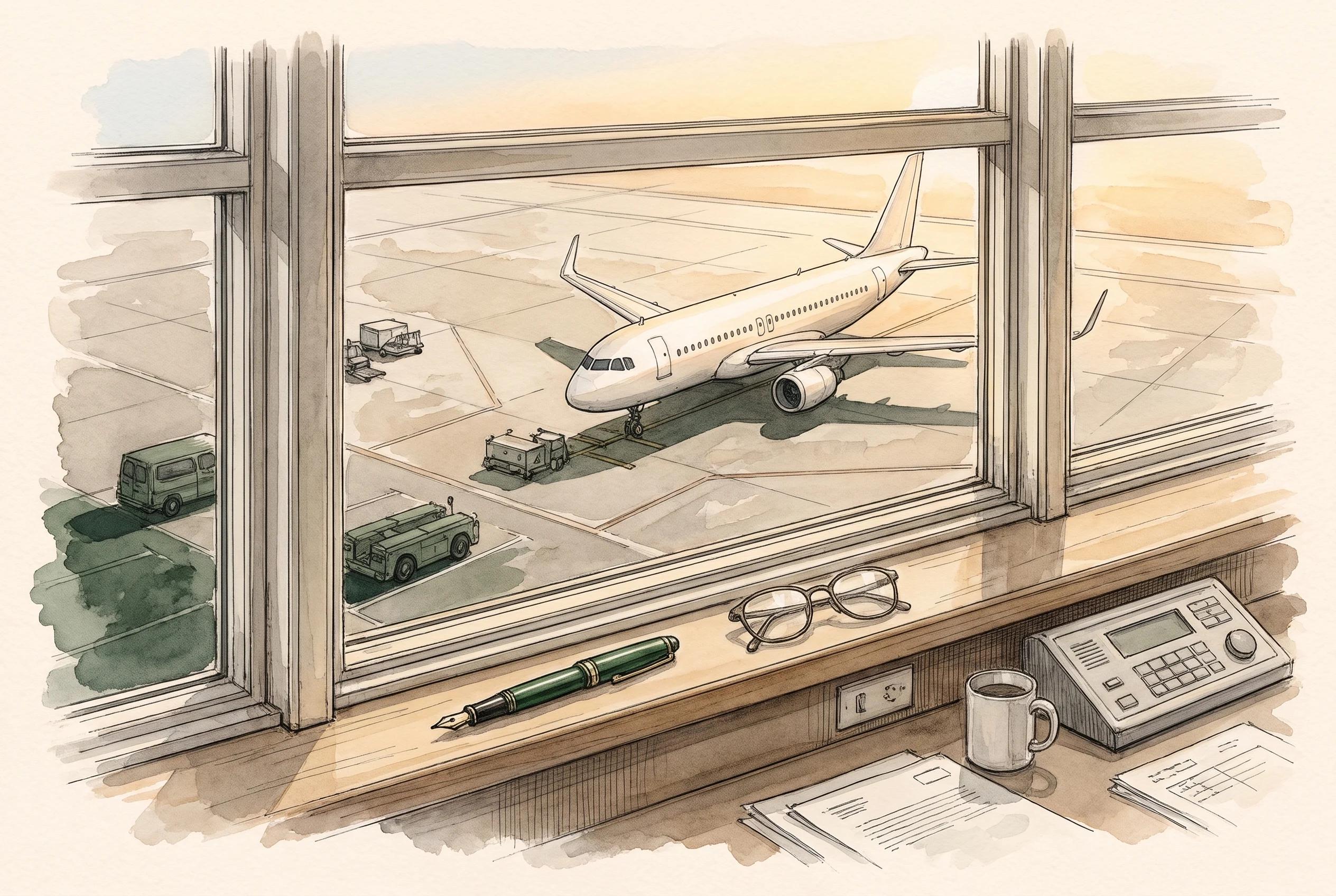
Half past nine on a Thursday morning in Nice, the day before a June race weekend, and a dispatcher in a glass office is doing arithmetic that has nothing to do with money. Twelve aircraft are inbound in the next ninety minutes and there are eight places to put them. Two will unload and leave again for somewhere with space. One crew is deep into a duty day that began before dawn. The ramp outside is full, neatly, tail to tail, like a car park at a wedding. Nobody is panicking. Everybody is recalculating.
Private jet prices during major events rise because supply is physically capped while demand compresses into a window of roughly 72 hours. The constraint is not fuel or distance: it is parking space, arrival and departure slots, and crew duty time at a single airport. Atljet market data for November 2026 shows a Citation XLS from Paris Le Bourget (LBG) to Nice Côte d'Azur (NCE) estimated at €10,000 to €12,400 one way in a normal month, and it is this baseline, not the aircraft, that moves when thousands of people want the same runway on the same morning.
That scene, composite but entirely ordinary, repeats across a handful of airports a dozen times a year, and it is the whole story of event pricing. What follows is the mechanism, and the four or five decisions that keep it from reaching you.
Private jet prices during major events: why do they rise?
Prices rise because the airport runs out before the fleet does. The fleet serving Western Europe is large and mobile; the number of parking stands at a coastal airport on a Saturday in June is a fixed integer. When demand compresses into roughly 72 hours around a single point on the map, the binding constraint moves from aircraft availability to ground capacity, and the cost of working around that constraint lands in the quote.
There are three distinct cost layers, and they are worth separating, because they behave differently. The first is positioning. In a quiet week, an operator finds an aircraft that is already near your departure airport. In an event week, the aircraft that suits you is in Vienna, and somebody has to pay for the hour and a half it takes to come and get you. The second is the drop and go. If there is no stand for the duration of your stay, the aircraft unloads and flies to a quieter field to wait, then comes back for you. That is two additional short flights on the operator's books, and they are not free.
The third layer is time itself. Crew duty is regulated and finite. An aircraft holding for a slot, or queuing for departure behind forty others on the Sunday evening, is burning the one resource that cannot be bought back. Operators price that risk in advance, because the alternative is a crew timing out at ten at night with passengers already on board. None of this is a surcharge in the hotel sense. It is the honest cost of a day that has become mechanically harder to fly.
The Monaco Grand Prix 2026: a dated case study
The 2026 Monaco Grand Prix is the cleanest example available, because the dates are fixed and public and the geography allows no alternative. The race weekend ran from 5 to 7 June 2026, with the race itself on Sunday 7 June at the Circuit de Monaco, the 83rd running of the event, officially the Formula 1 Louis Vuitton Grand Prix de Monaco 2026. The schedule is published on the official race page.
Monaco has no fixed-wing airport. Not a small one, not an inconvenient one: none. Everything arriving by air for the Principality arrives at Nice Côte d'Azur (NCE, ICAO LFMN), a short drive along the coast, or at the Fontvieille heliport (MCM) by helicopter from Nice, a brief hop that crosses the Cap and sets you down inside the Principality. This is the structural fact that makes Monaco the textbook case. There is one funnel, and the funnel has a width.
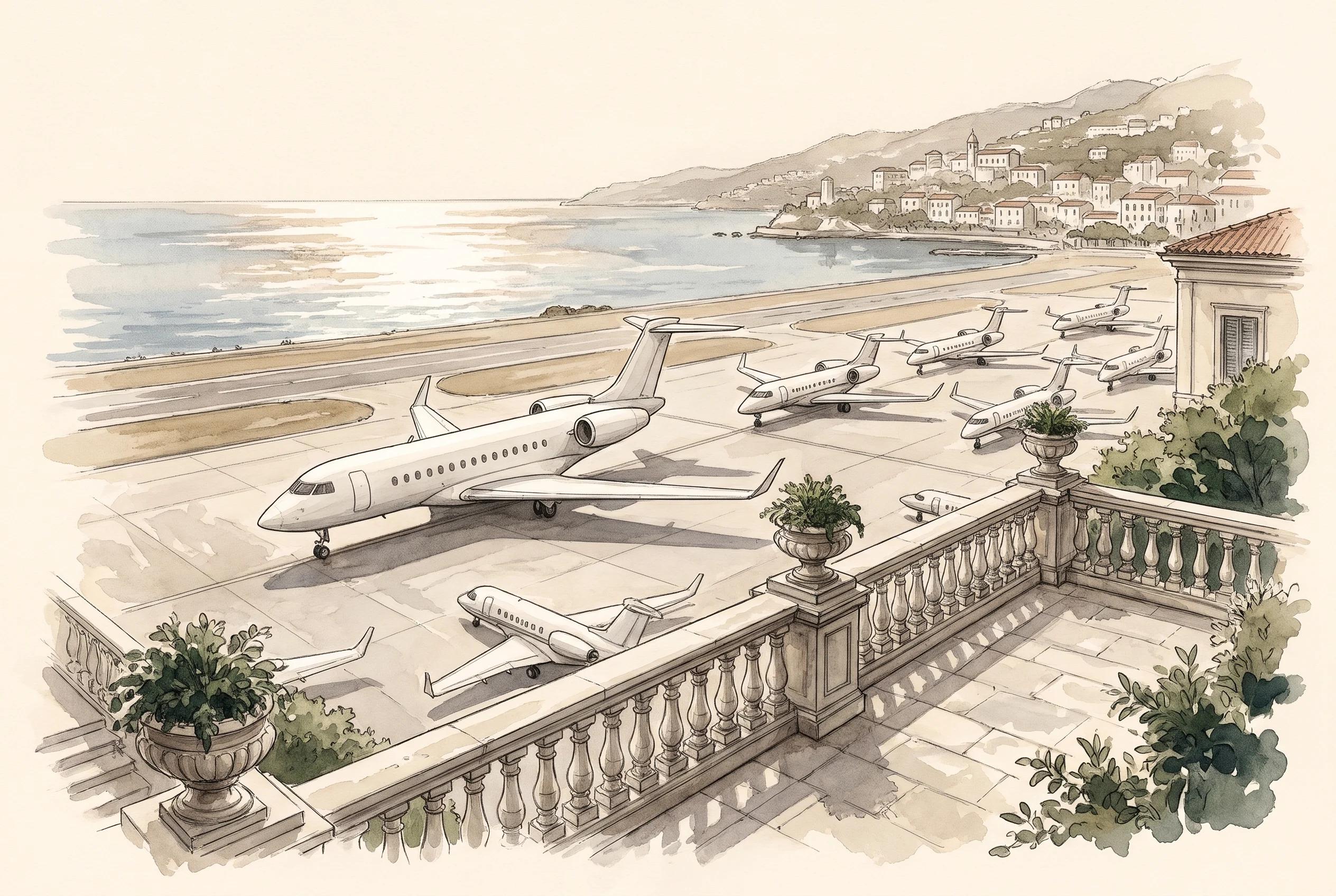
So the demand for a three-day event arrives through a single airport over about two mornings, and leaves in a single evening. No other evening in the European season compresses the way the Sunday after this race does. Everyone wants the same thing at the same hour: wheels up once the podium is over. The ones who get it booked it in January.
The lesson generalises. Any event with a fixed date, a single viable airport and a shared departure instinct will behave this way: the art fair weeks in Basel, the spring watch fair in Geneva, the regattas in the Solent and the Gulf. The names change, the arithmetic does not.
How far in advance should you book for a major event?
Six months, and the reason is not price, it is choice. For a June race weekend, the serious bookings are placed in December and January. By March the preferred arrival hours are thinning. By April you are choosing between a different day and a different aircraft class. By the final six weeks the question has stopped being what you want to pay and become what still exists.
This is the point that broker marketing gets backwards. The early booking advantage is not a discount for good behaviour. It is first access to a finite set of arrival and departure windows, and once those are allocated the market behaves exactly as any auction for a fixed supply does. A client who books in January and a client who books in May may be quoted on very different aircraft, because the January client took the Challenger 350 that was available and the May client is being offered the Falcon 900 because nothing smaller remains at that hour.
A practical sequence, in the order an experienced assistant works through it:

- Fix the dates six months out, before the aircraft is chosen. Dates are the scarce thing.
- Decide the departure hour before the return date. Peak outbound is worth more than any other variable on the itinerary.
- Ask whether the aircraft stays or repositions. If it cannot park, you are paying for two extra flights and you should know that at the quote stage, not after.
- Hold the secondary airport as a live option rather than a fallback, so the switch costs nothing to make.
- Keep the return flexible by a day where the trip allows. It is the single largest lever on the final number.
Nice or Cannes Mandelieu: which airport absorbs the overflow?
Nice Côte d'Azur (NCE, ICAO LFMN) remains the right answer for most Monaco-bound flights, and Cannes Mandelieu (CEQ, ICAO LFMD) is the serious secondary option when Nice is saturated. Nice is the closer of the two to the Principality, and it is the airport from which the helicopter connection to Fontvieille operates. Cannes sits further west along the coast, which adds road time toward Monaco but puts you in a calmer, smaller environment on the ground.
The trade is honest and easy to state. Nice buys you the shortest final mile and the helicopter option, at the cost of being in the busiest place on the coast at the busiest hour of the year. Cannes buys you a quiet arrival and a realistic chance of the departure time you actually asked for, at the cost of a longer drive east. For a Sunday evening departure after the race, that second trade is frequently the better one, and it is the choice an experienced traveller makes without drama.
Note what the baseline data says about the two: on comparable city pairs, the underlying flight costs are effectively the same. Atljet market data for November 2026 estimates a Citation XLS from Paris Le Bourget at €10,000 to €12,400 one way into Nice and €10,100 to €12,500 into Cannes. The airports are not priced differently in any meaningful sense. What differs on an event weekend is the probability of getting the slot and stand you want, and that is a scheduling decision, not a pricing one.
Does an empty leg really lower the price around an event?
Inbound, almost never. Outbound, frequently, and sometimes dramatically. The claim that empty legs are the clever way to arrive at a major event misunderstands how the flights are created. An empty leg exists because an aircraft has to move without passengers. In the days before a large event, aircraft are not moving randomly toward the venue, they are moving under contract with passengers aboard, and the few genuine repositioning flights that exist are going the wrong way, outbound and empty, to make room.
After the event the picture inverts completely. On the Monday and Tuesday following a race weekend or a major fair, a large number of aircraft need to return to home base, and many of them will leave the region empty. That is where the economics are real. If your plans allow you to stay a day beyond the crowd, which is in any case the more civilised way to use the Riviera, the return leg can be acquired at a fraction of a chartered equivalent. The rule of the thing is in our longer piece on how the empty leg is a system, and current availability sits on the empty legs page.
The limitation is the one that has always applied: the schedule belongs to the aircraft. You accept its departure window, its airport and its cabin. For a return journey where nobody is waiting at the other end, that is an easy concession. For an arrival on which an entire weekend depends, it is not a trade any sensible person makes.
The discipline of event travel is simple. Buy the date early and the aircraft second. Everyone who does it the other way round pays for the privilege.
Atljet Editorial
What the data shows: classes and routes compared
The table below sets out the baseline, which is the only sensible starting point for any event conversation. These are Atljet market data estimates for November 2026, one way, per aircraft, for a normal month without event compression. Read them as the floor from which an event week departs, not as a quote.
| Route | Class and type | Block time | Distance | Estimate, one way |
|---|---|---|---|---|
| London Farnborough (FAB) to Nice (NCE) | Light Jet, Citation CJ3 | 109 min | 594 nm (1,100 km) | €10,700 to €13,700 |
| London Farnborough (FAB) to Nice (NCE) | Midsize Jet, Citation XLS | 103 min | 594 nm (1,100 km) | €13,000 to €16,300 |
| London Farnborough (FAB) to Nice (NCE) | Heavy Jet, Falcon 900 | 97 min | 594 nm (1,100 km) | €19,400 to €25,900 |
| Paris Le Bourget (LBG) to Nice (NCE) | Light Jet, Citation CJ3 | 80 min | 397 nm (735 km) | €8,400 to €10,500 |
| Paris Le Bourget (LBG) to Nice (NCE) | Midsize Jet, Citation XLS | 75 min | 397 nm (735 km) | €10,000 to €12,400 |
| Paris Le Bourget (LBG) to Nice (NCE) | Heavy Jet, Falcon 900 | 72 min | 397 nm (735 km) | €14,900 to €19,700 |
| Geneva (GVA) to Nice (NCE) | Light Jet, Citation CJ3 | 46 min | 172 nm (319 km) | €5,600 to €6,900 |
| Geneva (GVA) to Nice (NCE) | Super Midsize Jet, Challenger 350 | 43 min | 172 nm (319 km) | €7,900 to €9,600 |
| Milan Linate (LIN) to Nice (NCE) | Light Jet, Citation CJ3 | 42 min | 147 nm (272 km) | €5,300 to €6,400 |
| Milan Linate (LIN) to Nice (NCE) | Super Midsize Jet, Challenger 350 | 40 min | 147 nm (272 km) | €7,500 to €9,100 |
| Zurich (ZRH) to Nice (NCE) | Midsize Jet, Citation XLS | 55 min | 249 nm (461 km) | €7,800 to €9,600 |
| Zurich (ZRH) to Cannes (CEQ) | Midsize Jet, Citation XLS | 56 min | 259 nm (480 km) | €7,900 to €9,700 |
Two things stand out. First, the class gap on short legs is narrower than people expect: from Milan Linate, the step from a Light Jet at €5,300 to €6,400 to a Super Midsize at €7,500 to €9,100 is modest in absolute terms for forty minutes of flying, which is why short-haul event traffic tilts toward larger cabins. Second, block time barely moves between classes on these routes. A Falcon 900 saves twelve minutes over a Citation CJ3 from London Farnborough. You are not buying speed on a 594 nm (1,100 km) leg, you are buying cabin and range, and on an event weekend you may also be buying the only aircraft still available at your hour.
For how a quote is actually assembled, line by line, see our breakdown of a real charter quote. For the specific planning rhythm of a race weekend in the Principality, the companion piece on the Monaco Grand Prix sets out the days in order.
When the dates matter more than the aircraft, the Atljet flight desk works the dates first and can arrange the last stretch too, whether that is the helicopter into Fontvieille, a chauffeured car along the Basse Corniche, or a boat from the port at Cannes.
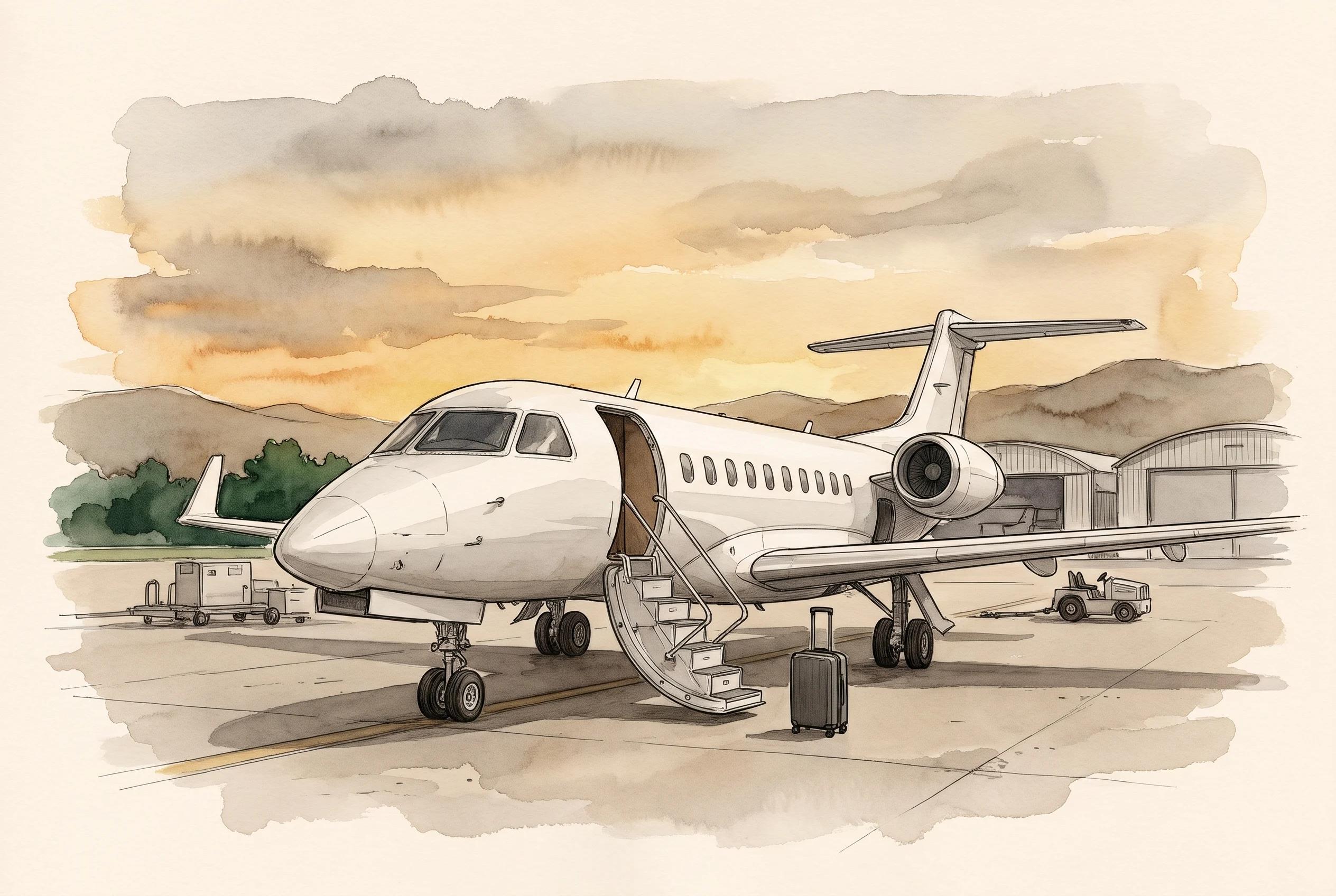
Back in the glass office in Nice, the dispatcher has found places for eleven of the twelve. The last one will unload, lift off again and wait somewhere quieter until Sunday. Someone paid for those two extra flights without ever seeing them on a schedule. The clients who booked in January did not. That, in the end, is the whole of it: the price of a big event is set in the quiet months, long before anyone is thinking about the race.
Questions people ask
- Why do private jet prices go up during major events?
- Because airport capacity is fixed and demand is not. Parking stands and arrival slots at the single relevant airport run out, aircraft are forced to unload and reposition elsewhere, and crews consume duty time waiting. Every one of those effects adds flying hours that someone pays for. The aircraft itself has not become more expensive, the day has.
- How much does a private jet cost to fly to the Monaco Grand Prix?
- Atljet market data for November 2026 gives baseline one way estimates into Nice Côte d'Azur (NCE): Light Jet from Geneva €5,600 to €6,900, Midsize Jet from Paris Le Bourget €10,000 to €12,400, Heavy Jet from London Farnborough €19,400 to €25,900. These are market estimates for a normal month. A peak race weekend departure sits materially above them, and the figure depends on the day and hour chosen as much as the aircraft.
- How far in advance should I book a private jet for a big event?
- Six months is the working horizon for a Formula 1 race weekend or an equivalent fixture. By three months out, the question is no longer price but whether the arrival hour you want exists. Booking inside six weeks usually means accepting a different airport, a different day, or an aircraft class above the one you intended.
- Which airport should I use to fly private to Monaco?
- Nice Côte d'Azur (NCE, ICAO LFMN) is the primary airport for the Principality, the closest to Monaco by road and the base for the helicopter hop to the Fontvieille heliport (MCM). Cannes Mandelieu (CEQ, ICAO LFMD) is the secondary option, further west along the coast, and it is worth considering when Nice is saturated.
- Can an empty leg lower the cost of flying to a major event?
- On the way in, rarely: during the peak window almost nothing is repositioning in your direction at your hour. On the way out, often: the days after a large event produce a quantity of aircraft that must return to base, and those legs are genuinely cheaper. The trade is flexibility, since the schedule belongs to the aircraft, not to you.
Questions on this guide? The flight desk answers within the hour.
Request options